

Most CMOs doing the in-house vs. agency SEO calculation are comparing an agency retainer to a single full-time salary. But the real question is whether your current setup can produce product-deep content at the velocity and strategic sophistication the channel now demands, including getting your brand visible in LLMs.
That determines whether organic becomes pipeline or doesn’t contribute to anything. Cost-per-head is just a proxy that makes the spreadsheet feel cleaner.
Key takeaways:
- The in-house vs. agency SEO decision is a capacity and context problem — the model that wins is the one that can hold strategy, execution, and AEO simultaneously.
- Fully-loaded in-house cost (salary, recruiting, tools, ramp) typically exceeds a comparable agency retainer once you account for what one or two people structurally cannot do.
- The diagnostic has three conditions: whether SEO is already a revenue channel, whether your team has real internal review capacity, and whether your current setup has any AEO capability at all.
What in-house and agency SEO mean
In-house SEO means the function lives on your payroll: one or two full-time hires who own organic strategy and execution and carry full-time context on your product, your customers, and your pipeline.
Agency SEO means you hire an external team — typically an SEO account strategist, writers, and an editor — that supplies strategy, execution, and tooling for a monthly fee, with product context that only gets as deep as the engagement funds.
Both models publish content and send reports. The difference is what each is structurally built to hold: the in-house hire compounds product knowledge but caps out on capacity; the agency brings capacity and specialist depth but has to build product knowledge deliberately.
What an in-house SEO function looks like at mid-market B2B SaaS scale
At mid-market scale, in-house SEO is usually one person — sometimes two — who owns strategy, execution, reporting, briefing, editing, and increasingly strategy for AEO. "I've been an army of one for a long time" is a description you hear repeatedly from this role.
That person is also covering events, webinars, social, and three regional requests that landed in their inbox before lunch.
The function works well when the channel is already producing and the strategic direction is set. It breaks down when the company needs to build topical authority for a new product launch, when the company pivots, accelerates output quality, or answers a board question about AI-answer visibility.
How SEO agency engagements are structured — and what that structure implies about context depth
Many agencies operate on a pooled-team model: a strategist, a few writers, and an account manager rotating across enough clients that no single person studies your product deeply.
The pricing reflects that — we’re talking about agencies that charge for SEO/AEO strategy and execution $2k. Skimming the homepage and shipping "what is X?" filler is the structural output of a model where product research is too expensive to fund.
Agencies that don't produce slop operate differently.
They watch product demos, watch sales calls, and run SME interviews before a brief gets written. That operating model gives quality of outputs, original content, proprietary research and should be priced at least for $6.5k per month retainers. This approach gives long-term gains for B2B SaaS companies as rankings are more persistent, engagement rates are high and pipeline is compounding.
Why cost-per-head is the wrong unit for this decision
"That budget is about what I'd spend to hire someone full-time locally." That's how the calculation usually starts.
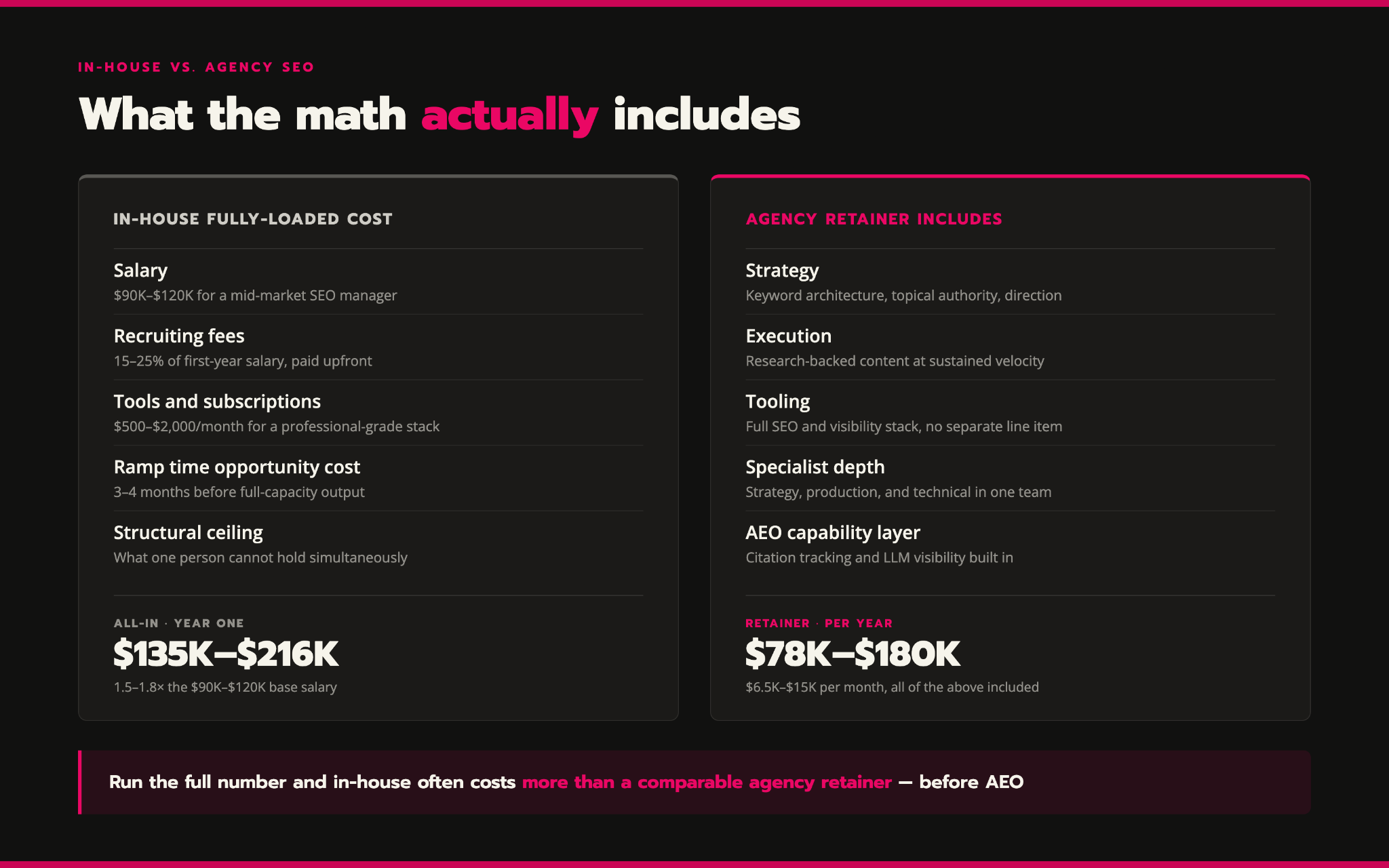
It ignores recruiting fees (typically 15–25% of first-year salary, based on standard agency placement rates), ramp time (roughly 3–4 months before a new hire produces at full capacity), tool subscriptions (Ahrefs, Screaming Frog, a content platform, AEO visibility tracking), and the structural ceiling of what one person can hold simultaneously.
Run the full number and in-house is often more expensive at comparable output quality — and that's before accounting for AEO, a distinct capability most individual in-house SEO functions haven't yet built.
The real cost comparison between in-house SEO and agency SEO: salary math vs. what you actually get
The build-vs-buy calculation looks cleaner than it is. A CMO comparing a mid-market agency retainer to a single full-time hire skips several line items that surface later — and those line items change the conclusion.
True fully-loaded cost of a one-to-two-person in-house SEO function
Recruiting fees on a $90K–$120K SEO manager typically run $13K–$30K upfront at standard agency placement rates of 15–25%.
Add a roughly 3–4 month ramp during which the channel is unlikely to accelerate. Add tool subscriptions in the range of $500–$2,000/month for a professional-grade SEO stack, depending on tools selected.
Add ongoing management overhead for a headcount that still needs briefing, feedback, and review cycles. The all-in number for one in-house hire over the first year is often 1.5–1.8x the stated salary when recruiting fees, ramp costs, and tooling are included.
What agency retainer tiers include
A mid-market agency retainer (typically $6.5K–$15K/month depending on scope) usually covers a combination of strategy, keyword research, content production, and reporting.
At this price point, a good agency will start the strategy built from interviewing SMEs, doing proper market research for SEO and AEO and mapping the window of opportunity.
Only after that (around 4 weeks), the execution should begin. Usually, a green flag is that execution starts from setting up a quality benchmark so B2B SaaS companies are scaling good quality production and getting long-term results.
The hidden cost of the army-of-one ceiling: what one person structurally cannot do
"I don't know how I'll explain to everyone that this isn't a one-person job — that it's a whole strategy and we needed to outsource because it's not."
That framing captures the structural problem. One person cannot hold strategy, execution, AEO research, and reporting simultaneously without something being not delivered on time. Even if they’re Content Engineers with skills in Claude Code and automations, there will always be a script that stopped running, that content calendar that wasn’t updated or a video recording project that took the whole week. As a result, organic lands on the backburner.
Also, what often requires time and research — usually strategy — deferred in favor of keeping the publishing calendar moving. The channel stays busy but stops compounding because of lack of clear direction based on the time constraints.
Decision signals: specific conditions that favor each path
The right model depends on three organizational conditions. Run this diagnostic honestly before committing the budget either direction.
Signals that favor building in-house: when brand context is the strategic edge
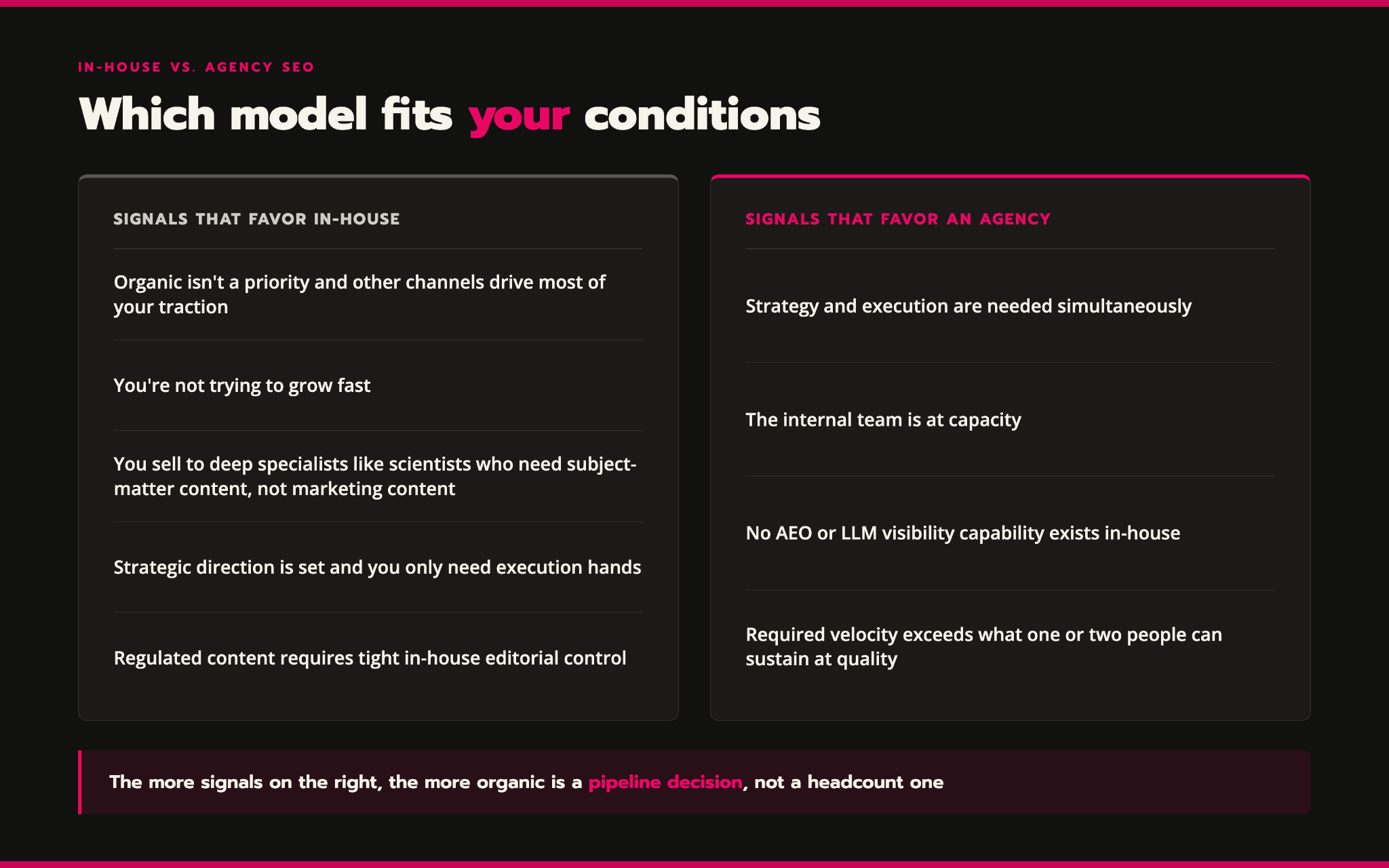
In-house makes sense when SEO is already a meaningful revenue channel and the primary need is execution depth within a strategy that's already set.
It also makes sense when the product is complex enough that an external team may need 6 or more months to produce genuinely useful content — and you have the time and resources to fund that agency ramp before pulling the function in-house. Companies with regulated content requirements (legal, medical, financial) sometimes prefer in-house editorial control for compliance reasons.
Signals that favor an agency: when capacity, sophistication, or AEO readiness is the gap
Agency wins when the channel is speculative or underperforming and the company needs first strategy and later focused execution.
It also wins when the internal team is at capacity, when AEO and LLM visibility capability doesn't exist in-house, or when the velocity requirement exceeds what one or two people can sustain at quality.
"The only goal that makes sense to the execs is: you search, and our brand comes up." That's an AEO problem, and it requires a layer of capability most in-house SEO functions haven't yet built.
What to look for in an agency that won't repeat “AI slop agency” you had
Agencies that don't produce slop share a specific operating model — they study the product before writing, run SME interviews, and enforce quality guardrails per piece rather than per engagement.
Mid-market B2B SaaS teams who own the pipeline number and have been through a bad agency engagement face a specific problem: they need content that is genuinely differentiated from what's already on the SERP, produced at a velocity the in-house team can't sustain alone, and built to show up in AI answers.
Most agencies struggle to deliver all three because their model doesn't fund the product research required to make the first one possible. Also, they don’t have a high-quality standard because nobody set the bar high for them in the past.
Kairos Labs is one concrete example of how a different operating model resolves that.
The process: a strategist watches the product demo, analyses top priority sales calls and runs structured SME interviews with subject matter experts before a strategy or content is built.
That raw qualitative input — what prospects ask, how the product actually solves the problem, what language customers use — gets analyzed and injected into briefs at runtime through RAG workflows.
Every piece is built around a defined information gain: a specific angle, a differentiated point of view, proof the competitor content doesn't have.
SEO-trained writers review and shape the output; the AI handles the heavy lifting, humans own the judgment calls.
The result is content that reads like the client — product-specific, conversion-oriented, and structurally built to improve citation likelihood in AI answers, not just rank positions.
The due-diligence questions to run before signing any agency contract
Ask to see the research process, not just the content calendar.
Specific questions that surface the model:
- How do you learn the product? If the answer is "we just check your existing content and the homepage," that's a red flag. The answer should involve demos, calls, or interviews.
- Who writes the briefs and what goes into them? Generic briefs produce generic output. Ask to see a sample brief from a past engagement.
- How do you handle AEO and LLM visibility? AEO and LLM visibility methodology is increasingly expected from agencies. If the agency doesn't have a methodology, the content isn't being built to show up in AI answers.
- What's your quality control process per piece? "We have editors" isn't enough. Ask what guardrails prevent AI slop specifically.
- Can we speak to a client in a similar category? A reference call on a past engagement in your vertical tells you more than any case study.
In-house vs agency SEO — decide what’s best for you
A five-question diagnostic the CMO can work through internally — framed as a board-ready argument that maps the answer to pipeline terms, not headcount terms.
1. What percentage of pipeline currently touches organic? If organic contributes below 10% of pipeline and the channel is still speculative, keeping basic SEO in-house makes sense. But if you’re generating at least 20-30% pipeline from organic and want to grow, specialized agency is a good idea.
2. Does your team have real review capacity? Not "can someone read drafts" — but can someone with deep product knowledge review 8–12 pieces a month at the depth that makes them genuinely useful?
3. Do you have any AEO capability today? If the honest answer is no, hiring an agency that knows how to do AEO is the best option to grow LLM visibility for your brand.
4. What velocity does the strategy require? A topical authority program that typically requires 6–8 pieces a month to compound is structurally difficult for a one-person function to sustain at quality.
Map your answers to one of two outcomes: build in-house or hire an agency.
Then take that to the board in pipeline terms — not as "we're hiring an SEO" or "we're retaining an agency," but as "here's what organic can realistically return at this investment level over the next 12 months, and here's the model that gets us there."
If you know the model needs to change but don't have a clear picture of where you currently stand, talk to us and we’ll run a 30-minute discovery session with you to check if you need an SEO/AEO agency that drives the pipeline.
FAQ
What's the difference between an SEO strategy gap and an execution gap — and does it change which model you should choose?
Yes, and it's the most important distinction to make before committing budget. A strategy gap means no one has mapped keyword architecture, topical authority, or AEO positioning to your pipeline goals — adding execution capacity without filling it first just produces more content that doesn't compound.
An execution gap means the strategy is clear but the team can't produce at the required velocity or depth. In-house is often the right fix for an execution gap when brand context is the primary bottleneck. Agency is almost always the right fix for a strategy gap, because it would likely take a new in-house hire roughly 3–6 months of ramp before they could produce the strategic plan you need.
What SEO functions should stay in-house even if you bring in an agency?
Product strategy, product knowledge, and the editorial relationship with sales and CS. The in-house owner should be able to brief the agency on what's changing in the product, what questions prospects are asking, and which content types the sales team actually sends to prospects.
How long does a good agency actually need to get up to speed on your product?
A research-backed agency running SME interviews and sales call review should be capable of delivering a good strategy in a month and then producing genuinely useful content within the first execution month of the engagement (second month of the collaboration).
If you're evaluating two agencies and both claim to be research-backed, how do you tell the difference?
Ask both to show you a qualitative analysis and a well-performing article that’s contributing to the pipeline.
A research-backed agency will deliver all this and will share solid briefs that contain verbatim language from customer interviews or sales calls, a specific product angle that doesn't appear in the top-ranking competitor content, and a defined information gain for the piece.
A bad quality agency will deliver you a 900-keyword list and start from a random set of keywords, without any justification why these topics and what’s the target audience.
Let's design a solid SEO/AEO strategy and execute it so you get ahead of your competitors.
Book a call