

When you hire an SEO agency, you agree to the scope of work, sign a contract, and start paying a monthly fee. It often takes months to see results, so you’ll be paying for a while before you know if it’s working.
In those early months, you should see a strategy tied to your business, articles and landing pages going live, and attribution that connects the work to qualified leads. Traffic and keyword rankings alone cannot tell you whether the investment is building pipeline.
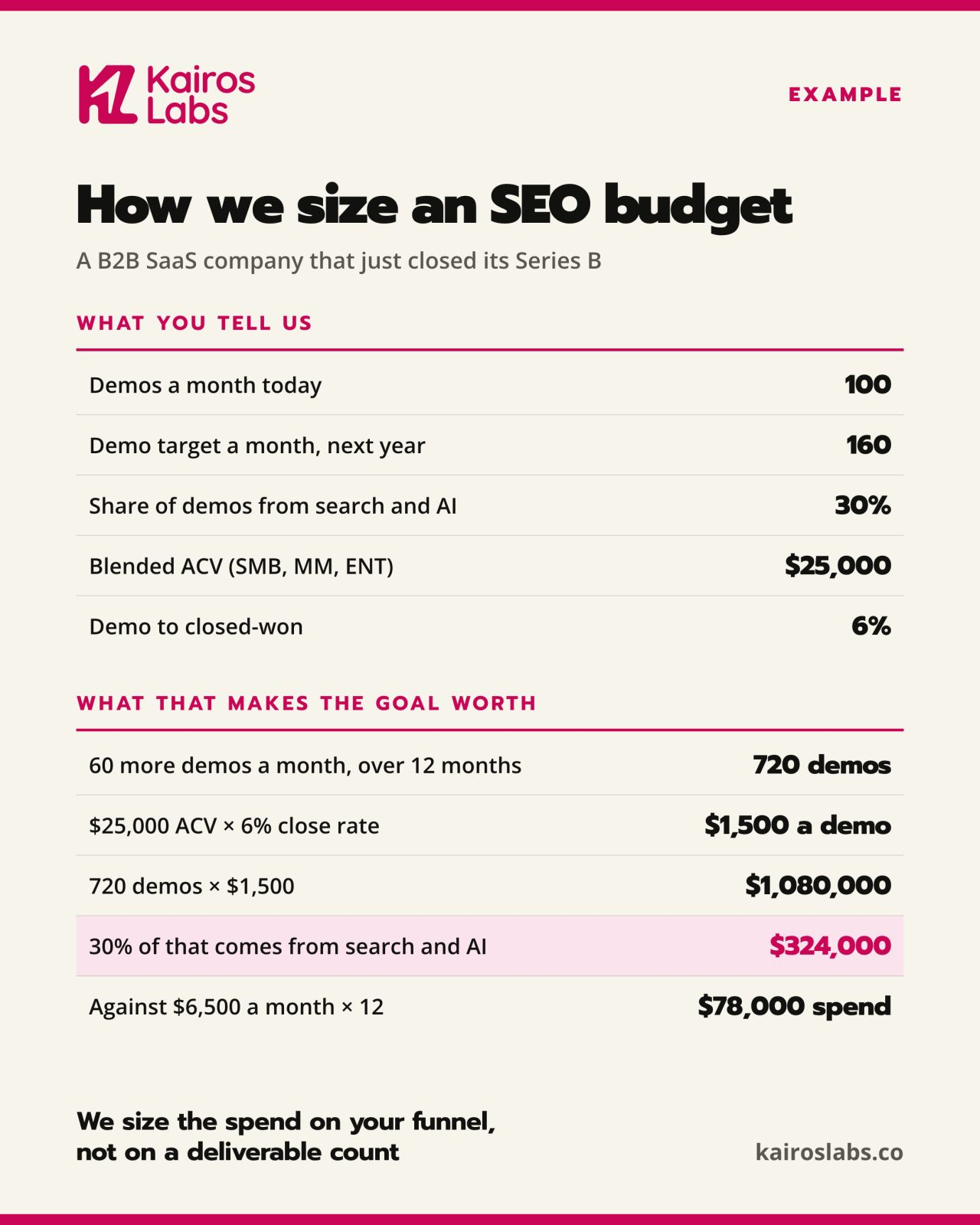
The potential deal value is your sales pipeline, which is why you can ask the agency to estimate the value of sales opportunities organic search and AI platforms could generate for your business, over what period, and how it arrived at that estimate.
The estimate helps you assess the opportunity before signing. Use it to agree on deliverables and review dates, then compare qualified opportunities and closed deals with the forecast as the work develops.
This guide explains what to expect at each stage of the first year, how to assess the results, and what to agree on before work begins. The timing will depend on your site’s starting position, the work involved, and how long your customers take to buy.
Key takeaways
- Before you sign, agree on deliverables, who will handle implementation, reporting milestones, and exit terms. Make sure you know what your team needs to contribute and if the potential pipeline justifies the cost.
- Expect a business-led SEO/AEO strategy first, followed by technical fixes, articles, and landing pages. Track completed work against agreed milestones. An audit identifies what needs fixing; implementation changes the site.
- Measure qualified pipeline from organic search, AI assistants, and the share of direct traffic supported by self-reported attribution. Track AI visibility as well, and compare results with their forecast to see if there are any gains.
- Include AI visibility in the scope. Ask which non-branded commercial prompts the agency will build from Search Console and customer calls, how it will establish a baseline, and what it will change to improve your presence.
What an SEO agency handles, and what it leaves to you
An SEO agency helps search engines find and understand your pages, builds an SEO/AEO strategy around your buyers and business priorities, and produces or improves articles and landing pages. The scope should also include technical implementation, relevant link building, AI visibility work, and attribution to qualified pipeline.
This is because some agencies hand over recommendations and leave your team to execute them. At Kairos Labs, we develop the strategy and produce articles and landing pages, with your content or product marketing lead reviewing the work.
When CertifID came to us, its Senior Content Marketing Manager, Will Looney, needed strategic SEO guidance and writers who understood cybersecurity. He needed a partner who could set priorities and do the work.
So before you sign with any agency, ask:
- What will you deliver?
- Who will handle implementation and publishing?
- What will you need from our team?
- How will you measure and report progress?
Use the answers to check whether the proposal covers the work you need:
What happens in the first 30 days
The first month establishes the SEO/AEO strategy and measurement system. The agency studies your product, customers, and market so it can prioritize work against business needs. For an engagement covering SEO and AI visibility, agree on initial deliverables such as:
- A technical SEO audit with issues ranked by priority and an owner for each fix
- An SEO/AEO strategy tied to business and product priorities, informed by product demos, sales calls, expert interviews, and competitor research, with topic clusters and a sequenced calendar for articles and landing pages
- An AI visibility strategy using non-branded commercial prompts built from Search Console and customer-call data, with baseline mentions, citations, and share of voice across agreed AI tools
- Attribution connecting analytics and CRM records for organic search, AI assistants, and direct visits supported by self-reported attribution, with a baseline for qualified leads and pipeline
At Kairos Labs, our Strategy Sprint builds the SEO/AEO strategy system, analytics framework, and content calendar around your business needs. We discuss the estimated pipeline opportunity before you sign. You keep the deliverables whether your team executes them or you continue with us.
Give the SEO/AEO agency access after you sign up
Month one slows down quickly when the agency can't see your data. If they have to wait on IT for logins every week, they can't effectively study your data. So, send these over before that first post-sign-up call:
- Google Analytics 4 (GA4), to review where visitors come from and which tracked actions they complete
- Google Search Console, to review search performance and indexing
- Your content management system (CMS), to audit existing content, with publishing permissions added if publishing is part of the agreed work
- Your customer relationship management system (CRM), or relevant reports, to review lead sources, deal stages, and deal values
- Product demos, sales call recordings, and time with subject-matter experts, so the agency understands your product and buyers
For Search Console, Google recommends giving your SEO agency read-only access during the audit. This gives them what they need for the first month, and you can expand access after you’ve agreed on the plan.
Months 1 to 6: fix SEO technical issues and put the content plan into action
Google needs to crawl and index a page before it can appear in search results. If important pages are blocked or difficult to reach, the agency should investigate those issues early. That work can happen alongside new content production.
The audit should determine the priorities. These might include
- Removing accidental indexing restrictions
- Fixing broken internal links, or
- Improving important pages that don’t answer buyers’ questions
The agency should also review pages that serve the same search intent. Overlapping pages may need clearer purposes or, where appropriate, consolidation. Related pages can then be organized into topic clusters, with links that help readers find the next useful answer.
Ask the agency to explain why each change takes priority and who will implement it. A recommendation sitting in a report hasn’t improved the site yet.
As articles and landing pages go live, check that search engines can index them and that they address the commercial searches and prompts in the strategy. Indexing and impressions help diagnose problems; they do not prove the work is generating qualified demand.
To verify that, track non-branded commercial prompts alongside relevant Google searches to see whether potential buyers can discover you without already knowing your brand. Review mentions and citations across AI assistants and Google AI Overviews, then connect resulting inquiries to your CRM.
Put milestones in the contract
Your contract should make delivery verifiable before pipeline results mature. An audit is complete when you receive the diagnosis and priorities. A technical fix is complete when the change is live and checked. Keep those milestones separate so a recommendation cannot pass for implementation.
Use a schedule like this as a starting point, then agree on dates that reflect your scope:
Months 6 to 12: when pipeline starts to build
As the engagement progresses, monthly reports should show qualified opportunities from organic search, AI assistants, and attributed direct traffic. Count direct only when a buyer’s self-reported source supports the connection; don’t assign all direct traffic to SEO/AEO.
For example, a demo request is an inquiry; it becomes a pipeline opportunity when your sales team qualifies it and assigns it a potential value.
Review those opportunities against the original forecast. If traffic is growing but qualified opportunities aren’t, ask the agency to investigate which searches and pages attract visitors, what those visitors do next, and where inquiries drop off. Reviewing those sources also lets you assess the channel’s contribution without inflating pipeline when a buyer encounters you in more than one place.
We achieved 31% year-over-year pipeline growth through our work with CertifID and increased the number of qualified leads converted into closed-won deals. Non-branded clicks grew 247.8%, while LLM traffic rose 308% year over year. CertifID also received its first ChatGPT-sourced lead in October 2025.
Those results didn’t appear in the second month. They grew over the year, and the work continues.
Use these questions to guide your monthly reviews. They describe what to examine as the work progresses, rather than deadlines for guaranteed results.
AI visibility is part of an SEO agency’s job now
Ask any query on Google these days, and there's a good chance you'd see an AI overview first, above the regular results. Your buyers also ask ChatGPT and Perplexity AI for solutions to their problems. So when you talk to an agency, ask about their plans for visibility in LLM tools.
Be cautious if an agency promises to get you featured. There’s no guaranteed way to be cited by ChatGPT or Perplexity, and Google says meeting the requirements for AI Overviews doesn’t ensure you’ll show up. However, the agency should still have a clear plan for improving your presence, experiments against a baseline, and reporting that connects visibility with qualified demand.
Ask the agency to show you how it does this:
- First, it builds a set of non-branded commercial prompts from Search Console queries and customer-call data. These should reflect how buyers describe problems and compare solutions.
- Next, it records mentions, citations, and share of voice across the agreed AI tools, keeping branded prompts separate so existing brand awareness does not inflate discovery.
- Then it tests changes to relevant articles and landing pages, tracking a test prompt set against a comparison set over an agreed period. Repeated checks help distinguish sustained progress from a single changing answer.
We used this approach with CertifID as search began to focus more on AI answers. From November 2024 to December 2025, the number of tracked keywords where CertifID appeared in Google’s AI Overviews grew from 36 to 165.
We also measured a growing pipeline, and CertifID began receiving ChatGPT-sourced leads. Its AI visibility gains sat alongside business results we could track. The monthly review should bring those measures together: commercial prompt presence, qualified inquiries, and the opportunities recorded by your sales team.
Before signing, ask
- Which non-branded commercial prompts it will track and how it selects them,
- How it will establish a baseline and comparison set, and
- How it will assess changes alongside pipeline from organic search, AI assistants, and self-reported direct sources.
Red flags to watch for before you sign a new SEO agency
Guaranteed rankings are an easy red flag. Google clearly states that no one can promise a #1 ranking, so if an agency offers this, they are either guessing or bluffing.
The other red flags are harder to catch, especially inside a polished proposal. Look out for these:
- A forecast with no explanation: The agency should show the assumptions behind its targets and identify where it lacks reliable data.
- Reports with no connection to business goals: The agency should report qualified pipeline from organic search, AI assistants, and supported direct attribution. More traffic or higher rankings alone do not establish a return.
- No access to the person responsible for SEO/AEO strategy: An account manager can coordinate the work, but you should know who makes strategic decisions and how to reach them.
- A proposal that could be for anyone: It should reflect your product, your buyers, your existing content, and your priorities.
- Vague promises about AI visibility: Ask what the agency will measure and test, and what it can reasonably conclude from the results.
- Unclear responsibilities or exit terms: You should understand what happens when work is delayed, responsibilities aren’t met, or you decide to end the engagement.
Before you sign, make sure both teams are clear on their commitments. A good agreement outlines the scope of work, reporting, client responsibilities, and the review process. It should also explain how to handle missed commitments and how to end the engagement if necessary.
Is hiring an SEO agency worth it?
Hiring an SEO/AEO agency makes sense when your buyers use Google and AI assistants to find solutions like yours, and you need help turning that demand into pipeline. At Kairos Labs, we work with your in-house content or product marketing lead. That person supplies product context, coordinates expert input, and reviews the work.
This also helps you avoid hiring freelancers article by article, which can leave your team managing everything around the writing. Even when the package includes “strategy,” that may amount to a list of bottom-of-funnel keywords. Your team still has to decide which buyer problems to prioritize, how articles and landing pages support each other, and how to track inquiries through to the CRM. Without that work, you can publish consistently and still struggle to tell what’s generating qualified demand.
With Kairos Labs, your team works with a strategist, writers, an editor, and technical specialists. We research the product, create articles and landing pages, track visibility across search and AI assistants, and connect reporting to pipeline.
Our execution packages vary by production volume and the depth of SEO/AEO work. The current packages are shown below:
Our work is designed for B2B SaaS teams with the foundation to turn more search demand into business:
- You have product-market fit and annual recurring revenue of USD 10 million–200 million.
- Your CMO or marketing lead can support the program, with a content or product marketer responsible for reviews and internal coordination.
- You have a serviceable addressable market: enough relevant buyers searching for problems your product solves.
- Organic already generates pipeline, but growth is flat, or you lack an integrated SEO/AEO strategy to expand it.
If that describes your team, let’s map the opportunity and the work needed to pursue it. Book a strategy call.
Let's design a solid SEO/AEO strategy and execute it so you get ahead of your competitors.
Book a call