


Content audit proposals look identical from the outside. Every provider promises a full inventory, a scored spreadsheet, and a prioritized action plan. The difference shows up in what you can do with the file once it lands: whether it tells you which pages to cut, which to rebuild, and the reasoning behind each call.
That's the standard we'd hold any provider to, ourselves included. Below are ten agencies doing content audits for B2B SaaS, and the criteria to judge them by.
Key takeaways
- The deliverable that matters is the decision, not the dataset. A scored spreadsheet without per-URL reasoning leaves the hardest part with you.
- Business relevance can't be scored from keyword data. It needs someone who understands your product and your buyer, and that requirement explains most of the gap between a $1,000 audit and a $6,000 one.
- Very few agencies sell a standalone content audit. Most run one inside a broader SEO engagement, so ask early whether you can buy the diagnosis on its own.
- Ask to see a sample scoring matrix before you sign. It reveals more about a provider than any capabilities deck.
- Every prune decision needs to survive someone asking, six months later, why that page went. Visible scoring rationale is what makes that answerable.
The 10 best content audit agencies at a glance
Every agency below runs content audits for B2B SaaS, and all ten were assessed on their own published materials:
The 10 best content audit services
1. Kairos Labs: Best agency that offers in-depth content SaaS audits
Best for: B2B SaaS teams who want an in-depth audit done by a senior SEO Strategist.
We're an agency that uses SEO and AEO to drive pipeline for B2B SaaS and some of our customers at the beginning of the engagement ask us to run an in-depth content audit.
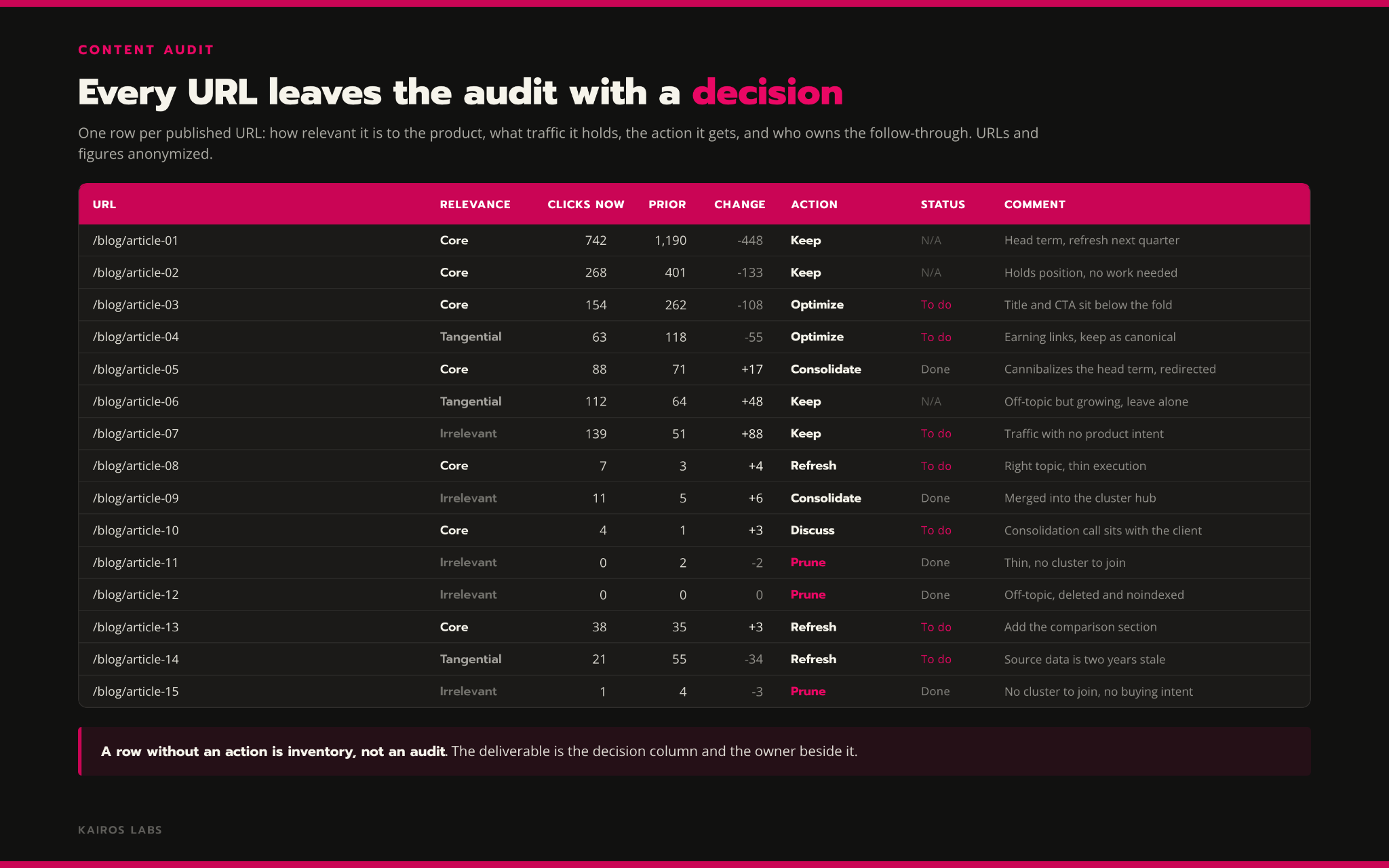
Every URL with real SEO potential gets scored on two axes: how it performs, and how relevant it is to what you sell, and how many qualified leads it’s supporting or bringing directly. We use your company context data: your ICP documentation, a product walkthrough, and your subject-matter experts to really be sure we get your niche and customers.
The audit includes a cannibalization map, and also minds AEO so no page that’s being retrieved by LLMs is getting pruned or consolidated. It works standalone or as the first stage of a longer engagement.
Watch out for: We work for B2B SaaS and tech companies so we don’t provide content audit services for B2C or other niches.
2. Platypus SEO
Best for: growth-stage European B2B SaaS companies that want organic treated as a revenue channel.
Platypus SEO works across SEO, AEO, and GEO for B2B SaaS, with teams in Belgrade and Sydney. Their audit is framed around whether a site is positioned to attract and convert qualified traffic rather than technical hygiene alone, which is the right framing for a content-led review. They state that every project is led by senior operators with five or more years of B2B SaaS experience, across cybersecurity, fintech, medtech, edtech, and martech.
Watch out for: The audit sits inside a broader retainer rather than being sold as a standalone piece of work.
3. Position Digital
Best for: B2B SaaS startups that need audit work without a five-figure monthly commitment.
Position Digital is a London-based SEO and GEO agency founded in 2019, serving B2B, SaaS, and professional services. Audits sit alongside content marketing, link building, and digital PR, and they've built proprietary AI-search tooling including a citations extractor. Their own site puts services from $2,000 a month with flexible deliverables rather than long lock-ins, which makes them one of the more accessible options for smaller teams.
Watch out for: A lower entry price generally means less manual scoring depth. Ask specifically how business relevance gets assessed.
4. Breaking B2B
Best for: B2B SaaS teams who want content-led SEO with website work attached.
Breaking B2B runs SEO for B2B SaaS and tech companies: technical audits, keyword research, content optimization, link building, and performance tracking. Web design and conversion work run alongside it, which suits teams whose pages need rebuilding as well as reviewing. They publish pricing publicly.
Watch out for: They mention technical SEO audit but no content audit in the offer they have.
5. Minuttia
Best for: Post-product-market-fit B2B SaaS wanting senior content strategy and AI search work.
Minuttia is a SaaS-only content and SEO agency founded in 2020 by Georgios Chasiotis. Services cover Google and AI search strategy, human and AI content creation, digital PR, and agent analytics tracking how AI systems interact with your content. They publish substantial original research, including a SERP study across nearly 1,500 software keywords, which is a fair proxy for how seriously a team takes methodology, and report more than 50 B2B SaaS clients.
Watch out for: The audit doesn't appear on their services list, so you reach it through a sales conversation rather than buying it outright.
6. Rock The Rankings
Best for: SaaS teams who want founder-led delivery from a firm that works with nobody else.
Rock The Rankings was founded in 2018 by Justin Berg and has run for years without taking a single ecommerce, local, or B2C client. That focus shows in the playbooks, and the small team means senior people stay on the account rather than handing off after onboarding. The work spans end-to-end SEO and GEO with audit and strategy at the front, and they publish pricing.
Watch out for: Content audit is mentioned in their Foundation program but there is no in-depth description on what the audit contains.
7. Spicy Margarita
Best for: B2B SaaS and B2B services companies that want a boutique, senior-only team.
Spicy Margarita is a London-based boutique SEO and AEO agency founded by Ben Goodey. They cap the roster at ten clients with no junior staff on any account, and run experiments across LLMs to test what actually moves recommendations. The focus is deliberately bottom-of-funnel: comparisons, alternatives, and evaluation-stage queries rather than broad awareness. They publish pricing and offer 30-day cancellation.
Watch out for: no content audit appears anywhere in their offering. Technical audits sit inside the fractional leadership tier, and every tier runs as an ongoing retainer, so there's no route to buying the diagnosis on its own.
8. Right Left Agency
Best for: SaaS and construction-tech teams who want SEO sitting alongside paid, creative, and web.
Right Left Agency works with SaaS, Construction Tech SaaS, B2B, ecommerce, and franchise brands. Their SEO covers technical, on-page, content strategy, AI search and GEO, and analytics, inside a full-funnel model that also includes paid advertising, email, branding, and web development. That breadth suits teams who'd rather not coordinate four vendors, and their case work leans on comparison content and digital PR for commercial-intent keywords.
Watch out for: Full-service breadth usually trades against depth in any single discipline. If the content audit is the whole job, a specialist may go deeper.
9. Synscribe
Best for: Seed to Series B teams who want execution engineered rather than staffed.
Synscribe is a Singapore-based product-and-agency hybrid founded in 2025 by Raymond Yeh. Every client gets a dedicated AI agent built on the open-source OpenClaw framework handling research, keyword planning, page generation, and monitoring, while the human team holds strategy and quality gates.
The differentiator is engineering: they implement fixes and programmatic SEO directly in your codebase rather than handing over a document and walking away.
Watch out for: Heavy automation and business-relevance scoring pull in opposite directions. If your archive needs judgment more than throughput, press hard on how much of the audit a human actually reads.
10. Flow Agency
Best for: B2B SaaS and professional services firms wanting a bespoke strategy rather than a packaged one.
Flow Agency, formerly Flow SEO, is a Berlin-based boutique founded by Viola Eva. Content audits sit within a wider set covering B2B SEO, paid media, GEO and LLM optimization, and backlinks, and their stated approach is that no single playbook wins.
Watch out for: Bespoke means scoping conversations take longer, and pricing is quoted per engagement.
What is a content audit?
A content audit is a structured review of every URL on your site that affects organic performance: blog posts, landing pages, product and use-case pages, and resources.
Each page gets scored on two dimensions. Performance covers traffic, rankings, impressions, and conversion or assisted conversion. Business relevance covers ICP alignment, coverage for your target personas, and proximity to commercial intent. Those two scores together produce one of four decisions for every page: keep it, refresh it, redirect it into a stronger page, or prune it

The quadrant labels do most of the work here. Where providers differ is in how they arrive at them, and what they hand you once a page has landed in one.
What a content audit actually gets you
An audit earns its money after the report lands, not when it arrives. Four things should be different once you've acted on it.
- Recovered value from pages you already own. On most mature sites the high-relevance, low-performance set is the single largest opportunity available, and refreshing costs a fraction of commissioning new work.
- Decisions your team stops deferring. Most content leads have a mental list of pages they suspect are dead weight and have carried it for months without acting. A scored inventory converts that list into something anyone on the team can take action.
- Permission to publish less. Once you can see which formats convert and which only collect sessions, the case for cutting output and raising standards makes itself.
- A baseline for whatever comes next. Migrations, repositioning, and strategy engagements all go better when they start from a scored inventory rather than an assumption.
Worth being clear about the limit: an audit doesn't create demand. It reallocates effort toward pages that can earn it. If nobody is searching for what you sell, an audit will tell you that, and it won't fix it.
Three situations that send teams to a content audit service
Your trigger determines which deliverables matter most, and it tells you quickly whether a provider's standard package will serve you.
Your content ranks but generates no leads. The pages rank, the traffic is real, and almost none of it reaches sales. Usually the cause is intent rather than execution: some pages rank for queries that were never going to produce a buyer, and no rewrite changes that. Telling those apart from genuinely thin pages is the entire job.
You inherited a blog with no ICP focus. Cleaning up an unfocused archive by hand works right up until the cuts have to be justified to someone who wasn't in the room. You need a map of which topics align with your ICP and a sequenced path to the editorial direction you want, or this is where teams shed topical authority they spent years building.
You need answers before a strategy or platform decision. CMS migrations, strategy pivots, and retainer commitments share a prerequisite: knowing what you have before you spend more. Running the audit as a standalone project first forces scope clarity and gives whoever signs off a baseline to point to.
What a content audit service must produce: the non-negotiable deliverables
Exporting a crawl takes five minutes. Below are the six outputs that turn one into an audit, each with the question that tells you whether a provider is producing it.
The full content inventory: what gets counted, and why URL count alone misleads
Raw count tells you very little. Take two 200-page sites: the first has 50 SEO landing pages and 120 blog posts, the second has 30 SEO pages, 20 blog posts, and 150 news items and product updates.
The first needs 170 pages scored properly. The second needs 50 scored and 150 asked a simpler question, which is whether they still serve the business at all. A provider who quotes both the same way hasn't looked at what they're being asked to review.
Ask: How do you categorize content types, and does your scoring change by category?
The scoring matrix: how business relevance is mapped against performance
Two axes sound obvious, but most providers only run one. Performance is the easy half, available from a crawl and a Search Console login without ever learning what you sell.
Business relevance gets skipped because it takes context that no tool holds, and it can't be automated: someone has to review every URL with real SEO potential by hand and place it in a quadrant:
- High business relevance, high performance — keep.
- High business relevance, low performance — refresh. The most recoverable value sits here.
- Low business relevance, high performance — a judgment call, and the quadrant where weak audits go quiet.
- Low business relevance, low performance — prune.
On a B2B SaaS site, that separation matters. A glossary post on a broad industry term is often the highest-traffic page on the blog and has never produced a demo request.
An integration page for the platform half your buyers already run gets a fraction of that traffic, and nearly everyone landing on it is a qualified buyer. Score on traffic alone and you'll rank those two in exactly the wrong order.
Ask: Can I see a sample matrix before we sign? If it shows traffic numbers with no relevance dimension, you're looking at a crawl export with color coding.
The cannibalization map: which of your pages compete with each other
Where several URLs chase the same intent, they split authority and muddle which one ranks. A provider should name each competing set, the consolidation target, and the redirect path.
For example, a compliance platform with four pages in one topic area: a product page for SOC 2 compliance, a blog post titled "SOC 2 compliance software," a "what is SOC 2 compliance" explainer, and a readiness checklist.
Only two compete. The product page and the software post answer the same commercial question, so Google alternates between them and neither holds position: Merge the post into the product page and redirect it. The explainer and checklist serve different intents and should stay.
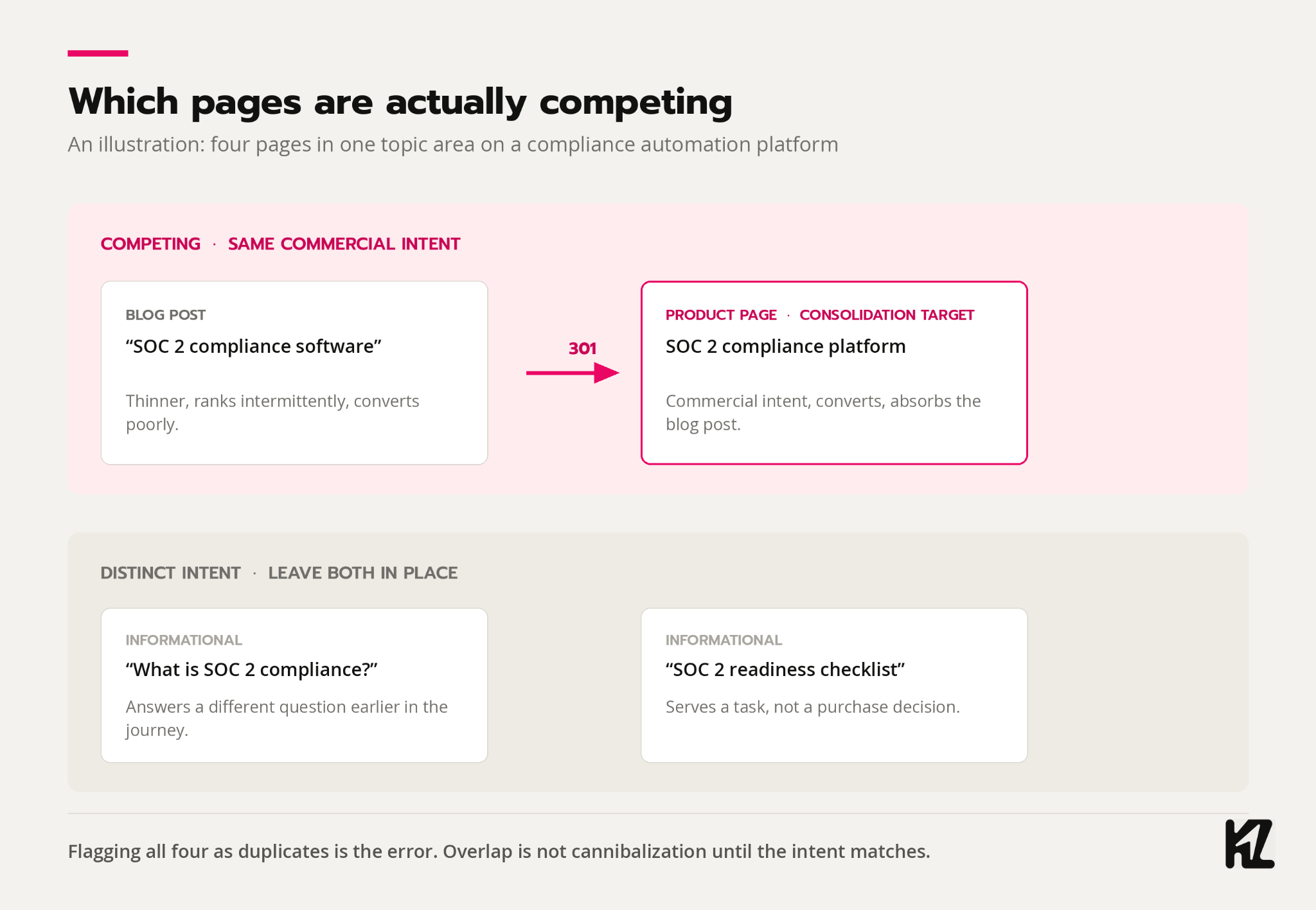
Ask: How do you identify cannibalization, and how do you decide which URL survives?
The AI retrieval check: which pages LLMs actually cite
A post can be losing organic traffic year over year and still be the source an LLM reaches for when someone asks about your category. That matters most at the prune step: a page with falling traffic looks like an obvious cut until you find it's retrieved regularly in AI answers, and deleting it removes you from a surface your buyers already use.

That's the domain-level view. The same measurement runs per URL, which is where it changes decisions: a handful of posts usually carry most of the retrievals, and they're rarely the ones your traffic report flags as healthy.
Ask: Do you check whether a URL is being retrieved in AI answers before you recommend pruning it?
The decision map: what a vendor hands you rather than leaves you to work out
Every URL gets a recommendation with its scoring rationale visible. This matters when someone senior asks why forty pages disappeared. "Low traffic" won't hold up. "They scored below threshold on both axes, and here's the matrix" will.
Take a close-automation platform selling to controllers. Its three highest-traffic posts are "how to become a CPA," "bookkeeping versus accounting," and a free invoice template.
All three are about accounting, all three pass a keyword-relevance check, and none will ever be read by someone evaluating closing software. Put them on a prune list bare and you'll be asked why you're deleting the pages that work. Attach the reasoning, and the same list reads as a decision.
Ask: Does every recommendation come with the reasoning attached, or just the verdict?
The sequenced action plan: why an unordered findings list never gets implemented
Sequence changes outcomes. Quick wins open: refresh core business pages where traffic is slipping, and prune low-value pages pulling nothing. Then, the consolidation targets go live, because a redirect needs its destination to exist first. Then confirm the keeps and batch mid-relevance pages losing traffic into one refresh queue.
Then redirect and remove. A page with no traffic and no links gets deleted and left to 404. A page that pulled traffic but never fit your buyer gets a 301 to the closest useful destination.
Every redirect runs straight to its final destination to avoid redirection chains. Last, decide what to do with the high-traffic, low-relevance pages.

Ask: What does your implementation sequence look like, and how do you prioritize it? If the answer is that you'll get a list and set your own order, expect that list to sit untouched.
How to choose a content audit agency
Those six questions are your script. What separates providers is the shape of the answers.
A provider with a genuine method names their axes, describes the weighting, and explains what happens when a page scores high on one and low on the other.
Expect them to ask for positioning & messaging docs, persona detail, and conversion data before they'll quote, because relevance can't be scored without it. Anyone who prices a relevance audit without asking a single question about your product is planning to proxy it from keyword volume.
The weaker version talks about data-driven insights and comprehensive analysis without ever describing a decision rule. They'll have a confident answer for what they look at and a vague one for how they decide. That gap is the tell.
One more thing to listen for: whether a provider asks how you're set up internally before they scope. Some teams have a strategist they want kept in the loop and only need the audit itself.
Others have capable people in-house and still want the whole channel handed over, because bandwidth is the constraint rather than skill.
What a content audit service costs, and what moves the number
What a content audit costs comes down to two things: how deep it goes, and who does the work. A senior strategist who sits through a demo, reads your positioning, and scores every page by hand produces a different document than a junior running a crawl through a template. Both are sold as content audits, and almost all of the gap between them is hours.
Prices run from $1,000 to $10,000 and up. Four variables move the number: how many URLs are in scope, whether relevance scoring is done by hand or proxied from a tool, how senior the person doing it is, and whether the audit stands alone or feeds a strategy engagement. If the build-versus-buy calculation is your real question, our breakdown of in-house versus agency SEO works through the trade-offs.

A cheap audit will reliably find your thin content. What it can't tell you is which thin pages deserve a refresh and which should go, because that call depends on knowing your audience, your funnel, and your product. We publish our pricing, and any provider worth considering should walk you through the same logic.
What our audits have produced
CertifID, a wire fraud prevention platform, came to us with 358 indexed pages and no reliable read on which were doing anything. We scored every page against traffic, business relevance, and pipeline contribution pulled from their CRM.
The imbalance came out fast. Fifty-five pages covering social engineering and cybercrime had produced two qualified leads between them. Fourteen product and solution pages had produced forty-two. Sixty of their 148 blog posts were outdated or overlapping enough to redirect, and 112 URLs were splitting authority with the pages that actually converted readers into leads.
So the plan wrote itself. We consolidated the dead weight, pulled those URLs from the sitemap, and rebuilt the editorial calendar around the clusters already earning, with articles sourced from SME interviews and customer calls rather than keyword tools. One of those enterprise posts closed a deal four times their average size, and the program has driven 31% year-over-year pipeline growth.
Content audit services: what a good one leaves behind
A content audit that actually gets implemented leaves you with a healthier site than the one you started with. Fewer pages, and the ones still standing are relevant to what you sell, rank for queries your buyers use, and bring traffic worth having. That's the return, and it compounds.
If you want to know what that would turn up on your site, request a strategy call. We'll tell you how much of your library is genuinely worth auditing, and whether the work earns its place on its own or as the front end of something larger.
Let's design a solid SEO/AEO strategy and execute it so you get ahead of your competitors.
Book a call