

ChatGPT doesn't rank pages the way Google does. So “ranking number” one in LLM means being shortlisted as the first solution to a prompt that returns software solutions. Just like on the image below:
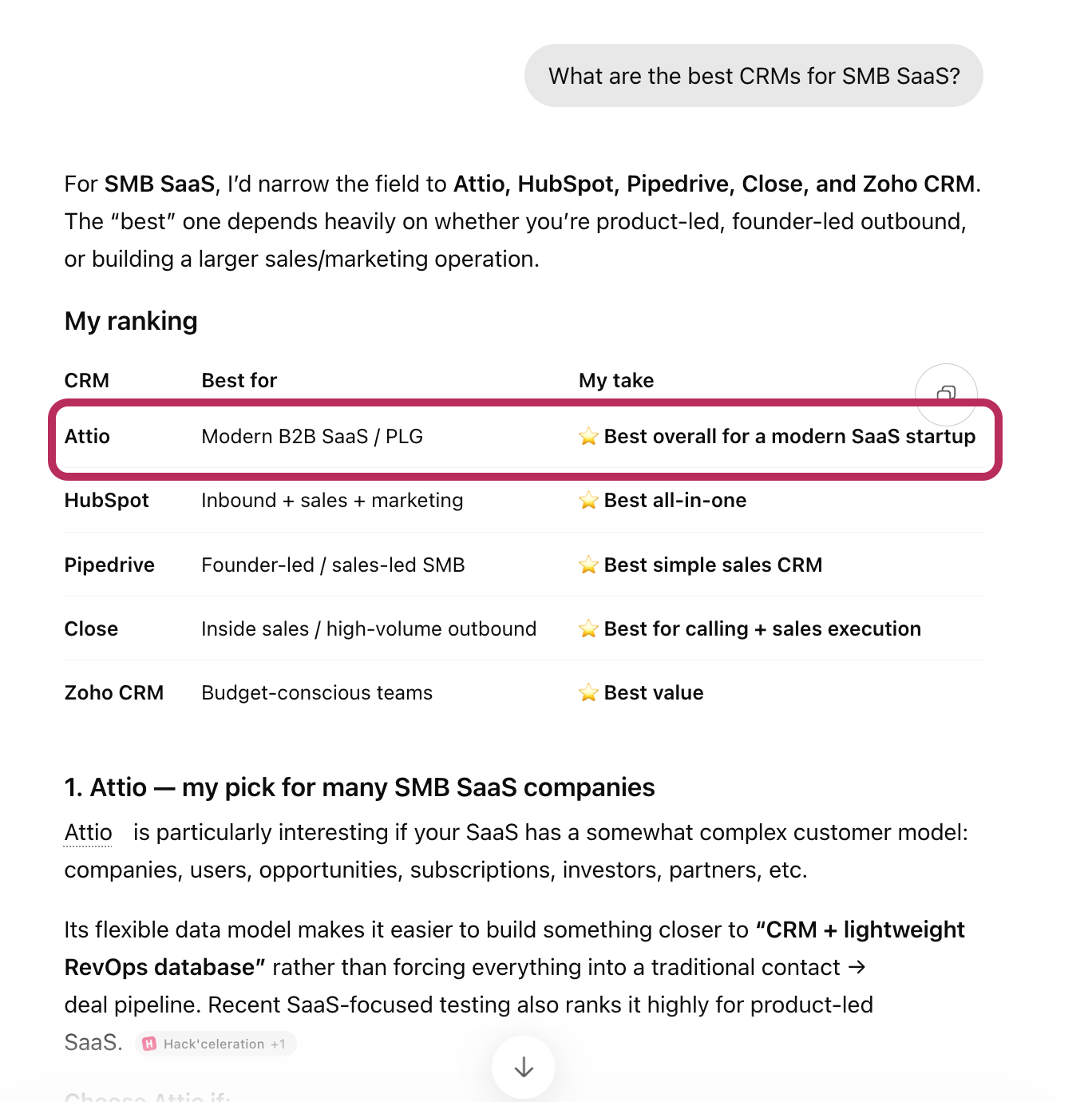
Also, your SaaS solution is either being mentioned in the set of tools it decided to surface, or you’re not present in one of the most important moments when buyers are making up their mind about what software tool to buy.
Interestingly, the brands that consistently earn mentions are the ones that built enough topical authority for ChatGPT to consider them credible sources. That authority comes from covering a subject in real depth on their websites and third-party sources, consistently over time.
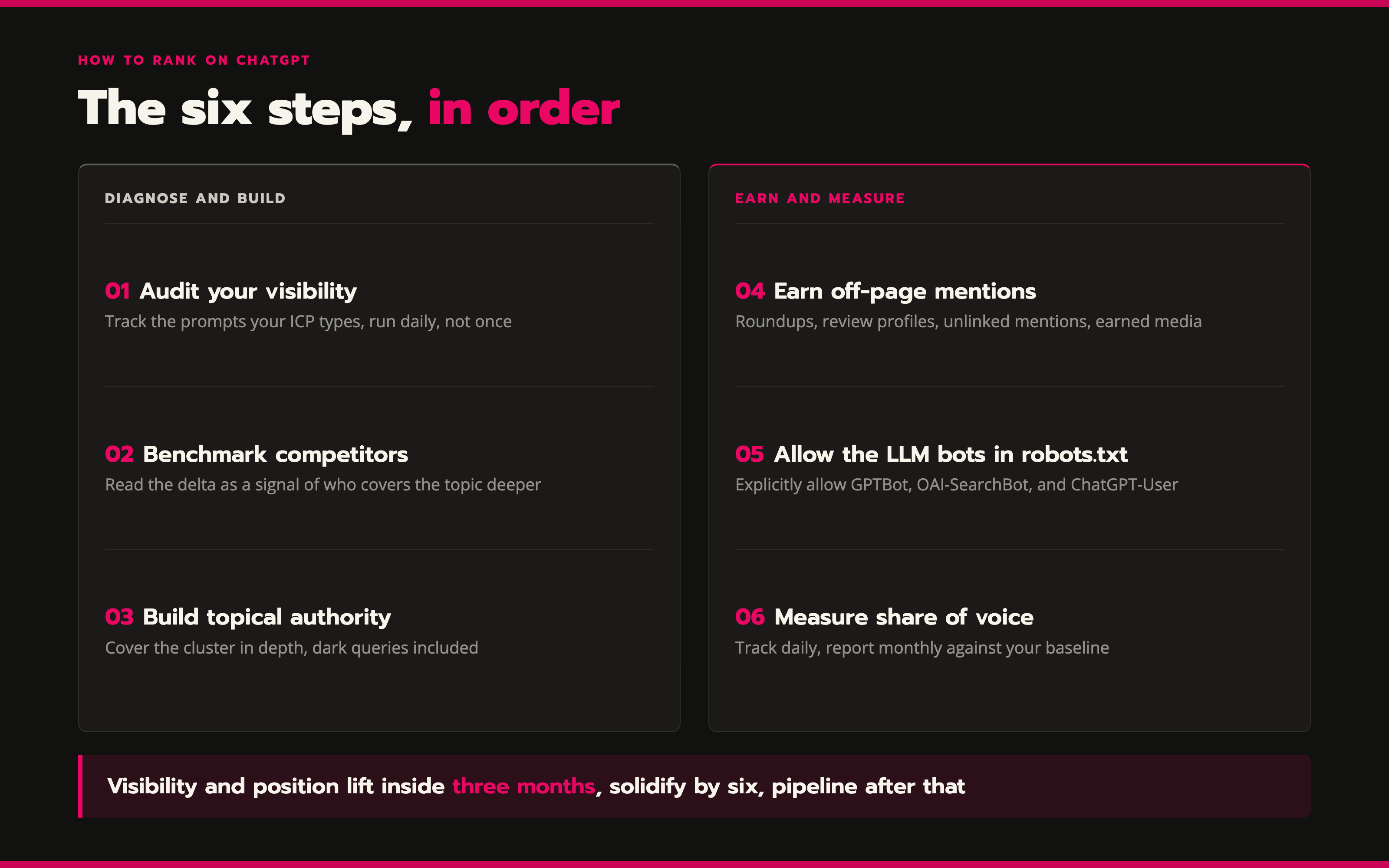
This guide explains the six steps to build that authority and rank in ChatGPT answers, from auditing where you stand today to producing content ChatGPT bots can crawl and trust.
Let's get into it.
Key takeaways
- Formatting plays like FAQ schema and BLUF paragraphs are table stakes now, not a differentiator. Most serious competitors already have them in place.
- Topical authority and third-party citations are the two levers most consistently tied to citation rate and share of voice.
- A drop in citation rate isn't always about your content. If a source ChatGPT relies on for your brand's authority changes, or you're dropped from a 'best of' roundup, your citation rate can fall with no changes on your end.
- Most AEO programs take six to ten months to build a measurable visibility in LLMs, then pipeline. Set that expectation before you start measuring.
- Competitive prompt benchmarking tells you which content clusters to fix first, not just whether you're behind overall.
Step 1: Audit your SaaS product current ChatGPT search visibility
Before publishing a word of new content, run a structured prompt audit. You can't close a gap you haven't measured. Here’s how to do it:
Build your prompt test set: map the questions your ICP actually types into ChatGPT
Your ICP types longer, more specific, comparative questions when they ask questions on ChatGPT. You will get these phrases from your sales call transcripts, support tickets, community threads, Reddit threads, and more.
Note: Not every prompt cluster connects to revenue. Most companies tracking a large prompt set find that a tight subset maps to actual buyer evaluation behavior, and that subset is where pipeline-tied results actually come from.
So, what do you do?
Segment your prompt set by funnel stage and choose only the prompt where brands are being mentioned. Also, set filters in your AI visibility tool to choose only “ChatGPT”
For example:
- Best EDR for a 300-person company with no dedicated security team
- Best tools for detecting insider data exfiltration to personal cloud storage
- Which SIEM is best for a team that can't afford Splunk's ingest pricing?
- Best vendors for continuous vendor risk monitoring across 200+ third parties
- Which identity security tools are best for stopping session-token theft and MFA fatigue attacks?
Prioritize the evaluation cluster. If your brand doesn't appear when a buyer types "what [category software] does [ICP description] typically use?", that's a big miss because your brand is invisible during an extensive LLM search where the user is comparing various tools, exploring features, use cases and problems these providers solve.
So your key goal of ranking in ChatGPT is really to get to that shortlist and ideally, get recommended by LLM so buyers trust you way before they contact their sales team.
Do you need support to audit ChatGPT, choose the right prompts and design the whole SEO & AEO strategy and execute it? We’re here to help you. Get in touch with us
Run the audit: manual prompt testing vs. dedicated LLM visibility tools
Manual testing is a good first shot, but it's prone to the probabilistic nature of LLMs. Running a prompt once tells you the vibe of the answer — what kind of brands get named, how the model frames the question, what sources it leans on.
That's useful.
What it doesn't tell you is whether you're actually visible. The same prompt run ten times gives you ten different answers, and your brand may show up in three of them.
Think about what a visibility score means. If your visibility is 10%, that's one in ten runs where you get surfaced. So a single manual test has a 90% chance of showing you an answer you're not in — and you conclude you're invisible. Run it once more and land in the lucky 10%, and you conclude you're doing fine. Both readings are wrong, and neither is something you can build a strategy on.
A better way to approach the audit is to invest in LLM visibility tracking tools that will let you measure your visibility, Share of Voice, sentiment and position every day, so you can form a baseline.
For example, if your position is 1.5 in ChatGPT but your visibility is only 21%, that tells you two very different things at once. When the model does name you, it puts you at the top of the list — ahead of competitors.
But if you have 21% of visibility while your competitors have 33% and 48%, for example, you're just not in four out of five answers. That's a coverage gap, not a ranking gap, and the fix is getting cited on more of the questions your buyers ask — not trying to climb a list you're already winning.
Read the LLM metrics: brand visibility, sentiment, position, Share of Voice

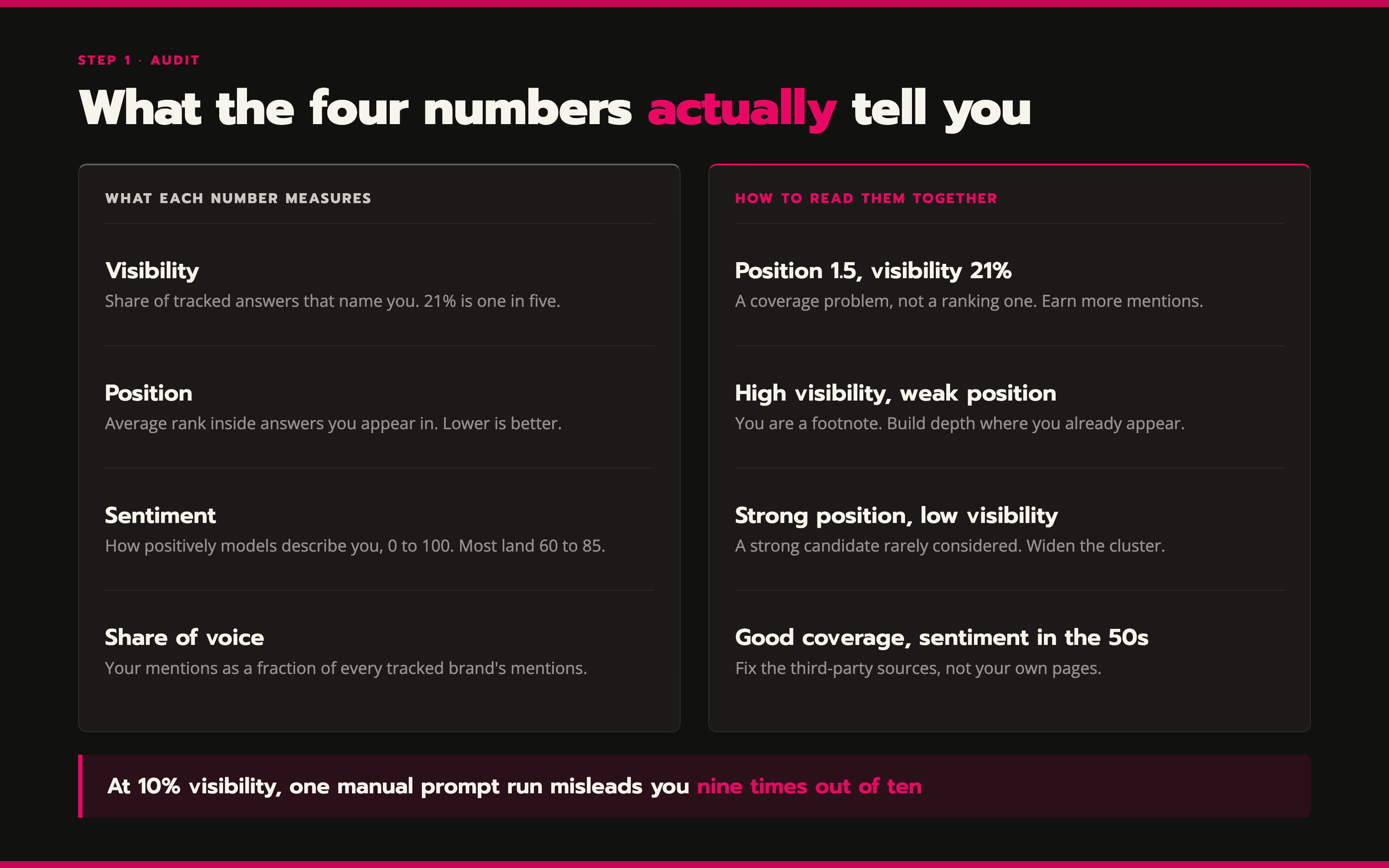
Four numbers do most of the work here, and they measure genuinely different things.
Visibility is the share of tracked responses where your brand gets named. Track 100 prompts across engines, get named in 21 of the responses, that's 21% visibility. This is the headline number — how often you're in the conversation at all. Everything else is conditional on it.
Position is the average rank your brand holds inside the answers where it does appear. Lower is better; 1.0 means you're consistently the first name in the list. Position ignores every answer you're missing from, which is why it can look excellent while visibility is poor. That combination — position 1.5, visibility 21% — isn't a contradiction. It says you win the answers you're in and you're absent from four out of five of them. Coverage problem, not a ranking problem, and the two need different work.
Sentiment is how positively the models describe you when they name you, scored 0 to 100. Most brands land somewhere in the 60 to 85 range. Below 50 is a real problem worth investigating, because the models are largely reflecting what third-party sources — reviews, forums, comparison posts, directories — say about you. A weak sentiment score is rarely something you fix on your own website.
Share of voice is your mentions as a fraction of all mentions across the brands you track, on the same prompt set. Visibility tells you how often you show up; share of voice tells you how much of the airtime is yours once every competitor is counted. These diverge more often than you'd expect — a brand can sit in a fifth of answers and still hold a third of total mentions, because when it appears it's discussed at length while competitors get a one-line reference.
Read them together. High visibility with weak position means you're a footnote in a lot of answers. Strong position with low visibility means you're a strong candidate that rarely gets considered. Good numbers on both with sentiment in the 50s means the models know you and don't describe you well. Each of those is a different piece of work.
Step 2: Map the competitor visibility gap on your priority prompt clusters
Your baseline tells you where you're absent. Now, let’s see who's showing up instead, and by how much, because that gap is your prioritization framework.
Benchmark competitor citation rates by cluster and read the gap as a topical coverage signal
A meaningful SaaS competitor gap on a high-intent cluster signals topical coverage weakness. If a competitor holds a higher brand mention rate on the prompts your pipeline depends on, they've likely published more authoritative content on that cluster, earned more third-party citations, or both. That analysis will affect your content plan (we’ll cover that in Step 3).
Run your audit prompts for each named competitor and record their citation rate by cluster. You're looking for delta: how much higher is their brand mention and share of voice on the prompts you both care about?
A large brand mention and position gap on a specific cluster almost always maps to one of three causes: the competitor has deeper topical coverage, they've earned more third-party citations in that topic area, or both. The gap is diagnostic, not discouraging. It tells you precisely where to invest.
Prioritize which gaps to close first: high-intent prompts to win
Close the gaps where two conditions overlap: the prompt cluster drives real tool mentions, and your competitors are surfaced but you’re skipped.
Closing a large delta on a high-intent cluster produces more measurable pipeline impact than closing a small delta on an informational one.
With priorities set, Step 3 is where you build the content that closes them.
Choosing between In-house vs. agency SEO? Read the article that will help you figure out what’s the best option for your company.
Step 3: Build topical authority ChatGPT can cite and get your brand mentioned
ChatGPT cites sources it treats as authoritative on a subject, and that authority comes from covering a topic cluster deeply and consistently. It doesn't come from publishing more pages on more keywords or adding a random FAQ block to a post that already exists.
Read on to learn how to build topical authority that gets you mentioned and cited in ChatGPT answers:
Map your cluster: identify the subtopics and "dark queries" that keyword tools miss
Keyword tools show you what gets searched on Google. They don't show you what buyers type into ChatGPT. Those prompts are longer, more conversational, and often comparative or scenario-specific.
"Dark queries" are the questions your ICP asks in ChatGPT that have no meaningful Google search volume but drive real evaluation behavior. You will find them through the same sources you used in Step 1, i.e., sales call recordings, support conversations, community threads, and competitor review sites.
Lastly, map the full cluster into primary topics, supporting subtopics, and dark queries before you write. This map becomes your editorial plan.
Write content ChatGPT can extract
Stephanie Trovato shared the type of content that gains presence in AI search engines.
“Create content that brings something new, i.e., your experience, a strong opinion, customer insight, real data, and more. Content that has depth, a unique perspective, and is useful. That’s what AI platforms want to link to.”
LLMs extract self-contained content that directly answers questions. Open each major section with a BLUF (bottom line up front) answer, then back it up with the reasoning.
Most importantly, create content that paints your readers’ problems and primarily solves them; put yourself in the reader's shoes and prioritize satisfying their search intent.
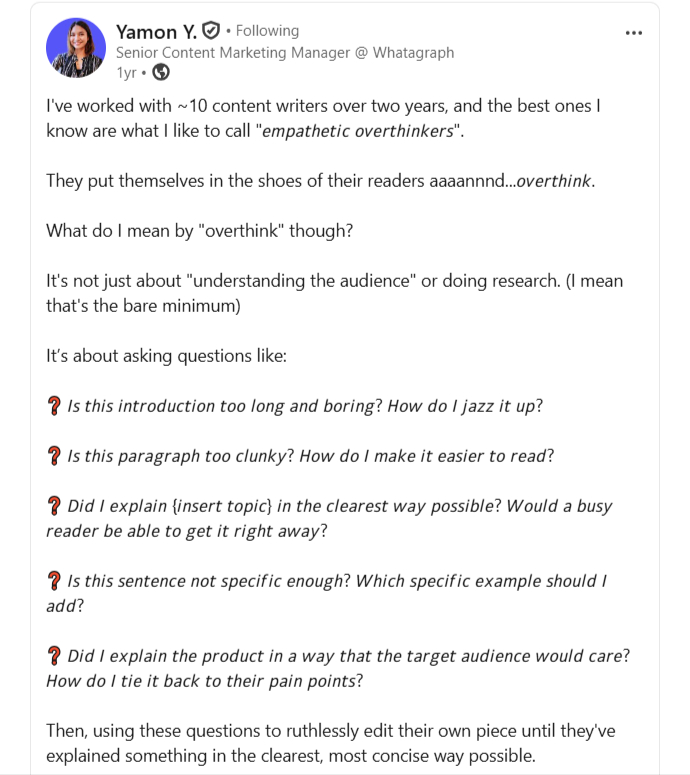
Yamon Y., Senior Content Marketing Manager at Whatagraph, calls this concept “empathetic overthinking” in her LinkedIn post.
Also, every piece in your cluster should cover the specific problem the content solves, how your product or service solves it, and the outcomes you produce.
Side note: Make your content easy for humans and LLMs to read. That means:
- Use headers consistently
- Break down complex points into bullet points, numbered lists, or tables
- Use clear and concise language for readability
- Keep paragraphs short (2–4 lines max)
Publish and consistently update your content
A post that earned strong citation rates six months ago drops in relevance if competitors publish deeper content in the same cluster.
Therefore, build a refresh cadence into your editorial calendar. Review every piece in your priority clusters quarterly for accuracy, freshness, and whether newer data should replace older claims.
Content refreshes can update the crawl signals AI systems rely on for live retrieval. A high-authority post with a recent publication date tends to outperform the same post left unchanged for a long stretch.
With owned content addressed, Step 4 turns to the off-page citations that multiply its impact.
Step 4: Earn the off-page mentions that move your brand visibility rate
Ahrefs analyzed 75,000 brands to see the search factors that influence brand mentions in ChatGPT. Brand mentions across authoritative external sources were among the strongest observed correlates of ChatGPT mention rate.
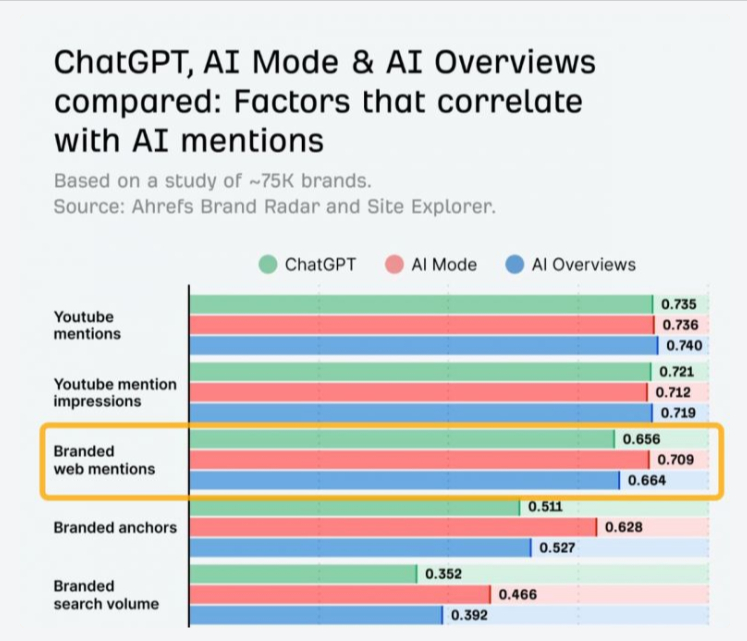
Here’s how to get those off-page citations:
Get onto "best of" lists and industry roundups
Review aggregation sites, analyst roundups, and editorial "best of" lists are frequently cited in ChatGPT answers. G2 category pages, Capterra comparisons, and editorial lists on recognized industry publications are associated with ChatGPT citation activity.
Identify the lists where your competitors appear, and you don't. Close those gaps through outreach, review generation, and, where it fits, publishing your own comparison content that earns citations over time.
Your own comparison content, "X vs. Y" articles, category overviews, buyer guides, and alternative posts can also earn you citations. This content type appears in live retrieval results and, over time, becomes the type of content other publications reference.
Publish them on your site, optimize it for live retrieval, and promote it through the same channels you use for demand generation.
Build unlinked brand mentions
ChatGPT's training data includes text, not just links. An unlinked brand mention in a trusted publication, a reviewer comment on G2 that names your product category, or a Wikipedia paragraph that accurately describes your company's role in a market all feed the training-data authority lane without requiring a hyperlink.
Systematically build brand mentions across these sites. You should also maintain an accurate Wikipedia presence, keep your G2 and Capterra profiles current with customer reviews, and pursue mentions in niche publications your ICP reads even when they don't link to you.
Prioritize earned media and thought leadership
LLMs appear to treat consistent narratives across multiple independent sources as a form of consensus. When your positioning, key claims, and category definition appear across a podcast transcript, a contributed article, an analyst brief, and your own content, all expressing the same core narrative, that consistency reinforces citation probability.
With off-page citations building, Step 5 closes the technical gap between your site and AI retrieval systems.
Step 5: Make your content legible to AI crawlers
Getting your content in front of ChatGPT's retrieval layer has less to do with crawl hygiene (assume your site already works). It has more to do with signaling clearly what your brand is, what topics you own, and which pages carry the most authority.
You will achieve it with these three steps:
Add an llms.txt file to direct AI crawlers toward your highest-value pages
An llms.txt file, placed at your domain root (yourdomain.com/llms.txt), is an .md file that signals to AI crawlers which pages matter most for language model training and retrieval.
Include your highest-authority cluster pages, product pages, and any pages with original data or case studies. Keep the file updated as your content inventory grows. This doesn't guarantee citation, but it removes a navigability barrier for AI crawlers doing live retrieval.
Update robots.txt to explicitly allow GPTbot, SearchBot and
Before an answer engine can cite you, it has to be allowed to fetch your pages. That permission lives in robots.txt, and on a lot of sites it's quietly working against you — either because a plugin or a CDN blocked AI user agents by default, or because nobody ever added them and the crawler is falling back to rules written for Googlebot years ago.
The thing to understand about robots.txt is that a crawler obeys only the most specific group that matches its name. If GPTBot finds a User-agent: GPTBot block, it reads that block and ignores User-agent: * entirely. Nothing inherits. So every rule you want a given bot to follow has to be repeated inside its own block — which is exactly why the file below looks repetitive.
OpenAI alone runs three separate agents, and they do different jobs:
- GPTBot — the training crawler
- OAI-SearchBot — builds the index ChatGPT search draws on
- ChatGPT-User — fetches a page live when a user's question sends ChatGPT to it
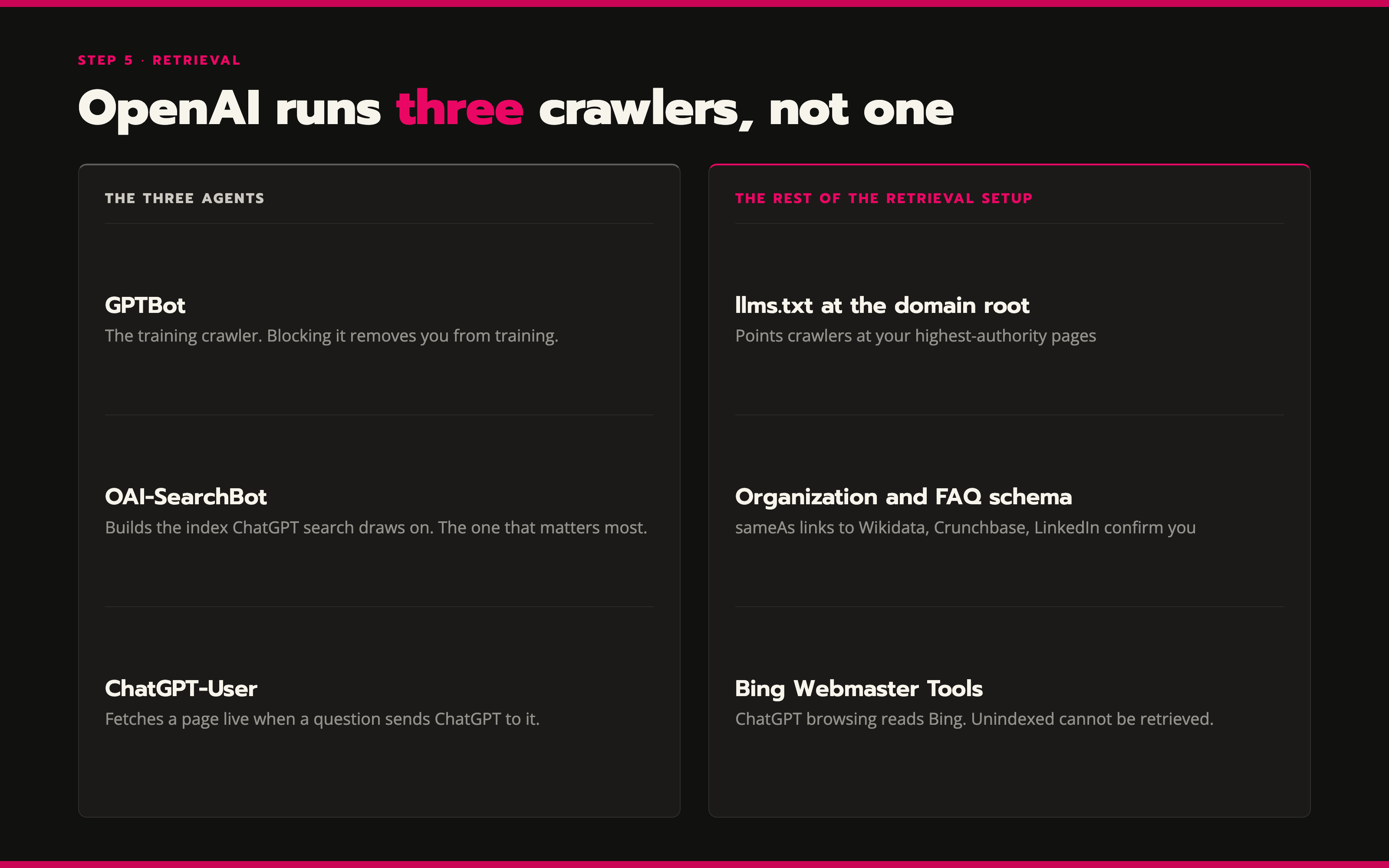
Blocking any one of them removes you from that surface specifically. If you want to be findable in ChatGPT search, OAI-SearchBot is the one that matters most.
Here's a working baseline for a WordPress site:
User-agent: *
Disallow: /wp-admin/
Allow: /wp-admin/admin-ajax.php
Disallow: /llms.txt
User-agent: GPTBot
Disallow: /wp-admin/
Allow: /llms.txt
User-agent: OAI-SearchBot
Disallow: /wp-admin/
Allow: /llms.txt
User-agent: ChatGPT-User
Disallow: /wp-admin/
Allow: /llms.txt
Sitemap: [your sitemap URL]
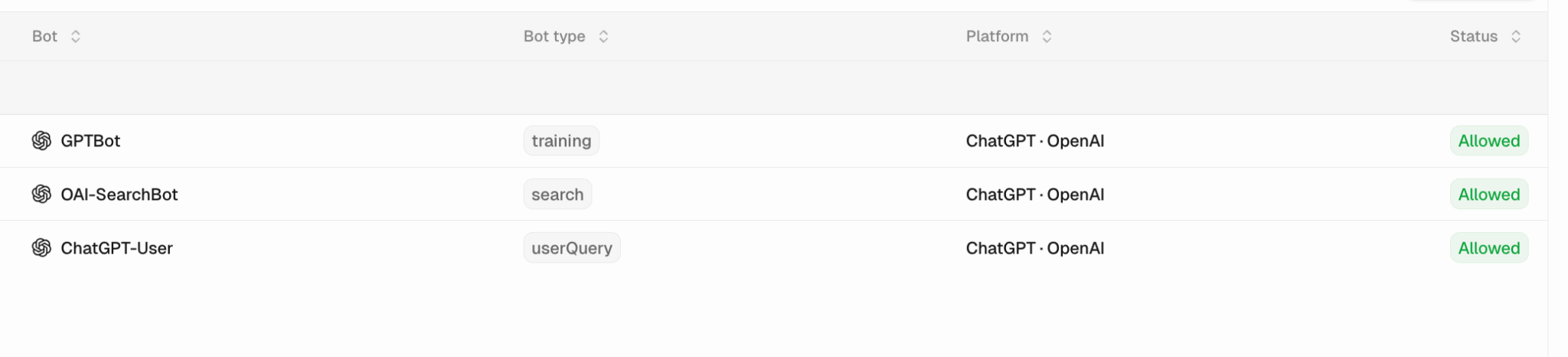
The desired state for ChatGPT is this:
Implement schema markup for your brand entity, FAQ content, and article authorship
For clarity, we don’t say that schema, FAQ and the right bylines will get you a first spot in ChatGPT. But like in SEO, all the small details and best practices implemented contribute and correlate with ChatGPT surfacing brands high.
Brand entity schema (Organization schema with sameAs links to Wikidata, Crunchbase, LinkedIn, and other trusted sources) tells LLMs who you are and confirms that multiple authoritative sources describe the same entity.
FAQ schema on question-and-answer pages makes those passages directly extractable by retrieval systems. Article and author schema establishes editorial credibility signals.
Implement these markups with LLM parsing in mind: clean, well-structured, accurate, and consistent with how you describe your brand in off-page mentions.
Submit your sitemap to Bing Webmaster Tools
ChatGPT's web browsing functionality uses Bing as its search index. Many content teams have Bing Webmaster Tools accounts they've never fully configured, or haven't submitted sitemaps to at all.
Verify your domain, submit your sitemap, and review the index coverage report. Pages not indexed by Bing won't appear in ChatGPT's live retrieval results, regardless of their Google performance. Setup takes under an hour and closes a retrieval blind spot most teams don't know exists.
Let’s move to the last step.
Step 6: Measure LLM share of voice and set your reporting cadence
Prioritize the citation rate by prompt cluster (what percentage of your high-intent prompts include your brand) and share of voice (your brand mentions relative to named competitors on the same prompt set) metrics.
Re-prompt your priority set every two to four weeks and log results against your baseline. Match the cadence to your publishing velocity: weekly publishing needs monthly measurement at minimum, a slower build phase can run on quarterly check-ins.
Take control of your ChatGPT visibility before the next exec asks
Running this sequence, baseline audit, competitive gap mapping, topical cluster build, off-page citation outreach, AI-crawler legibility check, and a repeatable measurement cadence, moves you from guessing why your brand is absent to having data that tells you exactly which lever to pull next.
If you want to get your B2B SaaS brand mentioned in commercial prompts and rank high on ChatGPT, book a free intro call with us.
Let's design a solid SEO/AEO strategy and execute it so you get ahead of your competitors.
Book a call