

Shortlisting a SaaS SEO agency is hard because what you see might not reflect how the engagement will look in practice. Most of what you're paying for happens before anything gets published, and none of it shows up in a pitch. By the time you can see whether an agency understood your product, you've usually signed for six months.
Portfolios and well-known logos, charts that show traffic going up and to the right, and a smooth discovery call show that an agency knows how to sell. None of them guarantees that it will take the time to understand your product before planning your strategy and writing for your audience.
A good SaaS SEO agency is a strategic partner that turns AI search into demos and trials across both Google and AI answers. Plenty of agencies run SEO for a SaaS company. Far fewer do it in a way that survives a long sales cycle, a technical buyer, and a product that takes more than a homepage skim to understand.
Good means understanding your SaaS go-to-market, audience, and products. It also means knowing what it takes to appear inside AI Overview, ChatGPT, or Perplexity while a buyer is still forming opinions.
This guide covers what SEO work includes and the five criteria that help you shortlist an agency. It gives you the questions to ask on a first call, how pricing determines quality, and who shouldn't hire an agency at all.
Key takeaways:
- SEO SaaS agencies should be skilled in the following areas: technical SEO health, content strategy, production, AI-answer visibility, and analytics/attribution.
- Ask what happens in the first month of the collaboration. Week four should produce a strategy, not a content calendar with generic keywords.
- A good SaaS SEO agency should know how to get brands retrieved, cited, and mentioned across ChatGPT, Perplexity, and other LLMs.
- Some don’t need to hire an agency yet, and it's worth knowing before the first call.
- Generic output is usually a budget problem. Product study costs senior hours most retainers never funded.
What a SaaS SEO agency actually does
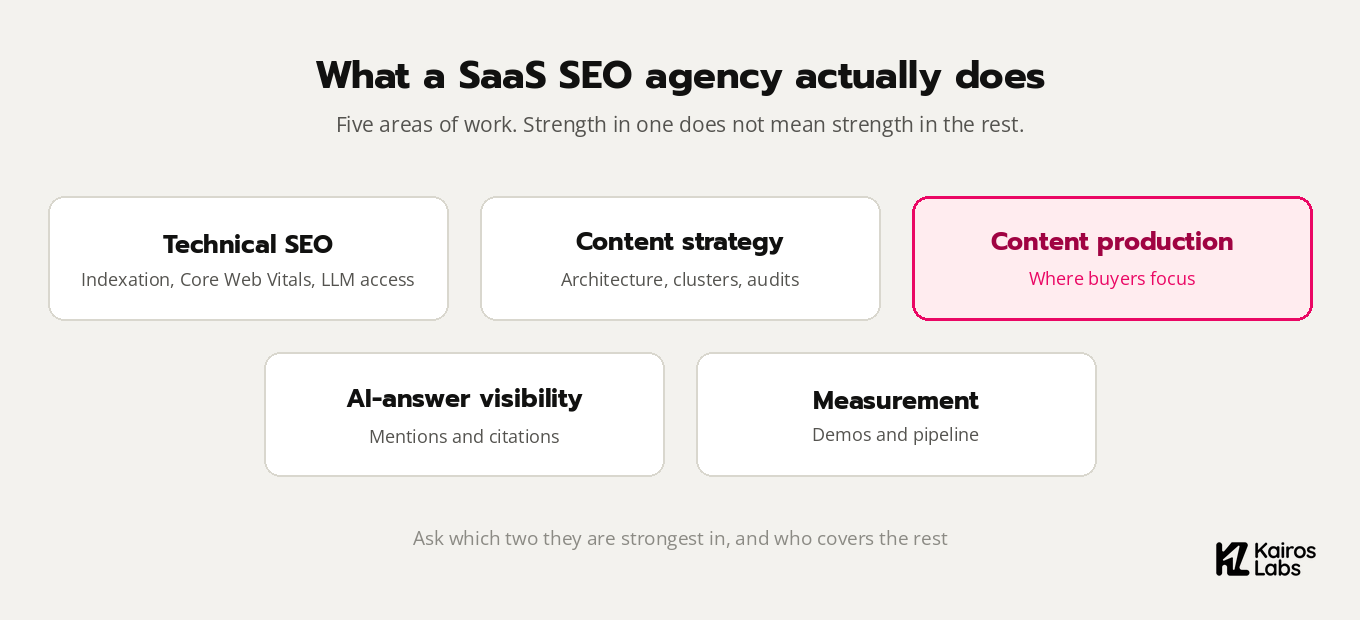
Most buyers focus on content production because that's the visible output. It's one of five areas an SEO agency should focus on. While an agency can be strong in one, it could be weak in the rest, so make sure to go through all these areas before choosing one:
- Technical SEO foundation. This covers crawl analysis, indexation, site health, Core Web Vitals, and LLM bot accessibility, to name just a handful. Think about tech SEO health as the foundation for your website. It won't show up in a content report, but it sets the ceiling on everything above it: Core Web Vitals feed into rankings directly, and a JavaScript-dependent site with indexation issues means pages that never get crawled can't rank, no matter how good the writing is.
- Content strategy. architecture and inventory. This includes SEO & AEO strategy, keyword architecture, topical clusters, identifying the window of opportunity, and an audit of what to refresh and protect. Done properly, it tells you what to publish next and in what order, which of your existing pages are competing with each other, and which ones are worth defending rather than rewriting.
- Content production. The actual content creation itself, including articles, comparison pages, product pages, and product-led content that speak to your audience, their pain points, and build trust over time.
- AI-answer visibility. Optimizing for mentions and citations inside ChatGPT, Perplexity, Claude, and Google AI Overviews, then measuring what moves, what lags, and what to do next.
- Measurement and attribution. Reporting that connects organic activity to demos and pipeline results.
An agency built around content production will hand technical findings to your engineers and consider the job done. A technical-first shop will deliver a clean crawl report and thin articles. Neither approach is necessarily wrong. It just means they’re not for companies looking for an end-to-end SEO experience.
If you’re looking for an end-to-end agency, covering all five of the above criteria is the baseline. What separates agencies that cover the full spectrum is where they start, and that shows up in onboarding.
A generalist starts with a keyword spreadsheet. A specialist starts by interviewing your Subject Matter Experts to understand what makes a lead qualified, what the product does, and where the SEO content opportunities are.
Why shortlisting a SaaS SEO agency is hard
Agencies optimize their own sites for the same SERP. "B2B SaaS SEO agency" surfaces dozens of near-identical service pages carrying the same claims: strategy and execution; we drive revenue. But not many tell you how they drive revenue, beyond the cliché “we produce bottom-funnel content.”
Also, what a service page can't show you is whether product study and analysis of your sales calls are budgeted into the engagement.
What a wrong-fit SaaS SEO agency costs you
Two quarters in, you've published a handful of pages. Your agency reports on keyword movements. Nobody has mentioned pipeline.
Rankings moved, so the program looks good on paper. What you can't answer is whether it will make more money than it costs, because there is no pipeline reporting. So you renew on faith or cut on instinct. Both are guesses.
So, in the end, you don’t know whether your investment in SEO & AEO will pay off, because there is no guarantee the agency will report on the pipeline in 6 months. As a result, your perceived value of the engagement is low.
The same gap runs the whole way down. The technical audit gets delivered, and the findings sit in a spreadsheet, but nobody on the agency side supervises it.
The strategy gets delivered, and production goes its own way, because the writers were briefed on keywords rather than on the strategy. Each deliverable is real on its own. None of them hands off to the next.
What you end up with is random acts of content rather than a direction. And because nothing connects, there's no chain to point at when someone above you asks what the investment produced.
How to spot a good SaaS SEO agency
Start with your symptoms. This tells you which criterion to focus on.
- "Our content sounds generic" points to vertical depth: nobody studied the product closely enough to write something only you could publish. You'll usually see it in the comparison and use-case pages first, where a writer without product access has to fill the space with something. The articles read fine and could have been published by any competitor.
- "We rank, but it doesn't convert" points to keyword architecture: you're ranking for queries buyers don't type when they're close to a decision. Traffic looks healthy, and demo requests don't move. The keywords were chosen on volume rather than on where they sit in an evaluation, so you're winning the audience that's still reading definitions.
- "Our pages aren't getting indexed" points to technical SEO. Nothing downstream of this matters until it's fixed. A page that never gets crawled can't rank, can't be cited, and can't be attributed to anything.
- "We aren't known in AI search", points to AEO. Formatting is usually already in place by the time someone notices, which is why another round of schema and FAQ blocks doesn't move it. What's missing is a reason for a model to name you over the twenty other sources covering the same query.
- "We can't tell whether content drives revenue" points to strategy or attribution. Two different problems that look identical from the outside. Either the content was never intended to increase pipeline, or it was, and nobody built the tracking to prove it, and you need to know which before you brief anyone.
Whichever one you recognize, the same five criteria apply. Your symptom tells you where to press hardest, not what to skip. An agency strong in exactly the area you're weakest in and thin everywhere else will fix the problem you can see and leave you with the next one. Score all five, then weight.
Start with the one that determines the other four: whether the agency understands what you actually sell.
- SaaS expertise: real case studies from companies like yours
Every agency claims to cover your vertical, but coverage only means they've written about it before. Depth means they can hold a position in it. Which vendor claims are marketing, which technical trade-offs a buyer actually weighs, and which objections surface once an evaluation gets serious? A summary of what's already published reads competently and adds nothing, and a technical buyer spots the difference inside a paragraph.
A content lead at a wire-fraud prevention company put their requirement simply: Kairos Labs team could both write and genuinely understand cybersecurity. That combination is rarer than the market implies. The strategist and writer who can hold a technical conversation is not equal to a generic writer most agencies staff on a SaaS account.
How to read the answer: listen for a named mechanism rather than an adjective. "We research thoroughly" is vague. If an agency requests recorded demos, SME interviews for specific roles, access to sales calls, and qualitative analysis with core themes identified, you know that they really want to understand your company and product to write in-depth content.
Notice who is making the request. An agency that asks you for access is planning to use it, and it usually comes with a caveat about your time: which SMEs they need, for how long, and by when. An agency that lists the same activities without asking for anything is describing a capability rather than a plan.
How to test: read something the agency published in your category and judge it the way your buyers would.
- Technical SEO capability: recommendations versus fixes
Content strategy sitting on an unrenderable site is wasted crawl budget. B2B SaaS search is far more competitive than it was a few years ago, and a site with indexation problems, JavaScript that search engines struggle to render, or content sitting behind authentication now costs you rankings you would have held on merit before.
An agency that treats technical SEO as a one-time audit handed to your engineers, with no follow-through, has left a dependency that will stall the plan
How to read the answer: agencies that only write recommendations describe categories of problems. Agencies that have shipped fixes describe a specific find, the fix, and the argument they had to make to get engineering time. The second answer is harder to fake and tells you how they'll behave when your roadmap is full.
How to test: ask what they'd do if the fix needed engineering time you couldn't get approved this quarter.
- SEO Strategy and execution: who does what
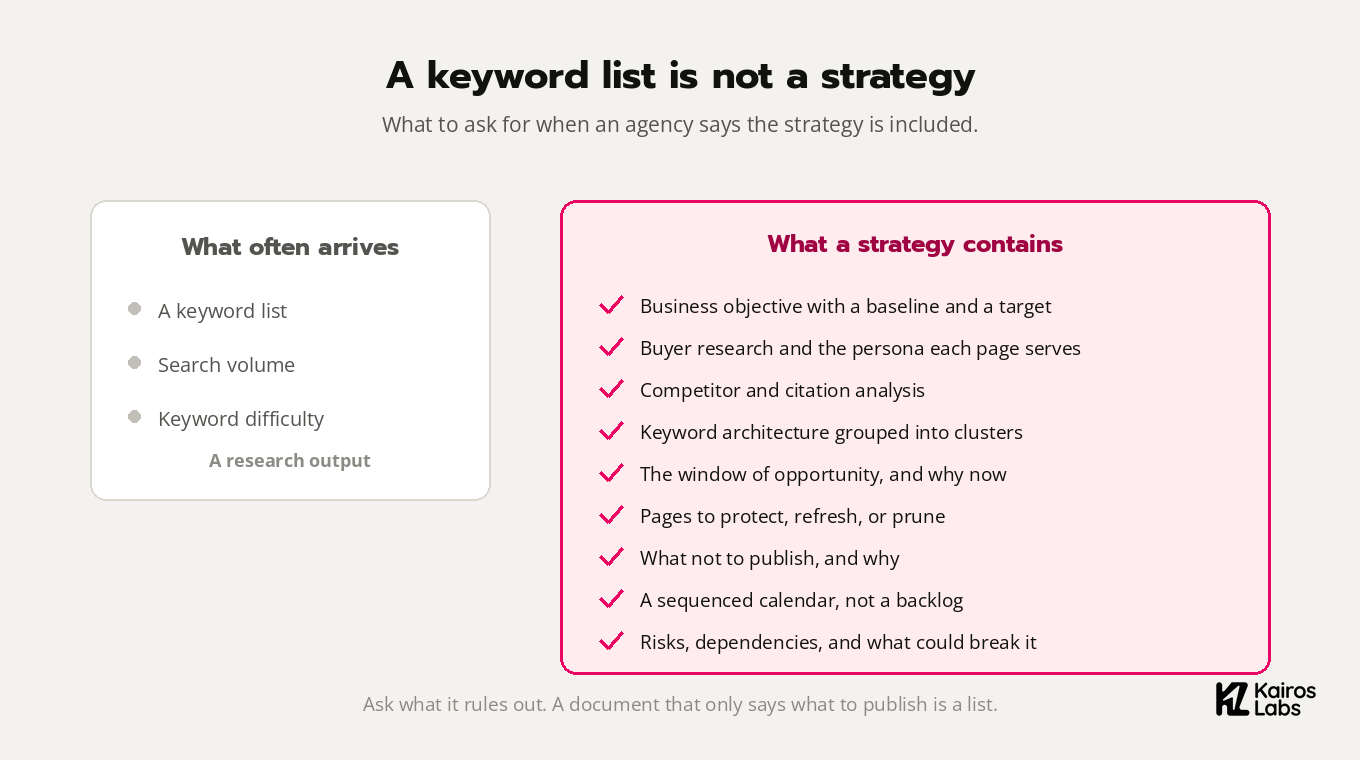
Almost every agency sells strategy and execution together. The gap is in what counts as strategy. A keyword list with search volumes is a research output, not a plan, and it gets delivered as a strategy often enough that buyers have stopped asking what the difference is.
On most calls, you're talking to a founder or a senior strategist who can speak fluently about both the strategy and the writing. That tells you nothing about who does either once you sign.
How to read the answer: vagueness about the process, or about who builds the strategy, usually means the senior person pitching won't be the one doing the work. The account goes to juniors or freelancers once the contract is signed. Ask for a strategy artifact rather than a portfolio piece. A keyword architecture or topical map shows you the thinking; a finished article shows you the writing, which you can buy anywhere.
How to test: Check who is doing the strategy and who is doing the execution on your account.
- AI-answer visibility: formatting versus information gain
AI visibility tracks closely with pipeline, which is why it belongs in this evaluation rather than a later one. A content marketer at an AI consulting firm described the connection plainly: when their visibility dropped, leads dropped almost one-for-one. It runs the other way too, which is the part worth paying for. You may not get a report connecting the two, but visibility you gain in AI answers shows up as leads whether anyone measures it or not.
An agency treating AEO as a formatting checklist is running plays you've almost certainly run already. FAQ schema, TL; DRs, snippet-shaped paragraphs. If those had worked, you wouldn't be reading a guide like this. Formatting makes content parseable. It doesn't make content worth citing.
How to read the answer: a result without a measurement design is an anecdote, and a measurement design without a result is a pitch. You want both in the same sentence, attached to an account they can name.
How to test: See if the content an agency is publishing is being cited in LLMs
Revenue attribution: ranking reports versus pipeline
Rankings are a leading indicator. What makes a choice defensible to a CMO is a line from visibility to pipeline: organic qualified lead growth, LLM-sourced leads, and deals traced to specific content and commercial pages.
Attribution in SaaS is genuinely messy, and any agency claiming otherwise is simplifying. Buyers educate themselves for months, return to your site repeatedly, then convert somewhere that takes the credit. A good agency says this out loud, then shows you how to spot correlations and results out of an SEO program that works.
How to read the answer: the useful signal is whether they volunteer the limits. An agency that names attribution limitations has thought about it. An agency that presents a clean number for a messy problem either hasn't, or is hoping you won't ask.
How to test: Ask for real business outcomes for the agency's clients.
What a SaaS SEO agency should do in the first month?
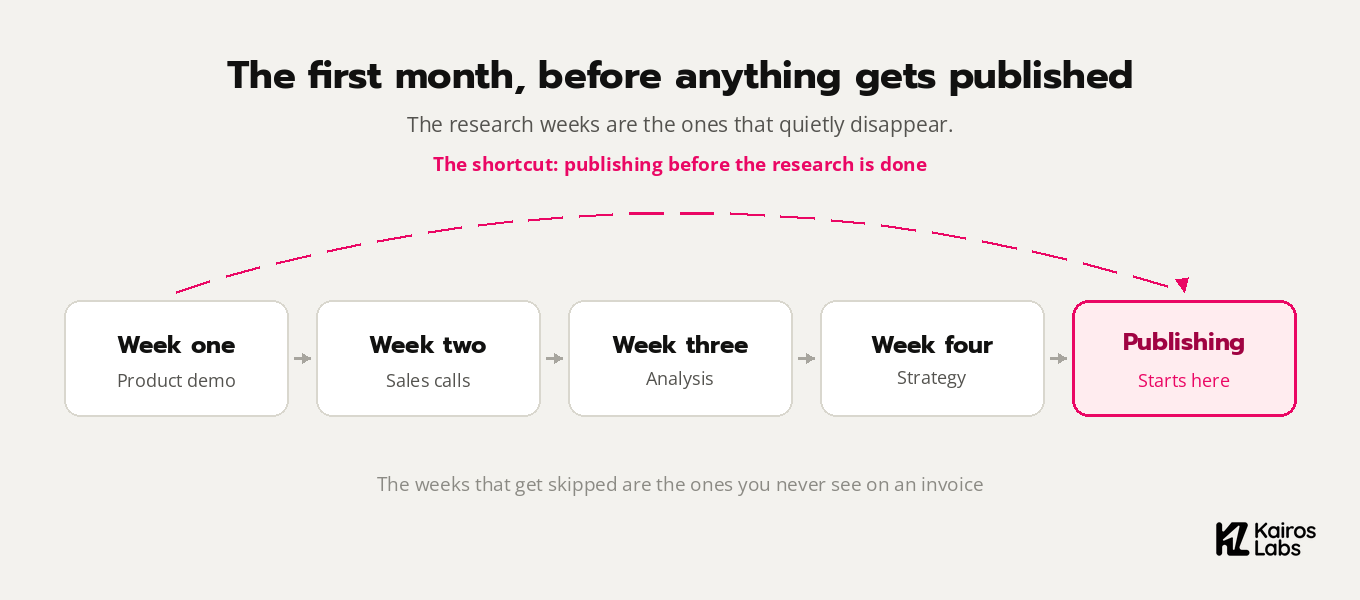
Most SEO agencies don’t take the time to understand a company’s product, sit through a demo, or listen to a sales call.
An agency that’s genuinely interested in creating great content for your business will be able to answer these four questions with a resounding ‘YES’ and show you the processes they use to prove it.
- Does your process include watching a product demo, and who on your team takes it?
- Do you analyze sales calls? How many, and at what stage?
- Do you run SME interviews? Who participates, and what do you produce from them?
- What analysis do you run on that qualitative data before writing begins?
The question about analysis is the one that separates agencies that do this from agencies that learned buyers ask about it. Listen for whether they can describe an output. Not the method, the result: what the analysis surfaced on a recent account, what it changed about the plan, and what they'd have written instead if they'd skipped it. An agency that runs this properly has an answer ready, because the findings are the most interesting part of their week.
Watching a demo is easy to claim. So is sitting in on a sales call, or pulling a few recordings from Gong. Both show up in a proposal as a line item, and an hour or two of junior time covers it, which is why almost everyone offers them.
Running thematic and discourse analysis on the transcripts, and saying what came out of it, isn't.
You'll recognize the output: your buyers' vocabulary, the objections sales fields weekly, the comparison competitors keep winning that nobody on your side has written about.
What week four should produce
An SEO & AEO strategy, not only a content calendar. It should include a keyword architecture tied to the buyer's journey, a window of opportunity, competitor analysis, a topical authority map, and an editorial calendar sequenced against that map. It should also include content-quality alignment: the guidelines and persona work that keep output sounding like the client rather than a language model.
Test it by asking what it rules out. A document that only tells you what to publish is a list. A strategy tells you what not to publish, which pages to prune, and why the second cluster waits until the first has authority.
Why most agencies skip it
Demos, sales-call listening, SME interviews, and qualitative analysis take time the retainer must fund. Most agencies price to win the account rather than to fund the work. Generic output follows, because the budget prevents anything else.
Pricing tells you what an SEO & AEO agency can afford to do
Per-article pricing ties an agency's economics to volume. Every hour spent watching a demo or analyzing a sales call is an hour not producing billable deliverables.
Low retainers create the same pressure, and product study is the first thing cut when the month gets tight. It rarely gets announced. The demo happens, the interviews get scheduled and then quietly dropped, and the first drafts arrive on time, reading like a competitor's blog. Nobody decided to skip the research. The month just ran out.
Agencies at lower price points are responding rationally to market price. But the constraint still predicts your output better than anything on their website does, so factor it into the decision.
How to test what a proposal actually buys
Give the agency your numbers. How many demos organic generated last quarter, what the target is for the next two, and then ask what they would do to close that gap.
The answer tells you more than any deck. An agency that has done this before will talk about which pages carry commercial intent, what has to be fixed before anything ranks at all, and how long the compounding takes before the number moves. One that hasn't will answer with a content volume.
Then ask for a line-item breakdown of first-month hours. Keyword research, content production, and reporting, with no line for product onboarding, SME interviews, technical work, or strategy, is the engagement as it will actually run. A proposal promising content in week one means the research is poor.
How to judge an agency's AI visibility claims
A good SaaS SEO agency should know how to get a brand retrieved, cited, and mentioned across ChatGPT, Perplexity, and AI Overviews. That work is real and repeatable. What nobody can do is promise a specific placement, because the systems are probabilistic and the same prompt returns different answers on different days.
So the claim to test is whether they can show you it worked.
What defensible measurement looks like
Track mentions, citations, and share of voice across answer surfaces over time rather than sampled once.
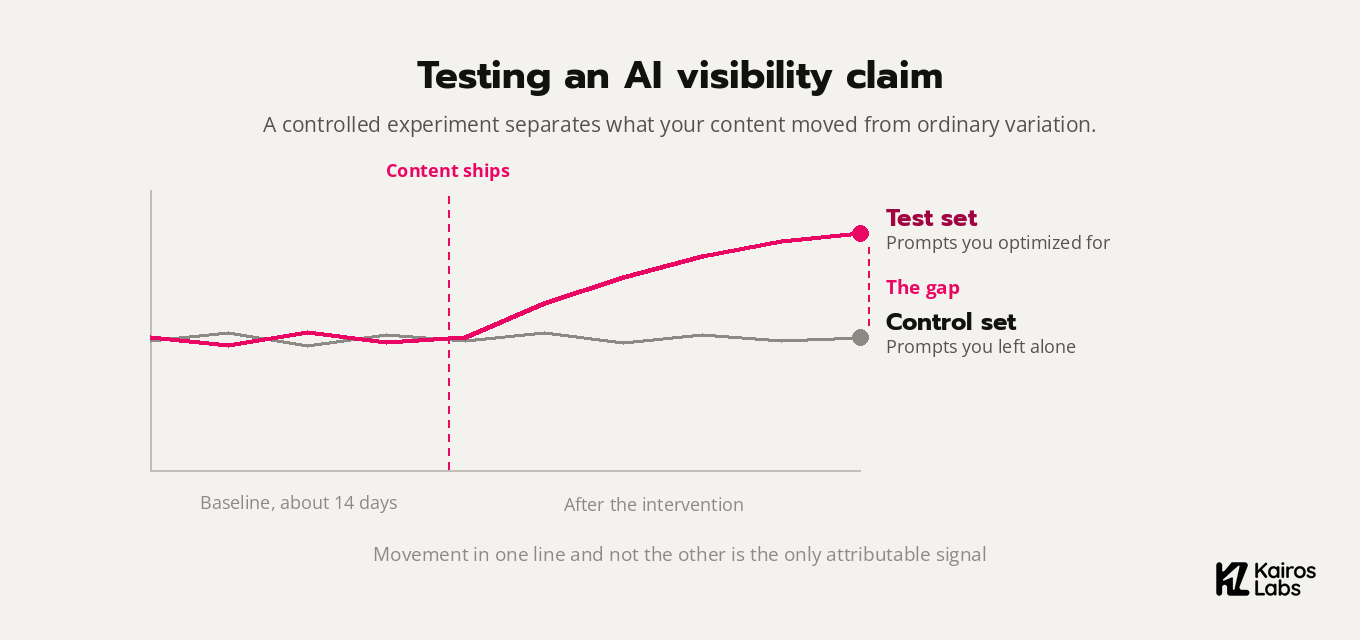
The method is a controlled experiment. Build a test set of prompts your buyers would realistically type, mapped to evaluation stages rather than keywords. Evaluation-stage prompts surface brands, and this is exactly your opportunity. A prompt like "best invoice reconciliation tool for mid-market finance teams" returns a shortlist. A prompt like "what is invoice reconciliation" returns a definition with nobody named in it. Only the first kind can put you on a list, so that's where the test set should sit.
Hold a control set you aren't optimizing against. Add both sets to your tracking and wait about 14 days before doing anything, so a baseline has time to form. One response is an anecdote, and one day is noise.
Then publish only against the test group, and leave the control group untouched. Keep running both. What you're looking for is movement in the test set that doesn't appear in the control.
Three red flags to look for in the answer:
- Guaranteed placement. Getting cited in ChatGPT is a real outcome to work toward. Guaranteeing it is not, because the agency doesn't control the model. An agency selling certainty here has already answered your vetting question.
- A dashboard built on prompt volume. Hundreds of untargeted prompts produce a percentage that moves for reasons nobody can isolate. Ask how the prompts were selected, and how results are separated from ordinary variation.
- A published framework offered as proof. Several agencies now market multi-step AEO methodologies as a point of differentiation. A framework shows they have a point of view, but whether it worked is a separate question. Ask what it produced for a real customer.
Who shouldn't hire a SaaS SEO agency at all
Pre-PMF (Product Market Fit) companies. SEO and AEO compound against a stable ICP. Before product-market fit, the ICP shifts faster than content strategy can track, and the engagement optimizes for a buyer you stop selling to.
Teams without an in-house content owner. An agency is a partner, not a replacement. Briefing, review, and approval need someone internal who owns the function. Without that person, cycles stretch and quality drifts.
If the real driver is avoiding a full-time hire, you're asking a capacity question, not a fit one. Most people compare the retainer to a salary and stop there, when the useful comparison is what hiring an SEO agency vs in-house buys you over a year.
The questions to ask a SaaS SEO agency
Bring this to the call. Score every agency on the same criteria before comparing proposals, and keep the notes. When someone above you asks why you picked who you picked, the notes are the answer.
Vertical depth
- What verticals do you work in, and how do you build subject-matter fluency before writing?
- Can you point me to something you've published in my category?
Product depth
- What happens in weeks one through four, before any article is written?
- Does your process include watching a product demo, and who takes it?
- Do you join sales calls and run SME interviews? With whom, and at what stage?
- What analysis do you run on the qualitative data, and what came out of it last time?
Technical capability
- Who runs SEO technical work on your team?
- What did you find and fix on your last SaaS engagement?
- What happens if a fix needs engineering time we can't get prioritized?
Strategy and execution
- Who creates the SEO & AEO strategy, and who writes the content?
- Have those people worked the same live account?
- What does that strategy tell a client not to publish?
AI-answer visibility
- What moved on a named account, and how do you know?
- What's the measurement design, and what's the control?
- What won't you promise, and why?
Pricing and attribution
- How are hours allocated in the first month, and is product study a line item?
- What pipeline metric are you pointing to on your most recent SaaS engagement?
- What does that attribution methodology miss?
The agencies worth your time will answer these directly. At Kairos Labs, every question on that list is one we answer the same way on a first call. Our strategy sprint includes four weeks of research before a word is written: product demos, sales call analysis, SME interviews, and the strategy document that includes our findings.
With Kairos Labs, CertifID grew their non-branded organic clicks by 247%, driving over $1M in ARR from organic and AI search over 17 months.
If you're looking for your next SEO & AEO strategic partner, book 30 minutes with Kairos Labs.
Let's design a solid SEO/AEO strategy and execute it so you get ahead of your competitors.
Book a call