You’re probably looking for an SEO company because your product pages aren’t ranking on the SERP, or because your blog is attracting visitors who don’t become qualified leads. It could even be because your team knows what buyers ask but doesn’t have the time to turn those answers into useful pages.
Choosing an SEO company is hard because we are a dime a dozen. And these agency sites are filled with traffic graphs, client logos, and promises about visibility in traditional search and large language models (LLMs).
Those signals can help you build a shortlist, but they rarely show who did the work, whether it reached prospective customers, or how much work your team has to do. For a B2B SaaS company that’s past $10M ARR, you need evidence that the agency’s work reached qualified buyers. Here is how to check what you can before making contact, then test the remaining claims before signing.
Key takeaways
- Start with evidence you can inspect: relevant work in your industry, a clear process, public pricing or an explanation of how they price their services, and an AI policy.
- On an intro call, ask them to walk you through a project from research through to publication. Ask what changed in qualified leads and sales opportunities.
- Treat AI as two separate questions: how the agency uses it in their process, and how it measures your visibility in AI-generated answers.
- Compare what each agency will deliver, the work your team must do, and the total cost and terms.
How to build a shortlist of SEO companies in ten minutes per agency
Start with each agency’s website and founder’s LinkedIn. Use the four checks below to build a shortlist, then ask about any missing details in one short email.
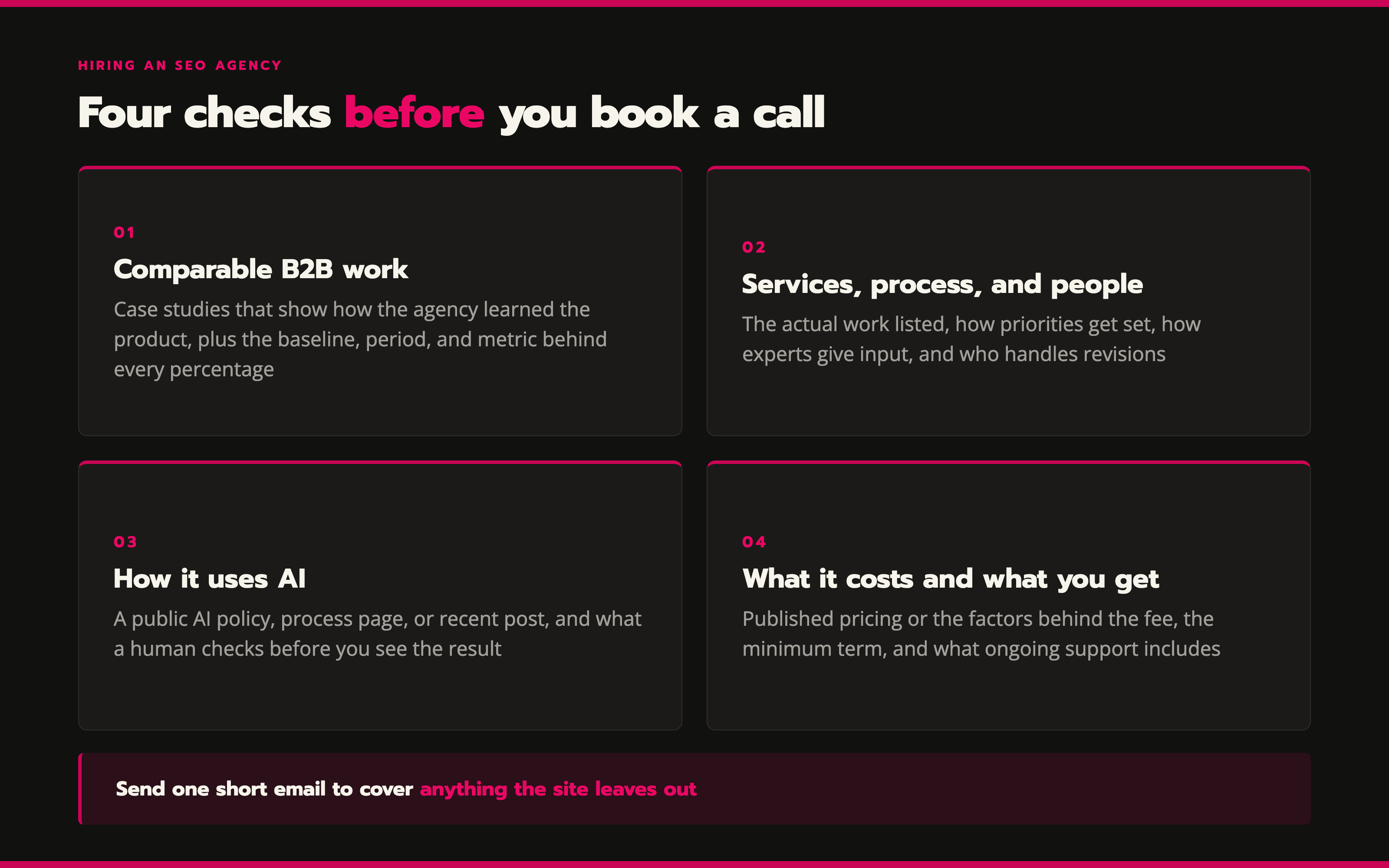
1. Has it worked on a comparable B2B problem?
Every agency has logos on their landing pages for brand affinity's sake. Look past those logos and go to their case study pages to see who they have helped, how, and decide whether their client’s use case applies to yours. This is because you need to know if they have experience solving the kind of complaints you have.
To know this, check the case studies. Does the agency describe how it learns a client's product and talks to subject-matter experts? Can you find content that explains a difficult buying decision accurately?
If a case study reports a percentage increase, look for the baseline, period, and metric. A rise in all organic traffic is different from a rise in visits to pages for prospective buyers.
For example, our work with CertifID includes interviews with their team, our content plan, the audits we conducted, and the relevant money pages we created.
We separated reports into growth in non-branded organic clicks, and pipeline.
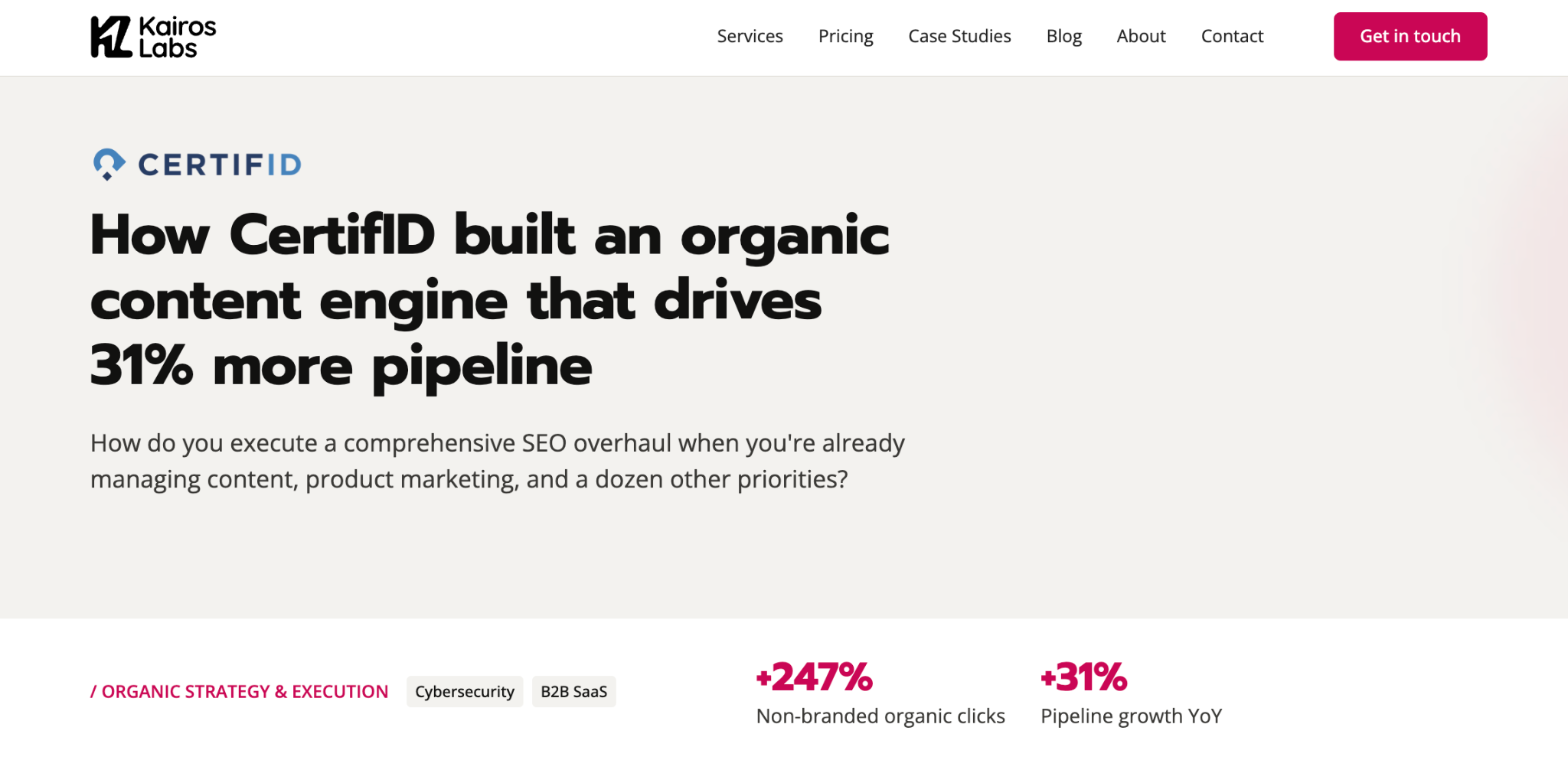
Both are measured on a year-over-year basis so readers understand what data they’re looking at. This way, you get a glimpse of what we did, how we did it, and whether the client saw measurable results that changed things for them.
2. Can you see the services, process, and people?
“Full-service SEO” tells you little about who will fix a page that isn’t indexed or who will interview your product experts.
Look for a description of the actual work: technical investigation, strategy, content research, writing, editing, publication, links or digital PR, and reporting. Note what is missing. If you need an agency to make changes in your CMS, an audit alone won’t solve your problem.
Look for how the agency chooses priorities, gets expert input, and handles revisions. And when you eventually shortlist them and get on a call, ask for those who will be dedicated to your account so you can know if you’ll get the outcome you want based on what you already found.
If the site gives you only an article count and a dashboard screenshot, keep looking. Four articles based on buyer interviews and product reviews are a different purchase from four generic drafts your team must rewrite.
3. Does it say how it uses AI?
Look for a public AI policy, a process page, or a recent LinkedIn post from the agency's leadership. If none exists, don’t try to infer a policy from silence. Ask how AI enters the work and what a human checks before you see the result.
For example, our agency Kairos Labs and Jo, who’s a founder is very open about using AI-first content workflows, operated by senior marketers, to create content that performs.
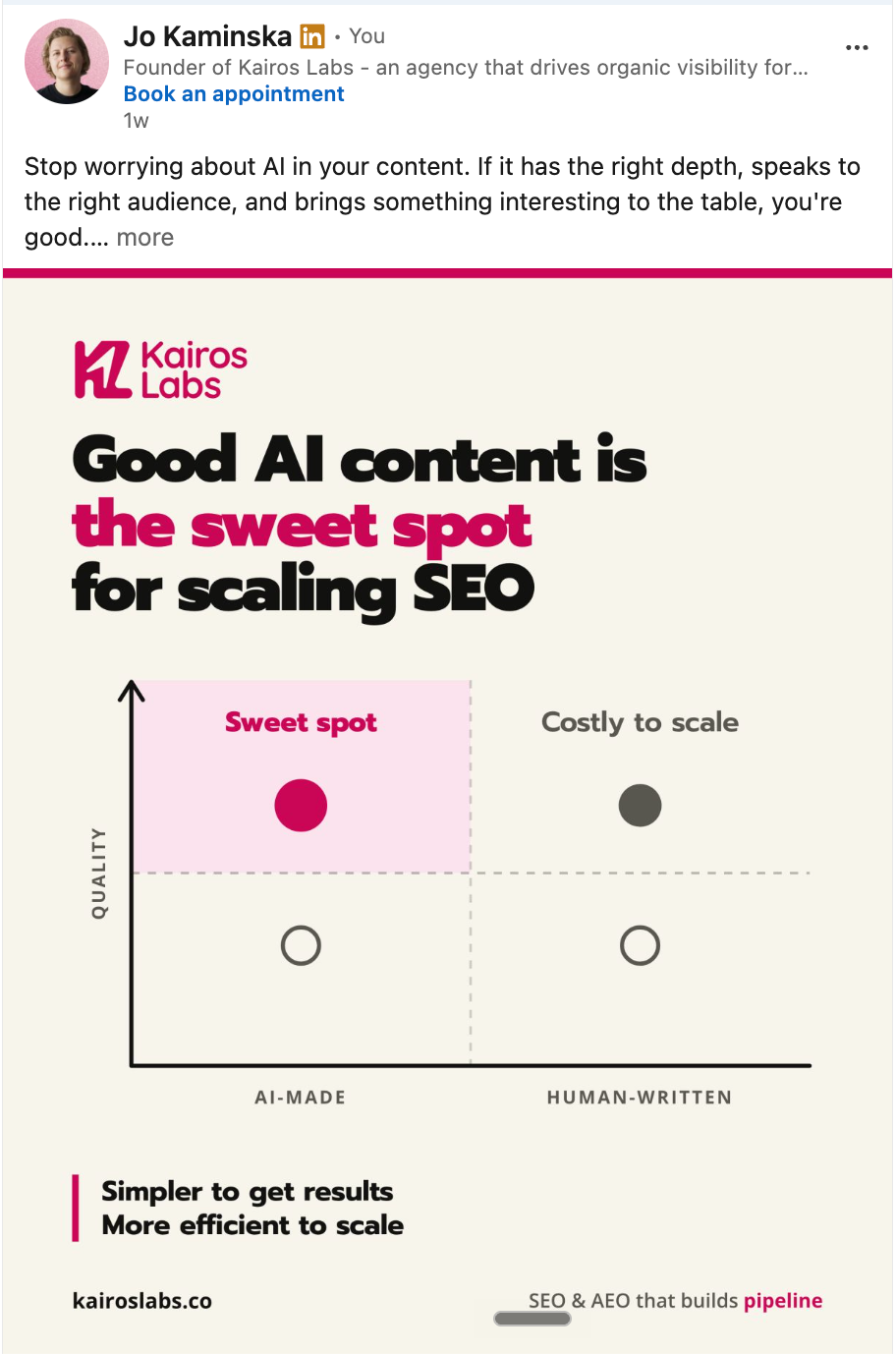
The company also has a 3-step fact checking process built into their AI workflows to create SEO articles and landing pages that are accurate.
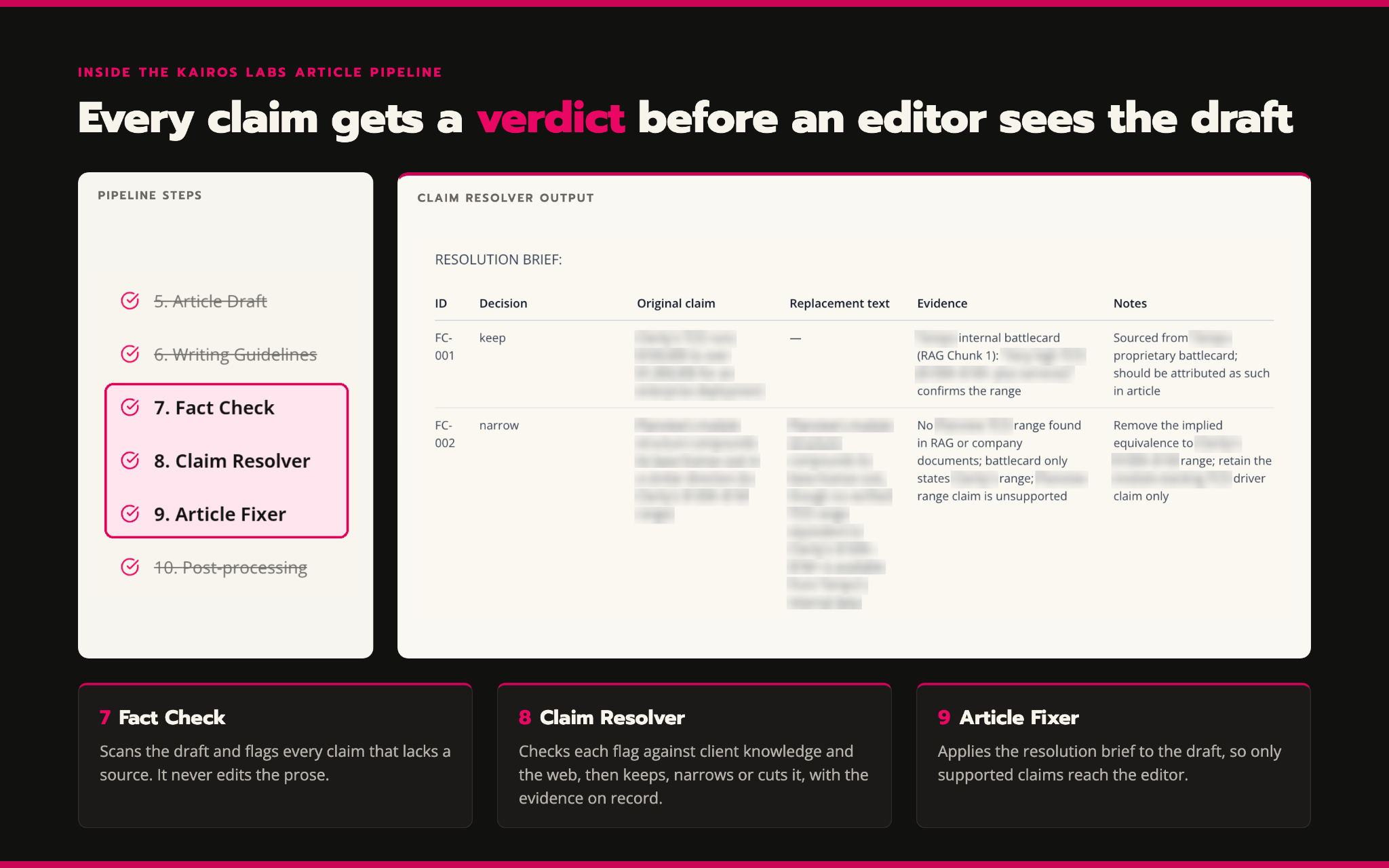
For a technical B2B product, the final test is simple: can the agency reliably explain how your product works without having to correct how a feature is explained?
You can also ask them which client documents or recordings are entered into third-party AI tools, who can access them, and whether the agency can comply with your restrictions. It need not publish its tool stack, but it should state its safeguards and editorial responsibility.
This is separate from AI-search visibility and how to rank in ChatGPT. You still need to scan its service page or recent posts to see what it measures, what changes, and how the agency measures those changes.
If that’s unclear, ask for it during an intro. All you need is that they understand AI search and visibility and can offer genuine help to get you visible.
4. Can you tell what it costs and what you get?
Published pricing helps you rule agencies in or out before a call because you’re able to decide whether it’s within your budget or not.
A custom quote is reasonable when scope varies, but the agency should explain what determines the fee: initial strategy, content volume, technical work, implementation, reporting, and any separate expenses. Look for a minimum term and what is included in ongoing support.
Our pricing page, for example, lists:
- Pipeline Strategy Sprint: four weeks, starting at $9,500.
- Momentum execution plan: starting at $6,500 per month.
These are starting prices for specific offers, not a quote for your company or an industry benchmark. The page also shows what each service includes.
Before contacting any agency, take stock of what you’ll need them to do, the realistic budget, and the expert or developer time you can provide. This is enough context to see whether its proposal addresses your problem.
Once you shortlist a few agencies from your numerous searches, book an intro call.
Use the shortlist call to test the claims
Once two or three agencies pass the quick check via their website, book a call to talk about what you need. On the call, questions can include:
1. “Show us one project from the work to the result”
Ask the team to walk through one comparable engagement. What did they find first? Which pages or technical changes did they deliver? What changed in search performance, and what evidence connects that change to qualified inquiries or opportunities? What else was happening in the client's business at the time?
A public traffic chart is a starting point. It cannot confirm leads or revenue. However, on calls like this, you need to listen for precision. “We grew traffic 200%” could mean 100 visits became 300, or that high-volume informational pages grew while demo requests stayed flat.
A credible explanation distinguishes what the agency delivered, what its report shows, and what it cannot confidently attribute.
2. “What would you investigate first on our site?”
A one-page discussion is enough to test how the team thinks. Share one product page and the problem behind your search. Ask what the agency would check before recommending more content or a technical rebuild.
Be careful not to turn this into a consulting call because all you need is an assurance that they’re a good fit for you.
If the page gets visits but no suitable inquiries, a useful answer may examine visitors, the questions the page answers, and whether its call to action matches the buyer's stage. If the page isn’t optimized in the SERP, a SaaS agency may start with indexing and site structure.
The goal here is to know if they have a generic answer (or content package) that may not be the solution to the issues you have. The more specific and nuanced their response, the better your odds that you found a good agency to partner with.
3. “How will we know whether this is working?”
Agree on a small set of results that match your sales process. This can be
- Search impressions or impression-weighted rankings
- Top rankings positions for money pages
- Brand visibility across LLMs
It can also include qualified inquiries and sales-accepted leads (which shows that your audience is closer to the one you want).
When it comes to opportunities and closed revenue this is more of a sales role so your agency shouldn’t be held responsible for commercial outcomes that are outside of their control.
You can also ask the agency how it distinguishes leads sourced by organic search from deals that organic content merely influenced. The same opportunity can qualify for both reports; adding those totals would count it twice.
Ask what makes an opportunity count as “sourced” or “influenced” by SEO, and which website and CRM records support each label. If those records aren’t linked yet, agree who will set up the tracking and what you can report until they are.
For AI answers, ask for typical queries they would run, platforms to keep an eye on, and other details behind any visibility percentage. Separate prompts containing your brand name from questions where a buyer is discovering options.
You should also keep mentions apart from links to your pages, and ask what the agency will change in response to what it finds. AI answers vary; a single appearance doesn’t establish a lasting gain or a new deal, so the agency must consistently track your “visibility” using a set of relevant, varied buyer queries.
4. “Who does what, and what does the fee cover?”
Confirm who will interview experts, write and edit pages, publish them, make technical changes, and review the reports. Your team may need to approve claims and provide product access. That is normal.
But you need to know what they’ll be responsible for. This can include setup fees, third-party expenses, the notice period, and the status of unfinished work. The contract should say which paid-for content, strategy files, and reporting exports you receive when the engagement ends.
Choose the agency you can hold to a clear plan
After the calls, put the answers next to your original problem. A useful comparison needs only four questions:
- Can this team solve our problem? Comparable work, a sensible first investigation, and the right people available
- Can we trust the evidence? Specific deliverables, defined metrics, honest limits, and a reference or anonymized walkthrough
- Can the work get done here? Named owners on both sides, realistic expert and developer time, and a publishing process
- Can we afford and control the engagement? Full scope and price, review points, clear contract terms, and access to our own assets
Don’t let a strong answer in an optional area compensate for a missing capability you need. A content portfolio cannot clear a technical backlog if neither team can implement fixes. An AI visibility dashboard cannot also compensate for inaccurate product pages, so that has to be fixed before “tracking visibility.”
If the critical uncertainty is delivery quality, a paid diagnostic or small-scoped project can test it. Agree on the output and review standard first.
You can even start with a short project to see how the team researches, writes, and responds to feedback; it cannot prove long-term pipeline returns.
At Kairos Labs, we work with B2B SaaS between $10M-$400M ARR on SEO and AEO strategy, content execution, and measurement. Our strategy work uses audience and competitor research, subject-matter expert input, and your deal economics to put an estimated pipeline opportunity next to a plan. That estimate is a decision aid; if your existing strategy is sound, you can discuss execution directly rather than assume you need a new sprint.
Let's design a solid SEO/AEO strategy and execute it so you get ahead of your competitors.
Book a call