If you lead content at an enterprise software company, hiring an agency should give your team more room to work. But that only happens when the agency understands your product well enough to write drafts your experts can review without having to rewrite them.
Most agencies offer a similar mix of strategy, content, and SEO. The useful differences become clearer when you look at how they learn your product, what they deliver, and how much work remains with your team.
We reviewed ten content marketing agencies for enterprise software to help you compare their specializations, services, delivery processes, and pricing.
Key takeaways
- The right enterprise content agency should understand what you sell well enough that your team can review drafts instead of rewriting them
- Kairos Labs is the right fit for enterprise software companies: it works from your product knowledge and business priorities, connecting the content your team needs with results it can measure
- Many agencies offer similar services. The difference lies in how well their process supports your team, from the first brief to final approval
How we evaluated these agencies
We reviewed each agency's website, service pages, and context from their blogs and LinkedIn, and held Kairos Labs to the same standard.
We asked five questions.
- Does the agency interview your product experts or attend demos before it writes?
- What product research and editorial checks does the agency describe before sending drafts to your reviewers?
- Does the agency write the content, or hand briefs back to your team?
- Does the agency work on how your brand appears in ChatGPT, Google AI Mode, and AI Overviews?
- Does the agency report demo requests and qualified leads, or only traffic and rankings?
The best content marketing agencies for enterprise software
1. Kairos Labs - a solid option for enterprise SaaS
Kairos Labs is an SEO and AEO agency for B2B SaaS companies between $10M-$400M ARR. We build content around your product, the questions buyers ask before choosing it, and the business priorities your team needs to support. We measure progress through sign-ups, demo requests, qualified leads, and the revenue connected to that work.
Our approach brings traditional search and AI search together. SEO helps buyers find your pages on Google, while AEO helps your content become a source for answers in ChatGPT, Perplexity, and Google’s AI Overviews. The aim is to make your product easier to discover and understand wherever buyers research their options.
How Kairos Labs works
We watch product demos, listen to sales calls, and interview your subject matter experts before writing. We capture the problems buyers describe, the objections they raise, and the details that explain how your product addresses them. That material becomes a client knowledge base that informs every brief, walkthrough, and screenshot.
For AI search, we track whether answers retrieve your content, cite it, or mention your brand. We test buyer prompts alongside a control set over a fixed period to help distinguish changes associated with our work from broader changes in the AI platforms.
Our reporting connects search activity with your CRM. We bring together organic search, AI assistant visits, and direct visits that buyers attribute to search, then examine the leads and deals associated with those channels. You work directly with the strategist responsible for the work, and we deliberately keep our client roster small.
CertifID, a real estate wire-fraud prevention platform, saw qualified leads grow 31% year over year during our engagement. Our case study also connects those leads with closed deals, reflecting the business outcomes we aim to measure.
Pros
- Strategy before content: The four-week Strategy Sprint maps keywords, topic clusters, and buyer prompts, and estimates the opportunity before you commit to ongoing execution
- A plan built around your priorities: Interviews with your team establish which products and messages matter most, so the editorial calendar reflects what the business needs to grow
- One team from plan to publish: Strategists, writers, a managing editor, and a technical SEO specialist coordinate the work, reducing the separate briefs and vendor handoffs your team manages
- Editorial review before your review: A managing editor checks drafts for inaccurate product descriptions and AI writing patterns before your experts review them
- Reporting handled for you: We set up tracking during the sprint and run the reports, so nobody on your team builds dashboards
Cons
- Not a good fit if your SaaS is below $10M ARR and you have a small product that's has limited Serviceable Addressable Market
- Not a good fit if you need a big marketing agency that does paid ads, LinkedIn ghostwriting, Reddit, YouTube and more under one roof
Pricing
- Strategy Sprint: from $9,500, one-time. Four weeks of SME interviews, keyword and AI-prompt research, topic clusters, and a three-month editorial calendar
- Custom pricing for enterprise software companies, depending on needs and complexity
2. Notebook Agency
Notebook Agency is an SEO and AI search agency focused on whether AI assistants recommend your product when buyers ask which tools to choose.
Its Trust Alignment Framework™ helps validate your product's capabilities, differentiators, pricing, and other relevant details, providing full context on your product and ideal customers to address common dealbreakers. Notebook Agency then questions all AI platforms, flags where their answers contradict your record, and updates your content to close the gaps.
When third-party pages misrepresent your product, it provides your team with guidance to correct them and helps distribute verified information across the web. It then continuously monitors the results and assigns a proprietary Trust Score™ to them.
Pros
- Helps to increase AI recommendations: The Trust Alignment Framework checks how LLMs describe your product against a record you've validated, then creates a strategy to fix the gaps
- Content informed by product details: The framework uses client-validated capabilities, differentiators, and buyer requirements to guide updates to your owned content
- Offers technical SEO, strategy, link building, digital PR and reporting
- Reported revenue impact: The team reports over $200 million in client revenue, naming Purple Mattress, Cirque du Soleil, Mejuri, and FreshBooks
Cons
- Limited framework availability: The Trust Alignment Framework page lists a waitlist, so confirm onboarding availability before planning your engagement
- Custom pricing, so you can’t budget until you talk to the team
Pricing
- Custom pricing
3. Campfire Labs
Campfire Labs uses original research, data journalism, earned media coverage, and long-form articles based on SME interviews to build your brand’s credibility. It has a team of senior strategists, ex-journalists, data specialists, and creatives.
Campfire provides fewer pieces per month (two, four, or six). Their focus is on conducting in-depth research, writing and designing reports, and building them to keep earning attention long after publication. Its earned media work also aims to build relationships with journalists over time, creating long-term opportunities for you with reporters.
Pros
- Distribution included: Every tier covers your blog, newsletter, and social channels, helping your team reuse research-heavy content without managing distribution separately
- Clear pricing so you can compare other agencies before you choose
- Original research: Separately priced research packages give your campaigns original findings, reducing reliance on the same third-party statistics competitors use
- SME interviews in every tier: Even the entry plan includes expert input, so product knowledge doesn’t depend on upgrading
Cons
- Low volume ceiling: The highest tier covers six pieces monthly, so you’ll need to discuss additional scope and cost for larger content calendars
- Three-month minimum: You commit to at least three months, so you can’t start with a single paid month to assess the service
Pricing
- 2 pieces a month: $5,000
- 4 pieces a month: $9,000
- 6 pieces a month: $15,000
4. Optimist
Optimist is an SEO and AEO agency for B2B SaaS and technology companies with over 10 years of experience. You can hire Optimist for consulting and advisory; confirm the execution scope before you sign.
Every engagement includes strategy, planning, briefs, implementation specs, and reporting. Optimist describes its production as "human-led, AI-assisted," with human editorial review and client approval before publication.
Pros
- Flexible monthly scope: Projects can shift with business priorities, letting your team redirect effort toward new content, technical fixes, or page updates
- No long contract: Monthly billing limits your commitment if priorities change, though you still need realistic milestones for work that takes longer
- Founder-led strategy: Tyler Hakes leads planning and prioritization, giving your team a named strategist to explain decisions across competing content and search needs
- Weekly AI visibility tracking: A custom dashboard tracks ChatGPT, Perplexity, Gemini, and Google AI Overviews, giving your team recurring evidence alongside search performance
Cons
- Internal implementation workload: The FAQ says your team handles implementation, so the engagement may not remove the execution work you want to outsource
- Briefs count as deliverables: The $5,000 example includes research and plans, so eight projects doesn’t mean eight finished articles
- AI-assisted production: Human review accompanies AI throughout production, so teams requiring human-written first drafts must resolve that requirement before signing
Pricing
- SEO consulting starts at $3,000 a month, billed month to month
- A $5,000 monthly engagement example includes up to eight projects, such as briefs, research, and implementation plans
- Content production uses custom pricing; confirm how much finished content the proposal includes
5. ércule
ércule combines technical content production with the systems that keep a content program moving. Its agency services explicitly cover established companies targeting enterprise buyers, and its writers handle technical documentation, product marketing, and blog content. The team learns your product before writing, so technical accuracy is part of their focus.
Its content systems work starts with the delays and quality problems in your existing process. ércule then helps define what gets written, who owns it, and how it reaches readers. The service combines reusable templates, editorial workflows, distribution, and measurement with SEO and GEO, helping a Head of Content with the work from briefing an article to proving its contribution.
Pros
- Help with publishing bottlenecks: ércule addresses ownership, templates, and production workflows, helping approved ideas move between teams instead of stalling
- Distribution beyond search: Owned channels, communities, and email help your team reach readers when useful technical content attracts little search demand
- Reusable editorial foundations: Templates and clear ownership help your team maintain a repeatable production process as more people contribute
Cons
- Custom agency pricing: Published app prices don’t cover agency services, so you need a separate proposal to establish your content budget
- Workflow changes need participation: Its content-systems service addresses team alignment and editorial ownership, so that engagement requires involvement beyond reviewing finished drafts
Pricing
- Custom pricing
6. Isoline Communications
Isoline Communications is a content marketing agency for technical B2B markets, including enterprise SaaS, cloud platforms, and telecoms. It writes for audiences ranging from network engineers to CFOs, which matters when the same software purchase needs both technical approval and a business case. Its software practice works with client teams to understand the product and market before shaping the content.
The work spans whitepapers, research reports, blogs, infographics, and videos, as well as sales enablement materials such as pitch decks, one-pagers, and battle cards. That gives your team a way to carry the same product explanation from an early research question into a sales conversation, instead of commissioning each asset without considering what the buyer needs next.
Pros
- Technical and commercial audiences: Isoline writes for engineers and financial decision-makers, helping your team address both implementation questions and budget approval
- Support for sales conversations: Pitch decks, one-pagers, and battle cards carry your product explanation from articles and reports into buyer evaluation
- Several technical formats: Reports, infographics, and video let your team choose how to explain a topic without defaulting to blog posts
Cons
- No published content packages: Its service pages don’t specify prices or monthly asset counts, so budget and output require a tailored proposal
Pricing
- Custom pricing
7. Content Visit
Content Visit specializes in cybersecurity content for vendors, including established companies with lean marketing teams. Its services connect technical content with the rest of a go-to-market campaign.
The team turns interviews, data, and original research into blogs, whitepapers, reports, and email content. It also creates landing pages, lead magnets, and nurture streams around your product and funnel, so a detailed security explanation can support both organic discovery and follow-up with interested buyers.
Pros
- Cybersecurity specialization: SME interviews and market research give your experts a defined role in shaping explanations, reducing reliance on generic briefs
- Content beyond acquisition: Landing pages, lead magnets, and nurture emails provide follow-up around articles and reports, giving interested buyers a next step
- Research supports several assets: Interviews, data, and original research become blogs, reports, and emails, letting your team reuse expert input across campaigns
Cons
- Cybersecurity focus: Its current services target security vendors, making its specialist approach less directly relevant to enterprise software companies outside cybersecurity
- Expert input required: Discovery includes one to two hours of your team’s time and SME interviews, so technical experts still need availability
- Custom pricing: The service page publishes neither fees nor monthly asset counts, so you can’t establish budget and output before discussing scope
Pricing
- Custom pricing
8. Flying Cat
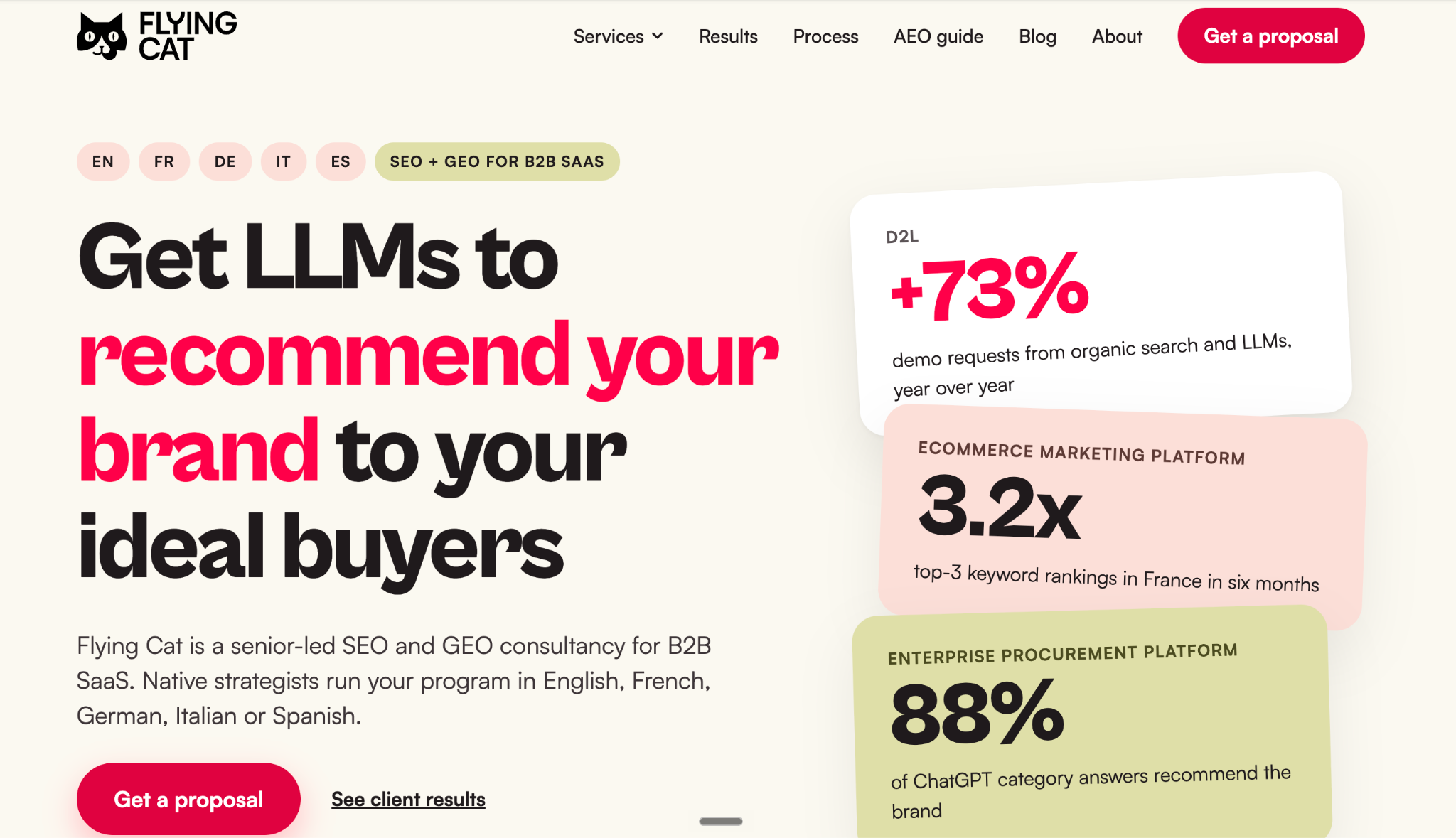
Flying Cat produces SEO and GEO content for B2B SaaS companies. They work with enterprise software providers such as D2L and Ivalua, and their writers receive briefs built from sales calls, product documentation, buyer questions, and the claims each piece needs to support. A strategist decides what the page needs to do before a sector-experienced writer creates the draft.
They also have a senior editor who reviews each piece based on your style guide to make it publish-ready. Flying Cat uses AI for research and analysis and describes its published writing as human-written. It also separates light refreshes from structural edits and full rebuilds, so an existing library doesn’t have to be treated as a batch of entirely new articles.
Pros
- Visible production progress: A tracker shows each piece’s stage, owner, and status, helping your content lead coordinate reviewers without requesting separate updates
- Refreshes alongside new pages: Light updates, structural edits, and full rebuilds let your team commission only the changes an existing page needs
- Design within the workflow: Graphics, tables, and wireframes can accompany content, reducing the need to brief your internal designer separately
Cons
- Retainer required: The $950 starting price applies within a retainer, so it isn’t a standalone article purchase at that price
- Human-written content: Flying Cat excludes teams seeking high-volume AI-written articles, so its service won’t meet a brief built around scaled production
- Variable monthly cost: Article volume, markets, languages, and writing responsibilities affect the retainer, so the starting unit price can’t establish your total budget
Pricing
- Content starts at $950 per article or page as part of a retainer. This isn’t a monthly package price; the total depends on volume, markets, languages, and who writes
9. Draft.dev
Draft.dev creates technical content for companies selling to developers. Its client list includes Cloudflare, JetBrains, and Auth0, and its formats go beyond general blog posts to tutorials, demo apps, and code samples. That makes it relevant when a developer evaluating your platform needs to see how something works before recommending it internally.
The team researches your product features, positioning, audience, and existing content funnel before building the content plan. Draft.dev uses AI in research and drafting, then puts every piece through developer review and technical editing. It also offers CMS publishing and distribution, so the engagement can cover getting the finished work in front of readers as well as producing it.
Pros
- Practical technical formats: Tutorials, code samples, and demo apps help developers evaluate implementation before recommending your platform to colleagues
- Developer review: Technical checks happen before your engineers review drafts, letting them focus on product behavior and claims rather than basic technical editing
- Publishing support beyond drafts: CMS publishing and distribution can be included, reducing the uploading and promotion work returning to your content lead
Cons
- Three-month initial commitment: The $9,000 monthly starting price means committing at least $27,000 before completing an initial test of delivery and technical accuracy
- AI contributes to drafts: Research and drafting use AI before technical review, so teams requiring human-written first drafts must clarify that requirement
Pricing
- Plans start at $9,000 a month, with a three-month initial minimum
10. Omnius
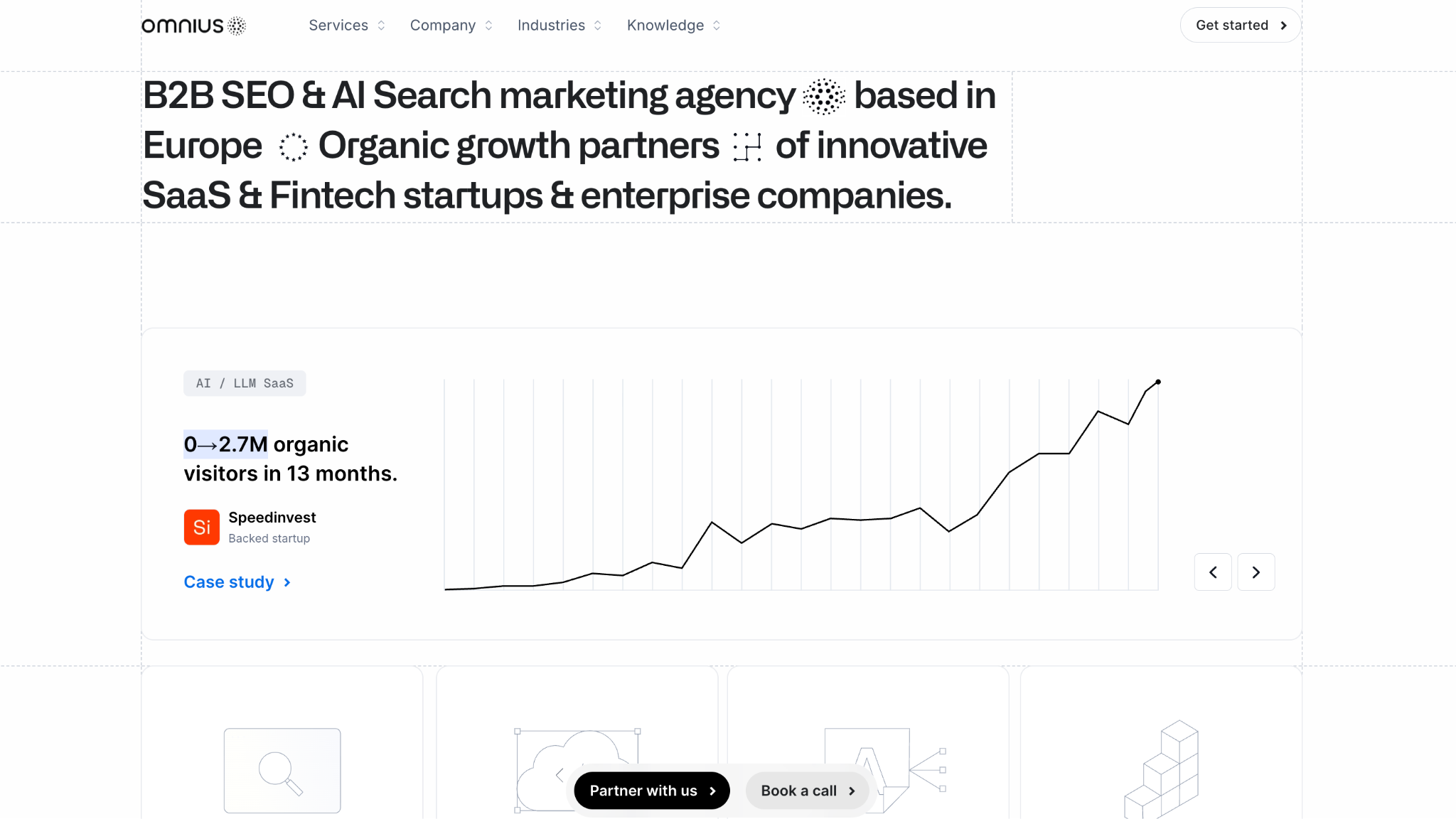
Omnius is an SEO and GEO agency for SaaS, fintech, and AI companies, with explicit positioning for enterprise businesses as well as startups. Its content marketing service starts with market research, product education, and keyword mapping, then turns that work into product-led articles and feature, alternative, and use-case pages. The purpose is to explain the product in the context of the buyer’s question.
Omnius manages writing, design, technical SEO, and GEO through the same delivery process. Omnius can also work with your team on your shared content calendar, including publishing dates, real-time updates, and weekly reports, using Slack for communication and Notion for project visibility. For a content lead coordinating search and production, that gives the different parts of the program one place to be planned and tracked.
Pros
- Content and website work together: Articles, landing pages, technical fixes, and publishing share one agency, reducing vendor handoffs for your team
- Product-specific page planning: Keyword mapping covers features, industries, and use cases, helping buyers find specific answers instead of a general product overview
- A shared delivery record: Publishing dates, weekly reports, and real-time updates help your content lead track creative and technical work together
Cons
- Custom pricing: Published service descriptions don’t establish your monthly cost or content allocation, so budget comparisons depend on a tailored proposal
- Conversion-first priorities: Omnius prioritizes bottom-of-funnel pages, which may be less aligned with teams primarily seeking broad awareness or editorial thought leadership
Pricing
- Custom pricing
How to choose a content marketing agency for enterprise software
Start with the work you need the agency to take off your team’s plate. A strategy, a set of briefs, and finished articles are different needs, so make sure the proposal covers the work you want to hand over.
You should also ask how they educate their writers about your product and how they avoid inaccuracy in product claims. You can then read writing samples alongside the proposed scope. Finally, agree on how you’ll measure progress, including delivery, search visibility, and qualified leads.
The right partner should make the work easier to manage and give you a clear account of what it contributes.
Give your team fewer drafts to rewrite
At Kairos Labs, we use product demos, sales calls, and expert interviews to build a strategy and write content grounded in what you sell. Your team brings the product expertise; we turn it into content buyers can find and understand through Google and AI search.
Let's design a solid SEO/AEO strategy and execute it so you get ahead of your competitors.
Book a call