


Fintech SEO follows the same basics as other B2B efforts. You need to do keyword research, create helpful pages that match what people are searching for, build internal links and backlinks, and make sure your website is easy for search engines to access.
Financial claims need extra care. If you leave out a condition, an accurate description can become a promise your company can’t keep. This affects how you brief writers, review drafts, and explain what your product can do.
It also affects how you spend your week: if a draft makes an incorrect statement about an eligibility rule, the compliance team will send it back, and if a keyword attracts the wrong audience, your sales team ends up with leads it cannot use.
This guide covers the choices that help you avoid both issues. As an example, we’ll use a company that sells software to prevent wire fraud for title companies.
Key takeaways
- Pick the buyer before the keyword. A wire-fraud search can come from a title company evaluating prevention software or from someone trying to recover stolen funds. Only one of them may be a customer you can serve.
- Use search results to identify questions worth investigating. If competing pages emphasize integrations, check with sales whether compatibility affects buying decisions, then explain how your product works with the buyer’s existing systems.
- Always include the conditions with every financial claim. Even an educational page needs an expert review if it explains what a product or bank protects.
- Track qualified inquiries as well as rankings. Evaluate an SEO partner by how much work your team still has to do on briefs and rewrites.
How is fintech SEO different from general B2B SEO?
Fintech SEO is the umbrella term for financial technology companies optimizing for traditional and AI search results. This includes companies in payments, lending, identity verification, and fraud prevention.
Clear product descriptions are important in every B2B field. In fintech, it matters more. That’s because leaving out a condition can mislead buyers about protection or risk.
For example, if you say a product “protects your wire transfers,” you need to explain which transfers are covered and what the protection includes. Qualia Shield, for context, offers $2 million in insurance coverage for eligible wire transfers and notes that a wire is eligible only if its instructions are reviewed in Qualia Shield and assessed as low risk. Additional terms apply.
If you skip the eligibility rule, it sounds like Qualia offers more coverage than it really does.
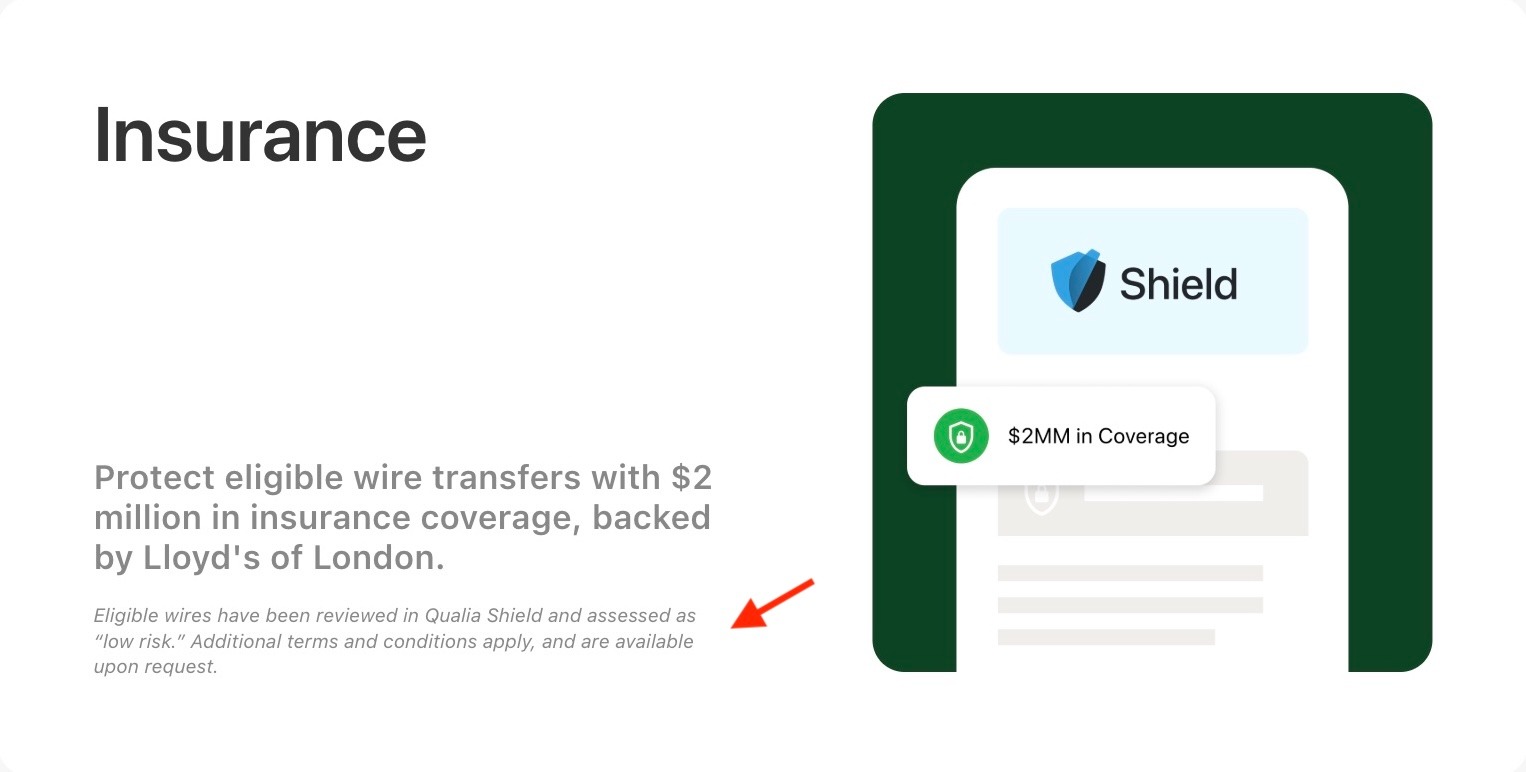
Qualia presents the coverage amount alongside the eligibility rule. The arrow points to the eligibility rule that the copy needs to preserve. Source: Qualia Shield.
Google expects more from finance content. These are called "Your Money or Your Life" (YMYL) topics, and Google favors pages that show real expertise and trust. For your team, this means you need to source every financial claim and have the right expert review it.
So, how do you do this?
How to build a fintech SEO/AEO program around real buying decisions
The next steps use standard SEO/AEO methods but focus on fintech buying decisions, where you need to be extra careful with product eligibility and financial claims.
1. Choose the buyer before you commit to a keyword
Start with your sales team. Ask which questions they use on a first call to rule a prospect in or out. For a wire-fraud prevention product, those could include the title production software a company runs, its closing volume, and the states in which it operates.
Those answers become your keyword filter.
“Wire fraud prevention software for title companies” describes the buyer. “How to get money back after wire fraud” is usually written by someone who has already lost funds. Both searches are about wire fraud, but whether you target the second depends on what your product helps with.
Your goal is to know who you’re optimizing for based on what your product can do, not just search volume.
2. Use search results to investigate buyer priorities
Search results show which types of pages rank for a query and what competitors highlight. Use this to spot possible buying criteria, then confirm those priorities with your sales team.
For a query such as “wire fraud prevention software for title companies,” integration details are worth investigating. Qualia offers fraud detection inside its title production software, with nothing separate to install. Closinglock lists integrations with SoftPro, RamQuest, and ResWare. Those details help a buyer assess whether either product works with their existing system.
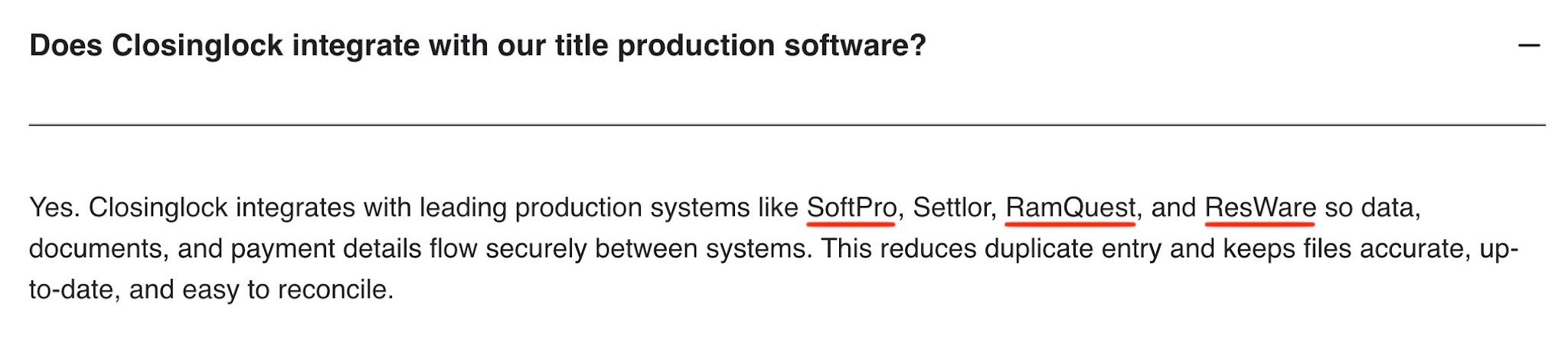
Closinglock names the supported systems, helping buyers check compatibility with their existing software. Source: Closinglock.
For example, someone searching “how does wire fraud happen?” needs an explanation of the problem, while someone searching “wire fraud prevention software” is already evaluating solutions. The first page can help them understand the risk, and the second can help them compare how different products address it.
When you link these pages, readers can move from learning about the problem to comparing solutions, without each article trying to cover everything.
Before creating new content, review what you already have. A content audit helps you see which pages to update or merge. If you have good educational content but lack a strong solution page, focus on adding that before writing more top-of-funnel articles.
3. Write every financial claim with its conditions attached
Always include the conditions with financial claims. If a benefit only applies in certain cases, readers need to know when it applies so they can decide if it’s relevant to them.
For example, in the United States, the FDIC states that nonbank companies are never FDIC-insured. Funds a fintech deposits at an insured bank may qualify for pass-through coverage if that bank fails. Eligibility depends on requirements including ownership and recordkeeping. That coverage doesn't protect customers if the fintech itself fails.
Let the type of claim guide what details to include and who should review it.
Check headings and meta descriptions as closely as body copy. They're short, so conditions get cut there first. And an educational page gets the same review as a product page if it says what a product or a bank protects.
4. Brief writers with approved facts and a named reviewer
Writers need more than old articles and product pages to explain a fintech product accurately. Give them the approved claim, the evidence for the mechanism in your product (where applicable), and any conditions they need to preserve.
For example, if a wire-fraud product covers certain eligible transactions, the writer should know what makes a transaction eligible and where that information came from. If the article explains what happens after a failed verification, include a product walkthrough or recording that shows the actual process.
You should include a reviewer in your briefs: someone from the product team for capabilities and workflows, and someone from legal or compliance for coverage and regulatory claims.
Specify what each reviewer needs to check. Resolve disputed claims before drafting, and have the relevant reviewer approve the final wording before publication.
This is how we conduct due diligence with our fintech clients at Kairos Labs. Every brief includes the approved claims and their sources, and our process flags any missing source rather than filling it with something plausible.
If you use AI in your writing or review process, set the same rule. Give it approved sources, and make it mark any claim it can't verify.
This way, the writer starts with approved facts, and your product team can focus on checking the description. That should reduce the amount of rewriting they need to do.
5. Put your proof on public pages buyers and AI answers can reach
A commercial page should do more than make a claim. Give buyers a way to check the details that matter to their decision, whether that’s an integration, market availability, or a product limitation.
For example, CertifID’s SoftPro integration page explains that users can verify payoffs or share bank instructions without repeatedly entering data or switching screens. It also includes a walkthrough of the integration. That gives buyers a workflow they can investigate, rather than leaving them to interpret a vague “integrates with SoftPro” claim.
Those supporting pages also need to be accessible to search engines. Google's technical requirements state that a page must be accessible to Googlebot and contain indexable content. Keep customer accounts private, but make the public product and documentation pages easy to find. Where availability changes by state or market, explain the difference on each page.
6. Check how AI answers describe the same buying decision
Your buyers may ask ChatGPT, Google AI Overviews, or another AI tool the same questions they would normally type into a search engine. It makes sense to check how those answers describe your product and the category.
For a wire-fraud provider, for example, does the answer preserve the conditions attached to insurance coverage? Does it name supported integrations correctly? Following the citations can help you determine whether an incorrect answer stems from outdated information or from something your pages haven’t explained clearly enough.
You can then improve the underlying content, but don’t treat that as a guarantee that the AI answer will change. Google says AI Overviews and AI Mode require no special markup or additional optimization, and being eligible doesn’t guarantee inclusion.
For an ongoing ChatGPT visibility audit, repeat a consistent set of buyer questions and track which brands are mentioned and which URLs are cited. A single favorable answer tells you very little. Repeated results against a baseline help you assess whether visibility and product descriptions are changing over time.
7. Measure qualified demand, not just search traffic
Rankings and traffic can tell you that people are finding your content. They don’t tell you whether those people are part of your ideal customer profile (ICP).
Agree with sales on what makes an inquiry qualified, including any market, customer, or transaction requirements that matter to your product. That way, your reporting can distinguish a form submission from an opportunity the sales team can actually pursue.
Then look at search queries and landing pages alongside qualified inquiries and pipeline value in your CRM. If the right prospects are reaching a page but not taking the next step, check whether the page answers the questions they need to evaluate the product and provides a relevant next step. If inquiries are coming in but sales keeps rejecting them, the content may be attracting the wrong audience or failing to make eligibility clear.
Attribution needs some care too. Google Analytics records direct traffic when it lacks a clear referral source, so a direct visit alone doesn’t prove someone discovered you through an AI tool. Keep identifiable referrals and self-reported discovery data where you have them, and use the same attribution rules consistently across all the SEO and AI-search activity you’re measuring.
Choose a fintech SEO/AEO partner that actually removes work
A fintech SEO partner should remove work from your team, not move it around. If you still have to write every brief, repeatedly explain the product, and rebuild drafts before they can publish, you are still doing too much of the production yourself.
When we worked with CertifID, we interviewed subject-matter experts, watched product walkthroughs, and studied how title companies and law firms work.
That product and customer context shaped both the new content we produced and the existing pages we refreshed, merged, or removed. The work also expanded into solution and partner pages for different buyer roles, so the SEO work wasn’t limited to producing more blog articles.
That is the kind of work we can take off your plate at Kairos Labs. We gather the product context, turn it into briefs and content, and have an editor review the work before we send it to your team. Your experts still contribute where their knowledge matters, but they should review only the details they can verify, not teach us the product again in every draft.
The right setup depends on what you already have, though. If the strategy is clear but your team can’t execute it consistently, the in-house versus agency decision may come down to capacity. If you still need to decide which SEO opportunities are worth pursuing, our B2B SaaS SEO strategy service uses buyer research, product context, and search analysis to build a plan for what to work on first.
Let's design a solid SEO/AEO strategy and execute it so you get ahead of your competitors.
Book a call