Choosing an enterprise SEO agency means finding a partner that understands your software and can help buyers discover it through traditional and AI search, then tracking whether those visits lead to sales opportunities.
An agency that works well for a single-product startup may struggle with enterprise SEO needs. In this piece, we compare ten agencies on how they handle enterprise SEO and AEO strategies to help you assess the options.
Key takeaways
- An enterprise SEO and AEO agency should help buyers find your products and understand why to choose them
- Enterprise search requires a strategy across product lines, with reporting that connects visibility to qualified sales opportunities
- Kairos Labs understands complex SaaS products sold to enterprise buyers and runs SEO and AEO programs that grow their visibility in search and AI answers
What enterprise SEO means for a B2B SaaS company
Enterprise SEO is the practice of optimizing complex websites with thousands of pages across multiple domains, often when SaaS products are sold to sophisticated buyers. Big websites require a thorough search strategy, cohesive messaging across all pages and loads of maintenance work.
The difference is the scale of coordination. A product rename can require updates across hundreds of pages, with approval from more teams. Content must also support buyers evaluating an expensive purchase over months, and reporting must connect search activity with sales opportunities throughout that cycle.
How enterprise and early-stage SaaS agencies differ
An agency working with early-stage SaaS typically starts with a focused search strategy to attract the first qualified buyers. An enterprise agency must coordinate that work across a broader product portfolio and keep content aligned with each product’s positioning.
How we chose these enterprise SEO agencies to review
We assessed each agency’s approach to enterprise SEO and AEO using the criteria below:
- Product knowledge: How the agency learns what your software does and uses that understanding to brief its writers
- Content strategy: How the agency organizes content around your product portfolio so buyers can find answers relevant to their needs
- Competitor research: How the agency uses competitors’ content and backlinks to identify search opportunities worth pursuing
- Product changes: How the agency keeps content accurate after a launch and protects search visibility during a migration
- AI visibility: Whether the agency only monitors brand mentions or tests changes against a baseline and control
- Delivery: Whether the agency produces content and implements website changes or leaves that work to your team
- Revenue reporting: How the agency connects search activity with qualified opportunities in the CRM
- Pricing: What each fee covers and which responsibilities remain with your team
Enterprise SEO agencies at a glance
1. Kairos Labs: best for SaaS companies with complex products and big websites
Kairos Labs is an SEO and AEO agency that helps B2B SaaS companies turn enterprise search into qualified sales opportunities. We study your product demos and sales conversations to understand what buyers need to know before choosing your software. Our writers use that research to explain specific capabilities, with your product marketing team approving positioning.
We build the search strategy around your commercial priorities, identifying where each product can compete and what content buyers need to evaluate it. We also conduct competitor research to guide which topics to pursue and where to invest in backlinks. As products change and capabilities improve, we keep existing content aligned with the new positioning.
We also conduct AEO tests to check whether our work improves how your products appear in AI answers like ChatGPT, using a set of commercially relevant prompts for comparison over time. We also connect search activity with CRM reporting so you can assess the qualified opportunities your investment supports.
Pros
- Connected product hubs: We organize content across products and personas around shared commercial priorities, helping related pages answer different buyer questions without losing the portfolio's positioning
- AEO brand visibility, Share of Voice comparisons with a control: We compare prompt-group changes with an unchanged set, helping your team distinguish movement in shortlist answers from normal variation between AI responses
- Reporting from your CRM: We set dashboards based on your CRM so you can track pipeline from organic, AI search and direct
- Writing and editing included: We prepare in-depth content. Our final SEO review includes internal links, ALT text and product images
- Direct access to senior specialists: You work with our founder and senior SEO/AEO experts
- Strategy follows product changes: Major releases or repositioning trigger a fuller review, helping your team update existing content before outdated descriptions undermine the new offer
- Ongoing SEO upkeep: We maintain redirects and sitemaps. Internal-link checks and small technical fixes run alongside new content
Cons
- Search-focused scope: If you also need paid advertising or marketing automation, you’ll need additional support beyond our SEO and AEO program
- Not suitable for simple products: We don’t work with early-stage SaaS companies that are looking for product-market fit or are validating ideas
- Not suitable for websites with no SEO: We build on complex programs that are in motion. We don’t publish 100 blogs to a newly launched website
Pricing
- Custom pricing
2. Previsible: best for international SEO
Previsible is a SaaS SEO agency that supports multiple products across global markets. Its team plans product pages and help-center content around buyers’ questions, helping them discover and evaluate your software through search and AI answers.
Previsible can also publish copy and deploy code directly when your internal team needs additional support. Its reporting connects search performance with sales pipeline and closed-won revenue.
Pros
- Capacity across products and markets: Dedicated engagements can include embedded and in-market staff, giving enterprise teams delivery support for localization and portfolio expansion without staffing every market internally
- Two-week delivery cycles: Previsible delivers work in two-week sprints under its Integrated model
- Category-specific AEO research: Prompt-cluster maps and citation-gap analysis identify where competing vendors appear, helping your team choose which buyer questions need stronger coverage
- Coverage beyond blog posts: Previsible plans product pages and organizes help-center content
- Commercial performance measurement: Previsible tracks trial starts and lead qualification alongside search visibility. It also reports pipeline and closed-won revenue
Cons
- Serves retail, ecommerce, media and healthcare alongside SaaS
- Its most popular plan adds capacity to marketing teams of 10 or fewer rather than owning the program
- Published results lead with traffic, clicks and impressions rather than pipeline
Pricing
3. TripleDart: best for CRM-informed search priorities
TripleDart is a B2B SaaS marketing agency that helps software companies attract qualified buyers through SEO and AI search. Its team uses CRM data to prioritize search opportunities, with competitor research guiding comparison pages and product-led content.
Senior operators set the strategy, while Slate handles keyword clustering and content-gap analysis. The platform also maps internal links and supports AI-search visibility tracking. Senior editors direct AI-assisted content production, and the service includes CMS publishing.
Pros
- Commercial pipeline reporting: TripleDart tracks organic visitors who request demos and follows their progress through qualification to closed deals
- Buyer evaluation pages: TripleDart explains product requirements through integration and use-case pages. Comparison pages support vendor selection
- CMS publishing included: TripleDart publishes approved content through CMS integration, reducing the upload and formatting work left to your team
- Connected content workflows: Slate groups keywords and identifies content gaps under senior operators’ direction. The platform also maps internal links
- AI visibility tracking: Slate monitors how AI surfaces represent your brand and tracks citations
Con
- Core client base is Series A to growth-stage companies
- SEO is one discipline in a full-service team alongside paid, ABM, Webflow and RevOps
- Organic Growth scopes content by asset count, up to 30 assets a month
Pricing
4. MADX Digital: best for programs across markets
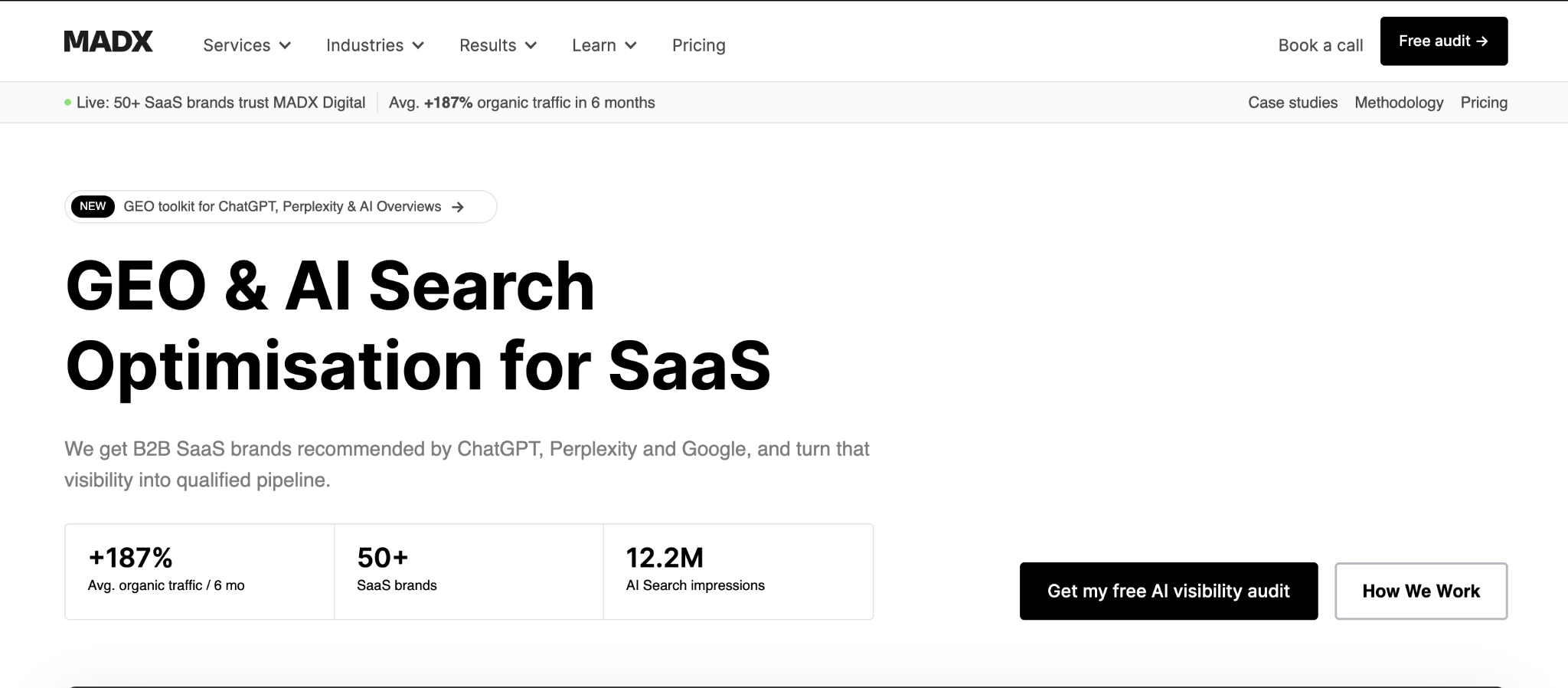
MADX Digital is a SaaS marketing agency that manages SEO and GEO across multiple products or markets. Its team researches your products and the people involved in buying them, then uses competitor analysis to identify which search opportunities to pursue.
Its Enterprise service plan provides a senior delivery team and priority support. Content production follows the agreed scope, while its technical specialists work with your developers on website improvements. Reporting connects the program’s performance with your sales pipeline.
Pros
- Delivery across a portfolio: MADX coordinates Enterprise engagements across products or markets. Content volumes and placements follow the agreed scope. The program also includes PR
- Enterprise pipeline reporting: MADX maps Enterprise reports to your pipeline, helping stakeholders assess commercial progress alongside search visibility
- Senior delivery support: Enterprise clients receive priority delivery from a senior team
- Defined service commitments: Dedicated onboarding and SLAs give procurement and marketing concrete delivery expectations to review
Cons
- Plans are sized by monthly article and placement counts
- The entry plan centers on off-site placements, with no articles
- Case studies lean to consumer-facing and early-stage brands
Pricing
5. POLARIS: best for SaaS migrations
POLARIS is an SEO agency providing B2B search services and enterprise migration support. Its team uses customer use cases and competitor research to plan content that helps buyers understand and compare your product.
For migrations, POLARIS identifies the pages driving existing demand and records their performance before changes begin. It coordinates URL mapping and launch checks with your marketing and technical teams to help protect that visibility.
Pros
- Protection for existing demand: POLARIS identifies important landing pages across business units before migration, helping your team prioritize what the redesign needs to preserve
- Tracking through the changeover: POLARIS verifies analytics and search-engine profiles during migration, helping your team retain usable performance data when URLs and site structure change
- Post-launch migration checks: POLARIS checks redirects and follows user journeys after release. The team monitors search visibility too, helping your developers identify migration faults that need attention
- Visible project delivery: You can follow scope and progress in POLARIS's Zoho project system
Cons
- Serves ecommerce and B2B sectors broadly, so SaaS is one practice among several
- Its AI search guidance treats B2C and ecommerce as more affected than B2B
- Measures SEO through Google Analytics traffic
Pricing
- US Integrated Partner (ENT): $15,800–$25,000 per month
6. Gray Dot Co: best for JavaScript and headless websites
Gray Dot Co is an SEO consultancy with expertise in JavaScript and headless websites. Its team uses search research and competitor analysis to develop content strategy.
Through SEO product management, Gray Dot turns recommendations into requirements with clear acceptance criteria, then supports your team's sprint planning. It checks implementation through QA and post-launch reporting so you can assess the result.
Pros
- Requirements your engineers can use: Gray Dot documents what developers need to build and why it matters. Acceptance criteria help your team check the completed work
- Development sprint integration: Gray Dot helps scope tickets and plan sprints within your development process
- QA and follow-through: Gray Dot tests changes before launch and reviews performance afterward
Con
- Guides implementation while your team executes the roadmap
- Serves SaaS alongside ecommerce, nonprofits, GovTech and media
- Most featured results come from media and ecommerce
Pricing
- Custom pricing
7. SimpleTiger: best for lifecycle marketing
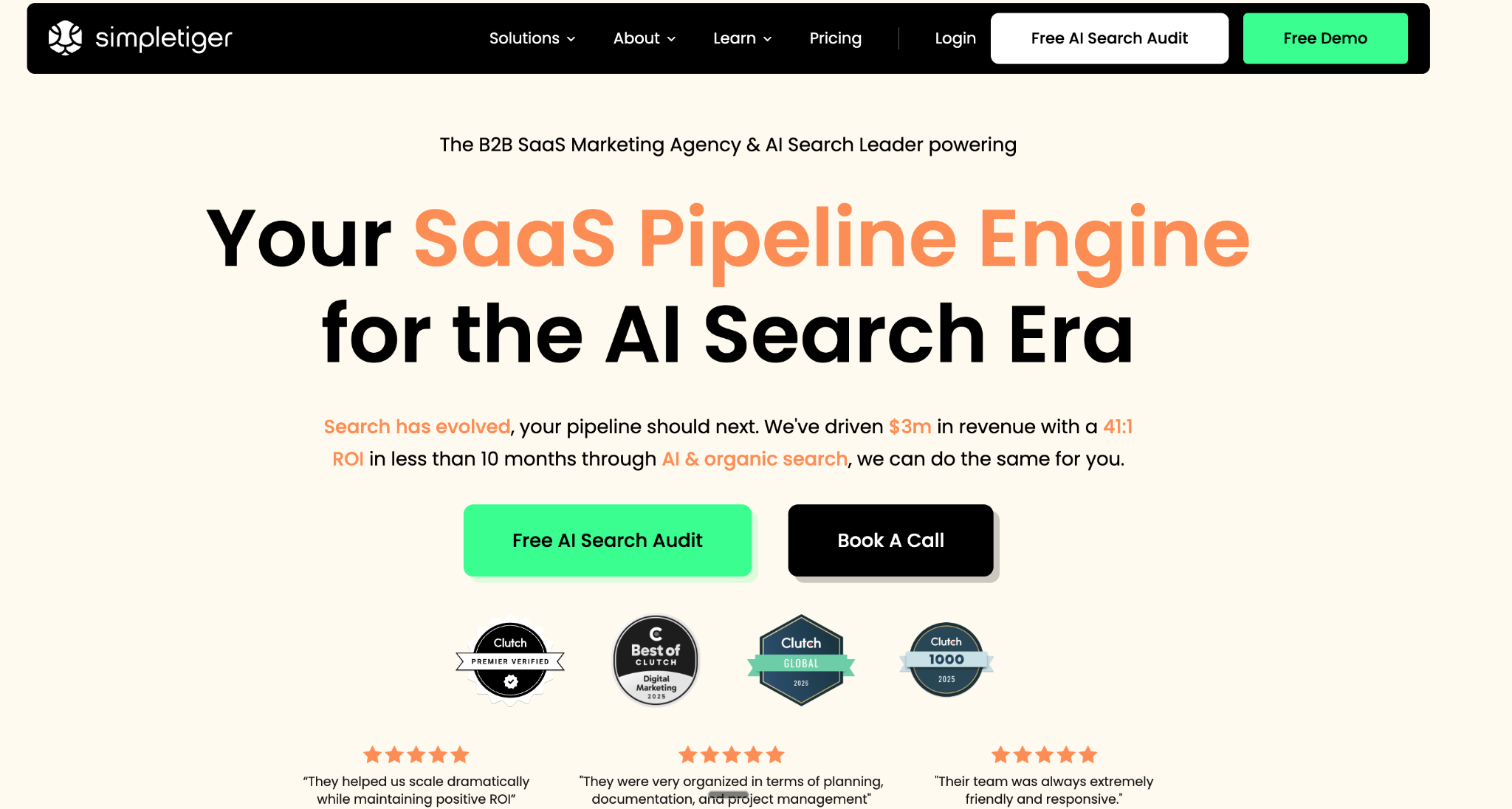
SimpleTiger is a SaaS marketing agency that combines organic search with paid acquisition. Its Pipeline Intelligence reporting connects channel activity with sales opportunities so your team can assess which work contributes to demand.
Its standalone SEO and GEO services focus on content and authority building. Within the broader Pipeline program, paid media starts with Launch, while Enterprise includes lifecycle email to follow up with prospects.
Pros
- Lifecycle email follow-up: Pipeline Enterprise includes email to nurture prospects through evaluation
- Commercial content coverage: SimpleTiger writes pages for buyers comparing alternatives or investigating product requirements. Feature explanations and integration pages give those prospects more detail before they request a demo
- Conversion page delivery: SimpleTiger builds Webflow pages for its demand-capture program
- CRM attribution setup: SimpleTiger connects CRM opportunity stages with channel activity through Pipeline Intelligence, helping your team see where prospects progress or stall
Cons
- Offer organized by funding stage, starting with early-stage startups
- Runs SEO, paid, email, web and RevOps as one managed system so it isn't specialized in organic only
- Tiers scale by content and link output
Pricing
8. Go Fish Digital: best for developing internal SEO capability
Go Fish Digital is a digital marketing agency whose enterprise SEO service includes competitor research and content mapping. It works with internal technical teams and trains product or editorial staff, helping those teams apply search requirements to future work.
Its GEO service includes semantic content audits and AI Overview analysis to guide updates to existing pages.
Pros
- Skills for your internal team: Go Fish Digital trains product and editorial staff to apply SEO requirements themselves
- Prioritized technical work: The agency identifies higher-priority search problems, helping your team allocate development time instead of treating every issue in an audit as equally urgent
- Competitive search research: The enterprise service examines competing sites alongside keyword opportunities
Cons
- Case studies center on retail and consumer brands
- Delivers recommendations that your team implements
- GEO measurement centers on AI Overview inclusion and content scores rather than pipeline
Pricing
- Custom pricing
9. Geeky Tech: best for flexible delivery models

Geeky Tech is a marketing agency providing SEO and paid media for technology businesses. Its team researches competitors and buyers’ searches to decide which content to prioritize. In-house writers update existing pages and create new content, with reporting covering search performance and AI visibility.
You can choose advisory support or share delivery responsibilities through Work With Us. Its Done For You package includes content creation and revisions alongside landing-page building.
Pros
- Delivery matched to capacity: Geeky Tech offers consulting when your team can implement its advice, or Done For You when you need execution. Work With Us lets you share the work with its team
- Shared execution available: Work With Us includes hands-on technical and landing-page optimization while your team stays involved, adding delivery capacity without transferring the whole program
- Content and landing pages: Done For You includes content creation and revisions alongside landing-page building
- Intent-led content creation: Geeky Tech uses competitor research and search intent to guide content. Its in-house writers update existing pages and create new ones
- Technical repairs included: Geeky Tech audits technical issues such as broken links and schema problems. It also reviews internal links to help buyers find relevant content
Cons
- A paid setup month: The initial setup month costs the same as the monthly retainer, so budget a full month’s fee for initial audit and planning work
Pricing
- Consulting from $1,500 per month
- Work With Us from $4,000 per month
- Done For You from $6,000 per month
10. Productive Shop: best for buyer-focused SEO strategy
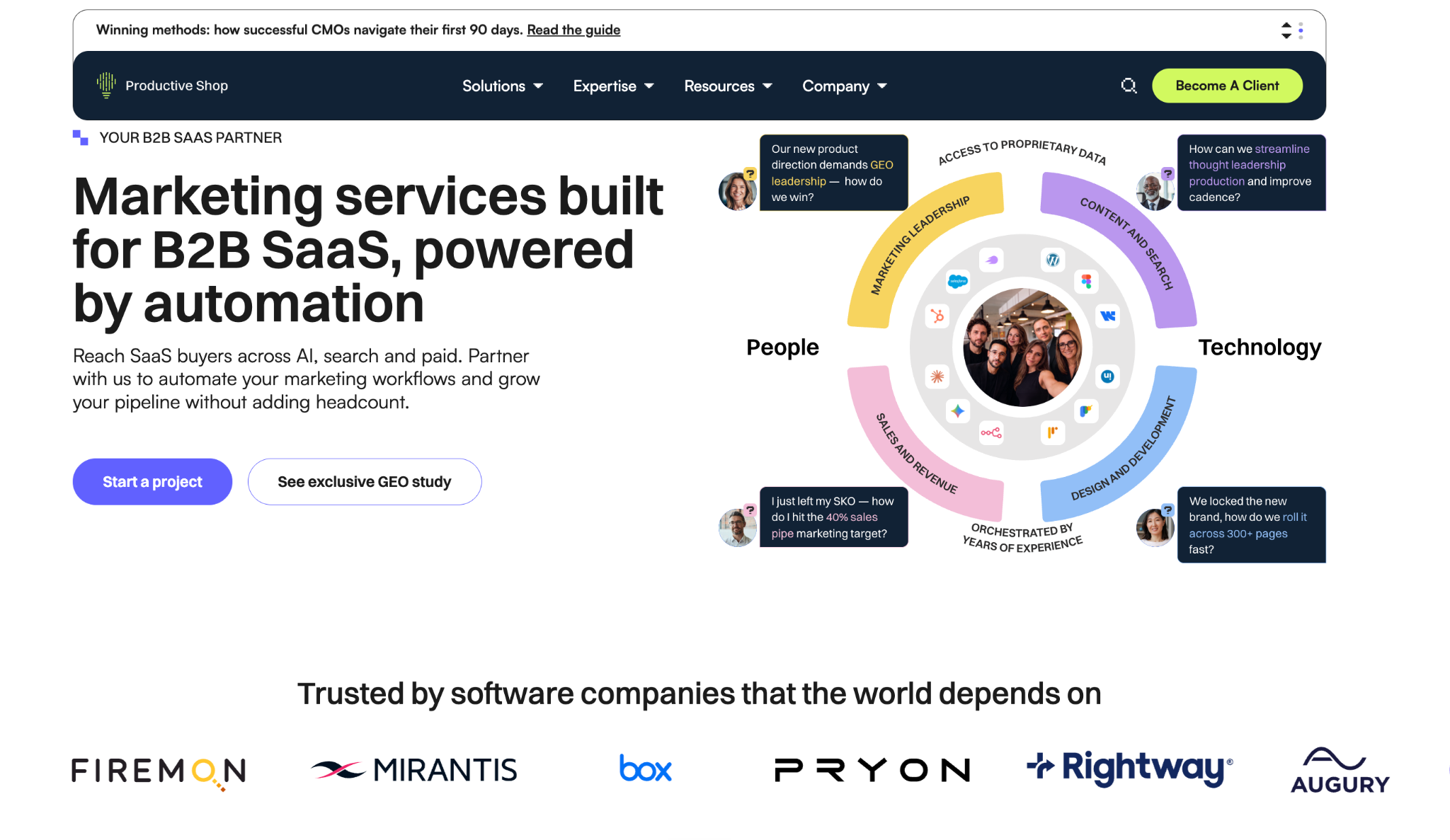
Productive Shop is a B2B SaaS marketing agency that maps search queries to buyer personas and funnel stages. Its competitor research covers content formats and links, while monthly reviews connect organic performance with pipeline.
Productive Shop can brief your writers or produce the content itself. Its developers can implement technical changes or prepare specifications for your team, letting you keep selected work in-house.
Pros
- Technical development available: Productive Shop's developers can implement technical fixes or prepare specifications for your team
- Flexible content production: Productive Shop can brief your writers or write the content itself, letting you add research support while keeping editorial production in-house
- Website conversion research: Productive Shop uses heat maps to study visitor behavior and review page layouts, helping your team investigate why relevant visitors leave without making an inquiry
- Buyer-focused keyword mapping: Productive Shop maps queries to the pages buyers need at each stage of evaluation. It considers the buyer's role so the content addresses the right decision
Cons
- Engagements center on moments of change: new funding, replatforming, a new CMO
- Web rebuilds and HubSpot consulting sit alongside SEO
- The Enterprise plan includes 4 to 6 content pieces a month
Pricing
- SEO consulting: Scaleup at $8,500 per month; Enterprise at $14,500 per month
- Tailor Stitched: Custom pricing
What to expect from an enterprise SEO and AEO program
1. Product knowledge should shape the content
An agency’s writers need to explain what your software does and why a buyer would choose it. The agency should have a set of trusted writers to make that possible.
The agency should also review product demos and sales conversations before briefing writers. Your product marketing team can approve their positioning and you can provide access to subject experts to check technical claims.
You should also plan publishing volume around your team’s review capacity, with specific approvers for sensitive product or positioning claims.
2. Content strategy must cover the product portfolio
Each product needs content that answers its buyers’ questions. The agency should organize every page they propose into connected topics, with clear paths to the relevant product.
It should also review existing content so outdated explanations and product capability don’t undermine new work and avoid keyword cannibalization.
3. Use competitor research to choose which searches to target
The agency should study how competitors attract buyers, then explain which searches your business can realistically compete for.
- Content: Review competitors’ product pages and publishing activity/cadence to find commercially relevant queries that competitors have possibly answered poorly so you can improve your pages to rank for those queries
- Backlinks: Identify which pages earn links and how those pages direct readers to competitors’ products
It should also check where competitors’ pages target the same searches and use similar claims. This helps your team avoid duplicating topics and explain what makes your product different.
The strategy should start where your product has a clear advantage, with a reason for pursuing more competitive searches later.
4. Refresh and update content with new products capabilities when it happens
When you launch a product or rename a feature, existing pages can give buyers outdated information. The agency should identify which pages need to be updated and agree on the new descriptions with the product dev or marketing team.
It should then coordinate those updates with your web team so the content is ready when the updates are live. If page addresses change, buyers and search engines should be directed to the correct replacements.
5. Test whether AEO changes improve your visibility
An agency should track the questions buyers ask AI tools when comparing tools in your category. Those questions should come from sales conversations and search console data, rather than a generic list of prompts.
The reporting should show whether AI tools recommend your company and describe its products accurately. A mention alone says little if the answer misrepresents what your software does.
To test improvements, the agency can update content for one group of buyer queries while leaving a comparable group unchanged. It should record answers before the changes and repeat the checks afterward, monthly or quarterly. This helps distinguish a possible effect of the work from normal variation in AI answers.
The agency should also inspect the sources those answers cite. If an external directory describes an old product, correcting your own website may not be enough.
How to choose an enterprise SEO agency
Use examples from your business to assess how an agency would work.
- Review product research and writing: Assess how the agency would learn your software, then review a sample on one of your technical topics
- Walk through an upcoming launch: Review how it would update positioning and affected URLs, then check how it would measure the result
- Test an ambitious search goal: Use a product category where you have little visibility and assess how the agency would build a competitive position
- Inspect how it analyzes AI visibility: Look for controlled AEO testing and reporting that connects search activity with qualified opportunities
Compare the work included in each proposal with the responsibilities your team would retain. A lower fee may leave your staff handling substantial writing or technical work.
Turn search visibility into sales opportunities with Kairos Labs
At Kairos Labs, we help enterprise SaaS companies reach buyers through SEO and AEO, with content that explains what makes their products worth choosing. We build the strategy around your product positioning and connect reporting with CRM data so you can assess its contribution to the sales pipeline.
Book a strategy call to discuss where your search program could attract more qualified buyers.
Let's design a solid SEO/AEO strategy and execute it so you get ahead of your competitors.
Book a call