

Outsourcing content marketing is supposed to take work off your plate. In practice, it often does the opposite: the drafts don’t speak to your core personas, the report still stops at organic sessions, and the content agency doesn’t report how much pipeline they drove.
That gap, between what outsourcing promises and what it actually removes, is the rework this guide is about. Not whether to outsource content marketing, but whether the partner you pick takes the work off your plate, or just moves it somewhere less visible.
We will cover what to hand off, what to keep, which model fits your team, and what the first year looks like once it's working.
Key takeaways
- The failure mode repeats across almost every bad engagement. Drafts come back needing a rewrite, reporting stops at traffic, and at renewal there's no dollar figure to defend. Fix the handoff, not just the vendor.
- Outsourcing isn't one purchase. A freelancer, an agency, and a full-service partner transfer ownership at different points. Picking the wrong one for your actual constraint is what creates rework, not the partner's skill.
- It isn't fully binary either. Some work moves entirely, some stays a shared call, and three things never move at all: product positioning, ICP, and the final publish decision.
What outsourcing content marketing means
It means handing a third party some mix of SEO/AEO strategy, production, and distribution, so your team sets direction and reviews the output instead of producing it.
How much moves depends on where the actual constraint sits. A narrow scope hands off writing only, against briefs you still produce. A full-stack scope hands off keyword architecture, the editorial calendar, and the reporting layer connecting it all to pipeline.
Two things stay yours no matter the scope: product positioning and the final publish call. Positioning decides who the content is even trying to reach — get it wrong and every piece attracts the wrong buyer, which is a bigger problem than any single bad paragraph. The publish call is just accountability: it's your name on the page, not the vendor's.
When outsourcing content marketing makes sense for you
Three signals show up consistently in conversations with marketing leaders, and each points to a different problem.
The first: a strategy that's already agreed but hasn't shipped in two quarters, because the team is stretched across every other channel. That's a bandwidth problem. The plan is right, nobody has the hours to run it.
The second: sessions climbing while the pipeline stays unaccounted for. The exec asks what organic returned, and the honest answer is a traffic chart with no dollar figure behind it. That's an attribution gap.
The third: more than half of B2B software buyers now start their research inside an AI chatbot before they ever open Google, according to G2's 2026 buyer survey. Being absent from those answers is a pipeline problem, not a visibility nice-to-have.
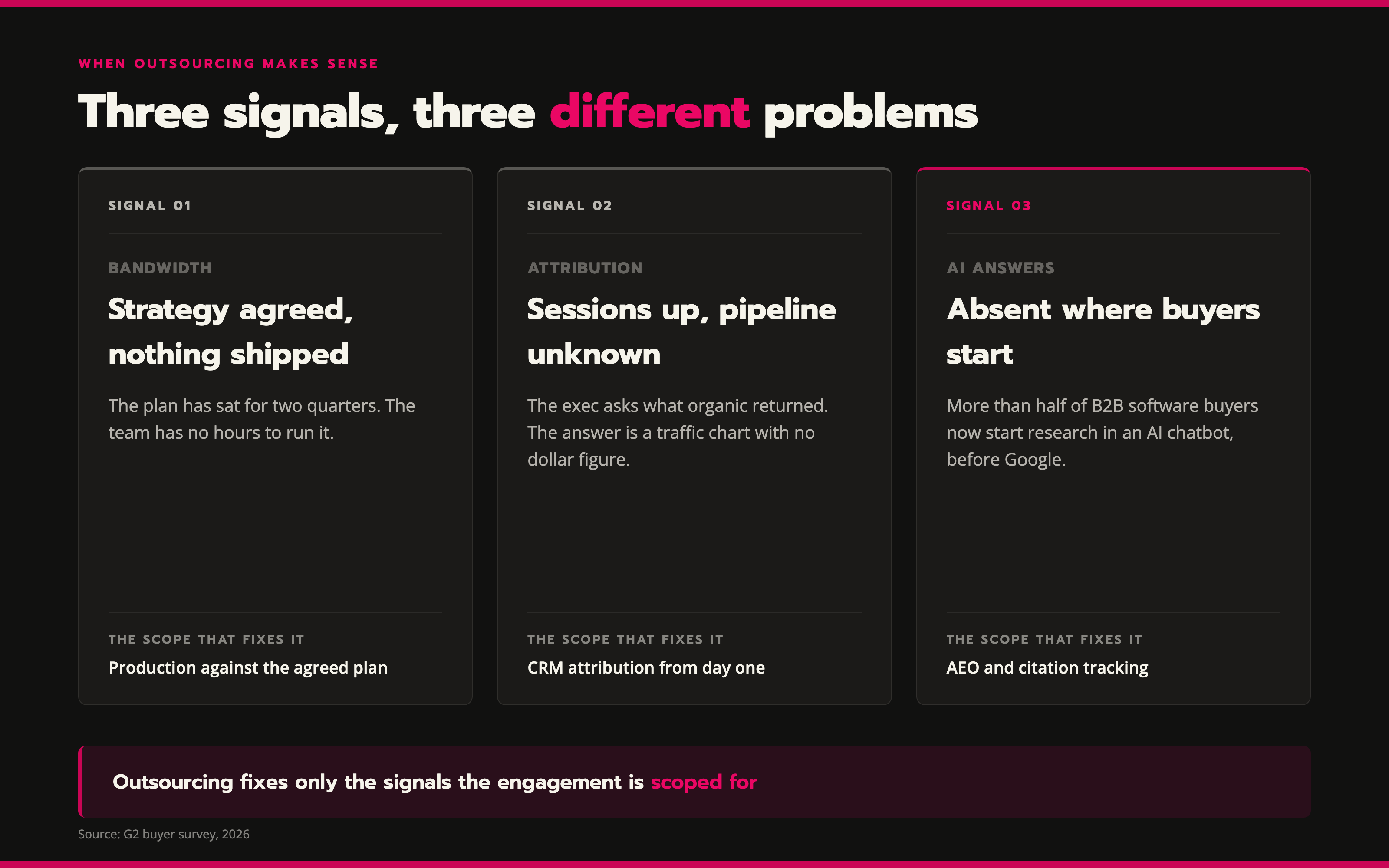
Outsourcing can close all three signals, but only if the engagement is scoped for each one. A partner who writes more content without setting up CRM attribution doesn't fix the second signal just by producing volume, the same way a partner with no AEO scope doesn't touch the third.
The right entry point is a scoped strategy engagement before any retainer starts, one that ends in a pipeline number the client keeps whether or not they continue.
Which outsourcing model actually fits your team
These aren't the same purchase, and confusing them is where most rework starts. If an SEO agency is the decision you're already working through, this is the layer beneath it: which delivery model, not just which company.
The table below shows where each one hands off ownership.
A freelancer is the right call when the brief is already written and the strategy is already set. The constraint is throughput on a fixed set of topics, not direction.
A team publishing two posts a month off an existing content calendar, needing a third writer to keep pace, is the clean freelancer case. The limit is context: a freelancer works from exactly what you hand over, so without recorded demos, sales calls, and SME interviews behind the brief, the output reads correct on the surface and invisible to a buyer who already knows the category.
An agency is supposed to solve more than that: SEO/AEO strategy and execution together. In practice, it's the model most likely to produce the exact problem this guide opened on.
Three patterns account for most of the failures:
- A brief-only agency ships outlines and leaves the actual writing to your team, meaning you're paying for strategy you're still executing yourself.
- A traffic-only reporter never scopes CRM attribution in at the start, so nobody can answer what the channel returned at renewal.
- A voice drifter lets the content stop sounding like the brand around month six, with nobody running a correction round to catch it.
A good SEO/AEO agency that’s focused on driving pipeline will fix all three areas. Also, a modern agency should create you a strategy and share tactics on how to get your brand visible in LLMs like ChatGPT and Claude.
They’ll ship strategy, briefs, monthly reporting and SEO/AEO content that sounds good to your audience.
Skip a full-service partner if the team is small and there won’t be anyone available to review SEO/AEO strategy and drafts sent by the partner.
What to hand off, what to co-own, and what to never let go
Nearly every outsourcing guide splits this into two piles: yours or theirs. That misses the pile most engagements actually live in — the work that's genuinely shared, not handed over.
Hand off entirely: research, drafting, technical SEO mechanics, the editorial calendar, and, in a full-service engagement, the reporting layer connecting organic to CRM.
A partner needs six things on day one to do this well:
- Recorded demos and sales calls
- SME interviews
- Your ICP and persona documentation
- A competitor shortlist
- CRM access for attribution setup
The first three matter most. Without them, drafts default to category-level generics that are technically correct and invisible to a reader who already knows the space.
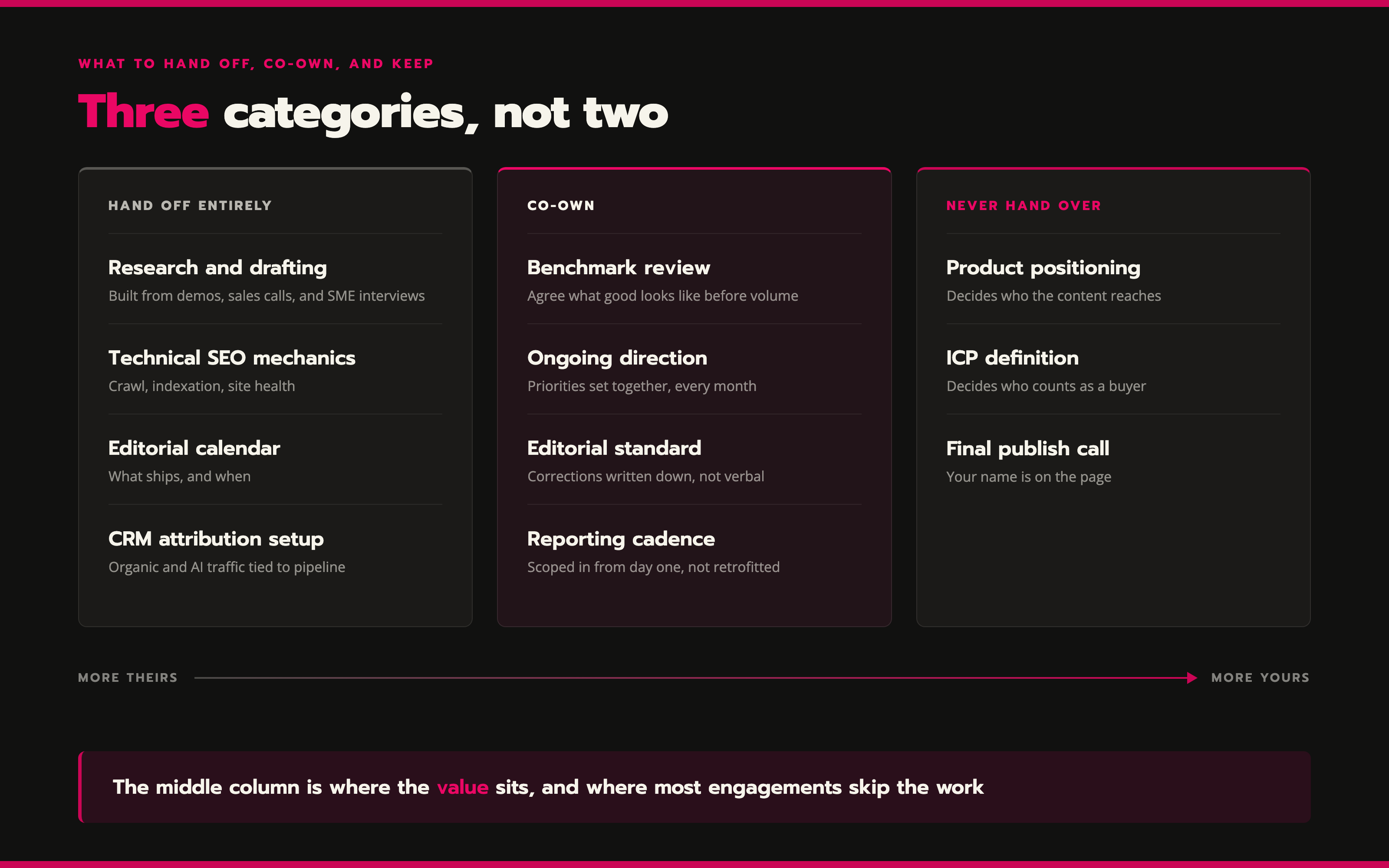
Co-own: direction and review. This is the part most outsourcing guides skip, because it isn't a clean handoff, it's an ongoing loop.
A bunch of benchmark articles, reviewed properly against your real standard before volume starts, does more to prevent rework than any brand guide, because the writer and editor both know exactly what "good" means for your account before they're producing at scale.
The reporting layer belongs here too. It has to be scoped in from day one rather than retrofitted three months in, because attribution added late just means months of unmeasured work.
Never hand over: product positioning, ICP definition, and the final publish call. These decide who the content is for and what it's allowed to claim. So here, if you need help, it’s best to hire a GTM agency that will help.
How to vet a content partner before you sign anything
Start with the attribution model, before writing samples come up at all. If the answer is sessions, that's the number you'll have at renewal, and sessions don't survive contact with an exec meeting.
Product context is the next thing to press on. "We'll send a brand guide" means the drafts will read like the brand guide, not like your product. What you want to hear is demos, sales calls, and SME interviews flowing straight into the brief, not sitting in a folder nobody opens.
Quality control timing matters more than people expect: does it happen before you see a draft, or after? If QA is your job, you haven't actually outsourced the work.
And a named case study with a pipeline number attached is worth more than a portfolio. If the answer is a session count, or something vague about great results, that's your answer too.
What your first 12 months could look like
Months 1–3: A benchmark article ships early, the editorial loop gets established, and topical cluster coverage starts building. Movement shows up in Search Console before anything resembling pipeline does. That's expected at this stage, not a red flag.
Months 4–6: Cluster authority deepens, non-branded clicks compound, and sign-ups and demo requests start appearing in the attribution report for the first time.
Months 7–10: This is where the pipeline builds. The articles that ranked back in month two or three are now catching buyers at decision stage: comparison pages, alternatives content, category pieces seeded early are finally converting.
Month 12: Most programs reach break-even, and the renewal conversation has a dollar figure behind it instead of a sessions trend.
That's the general shape. CertifID ran longer than 12 months, and the extra time shows what compounding looks like with more room to work: a static archive of three- and four-year-old posts and a single content owner with no bandwidth for a content audit going in, a familiar shape in compliance-heavy categories like cybersecurity.
Seventeen months in, it produced 247% growth in non-branded organic clicks, 31% pipeline growth year-over-year, and a $57K enterprise deal sourced from a single listicle.
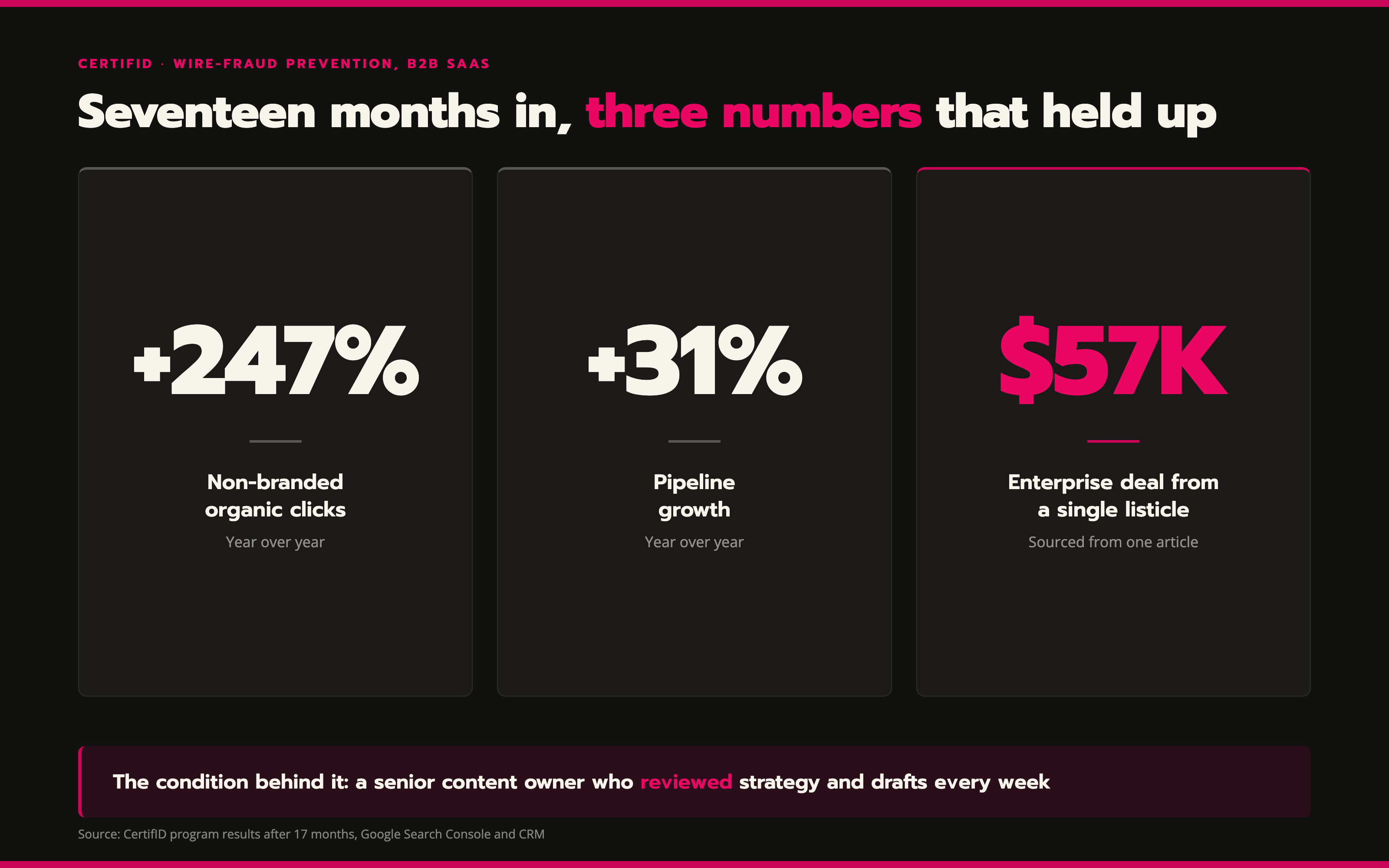
What was necessary here: a senior Content Manager who had weekly calls with our agency, reviewed the SEO/AEO strategy and drafts. This is a must if you want to scale the engagement and results.
Start with proof, not a retainer
If an agency has burned you before, more due diligence on the next pitch isn't the fix. Starting somewhere that doesn't ask for trust upfront is.
That's what a scoped strategy sprint is built to do: it produces a pipeline number in dollars before any retainer decision, and the client keeps that number either way.
It's the same test this guide has been describing, just run once, at small scale, before anything bigger is on the table — proof before commitment, instead of commitment before proof.
Would you rather commit to a retainer on trust, or see the number first?
Let's build something great — book a strategy call.
Let's design a solid SEO/AEO strategy and execute it so you get ahead of your competitors.
Book a call