


Key takeaways
- Track how often AI assistants mention or recommend your product, but check website visits and qualified leads separately to assess business results
- Test questions buyers ask when evaluating software, repeat them over time, and save the full answers so you can compare what changes
- Use the answers to spot outdated product details and questions your content doesn’t answer, then make improvements and check the results
- Choose a tracking tool that monitors the AI assistants your buyers use, explains its scores, and saves time collecting and reviewing answers
If you lead marketing at a B2B software company, someone has probably asked whether ChatGPT recommends your product. A tracking tool can help answer that. It can’t tell you, from a visibility score alone, whether more people are buying because of those recommendations.
That distinction matters when you’re deciding what to fix and what to spend. This guide explains what to measure, how to investigate the answers, and which tools to consider.
What is LLM visibility?
LLM visibility describes how often a brand or its content appears in a defined set of AI-generated answers, and how accurately those answers describe it. You’ll also hear about AEO (Answer Engine Optimization) and GEO (Generative Engine Optimization), which usually refer to work intended to improve that presence.
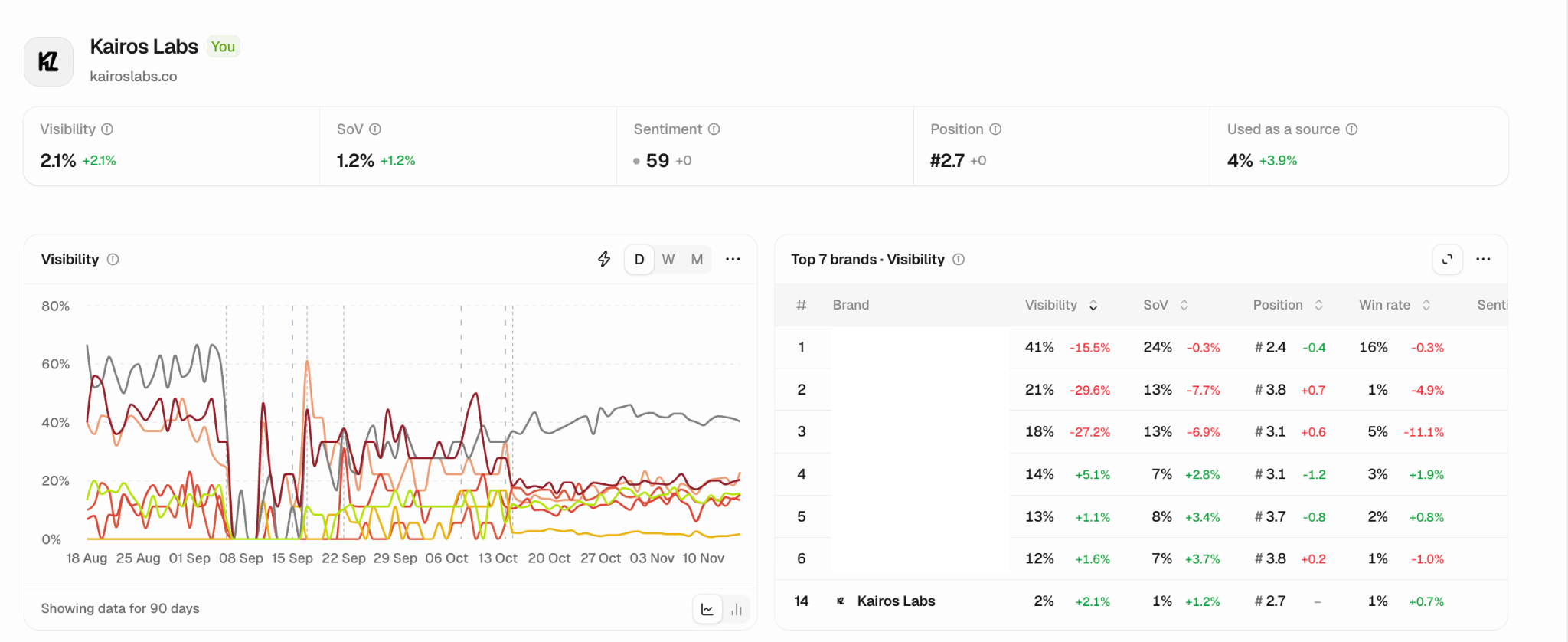
An AI assistant can mention your brand, recommend your product, or link to your website. These mean different things, so track them separately:
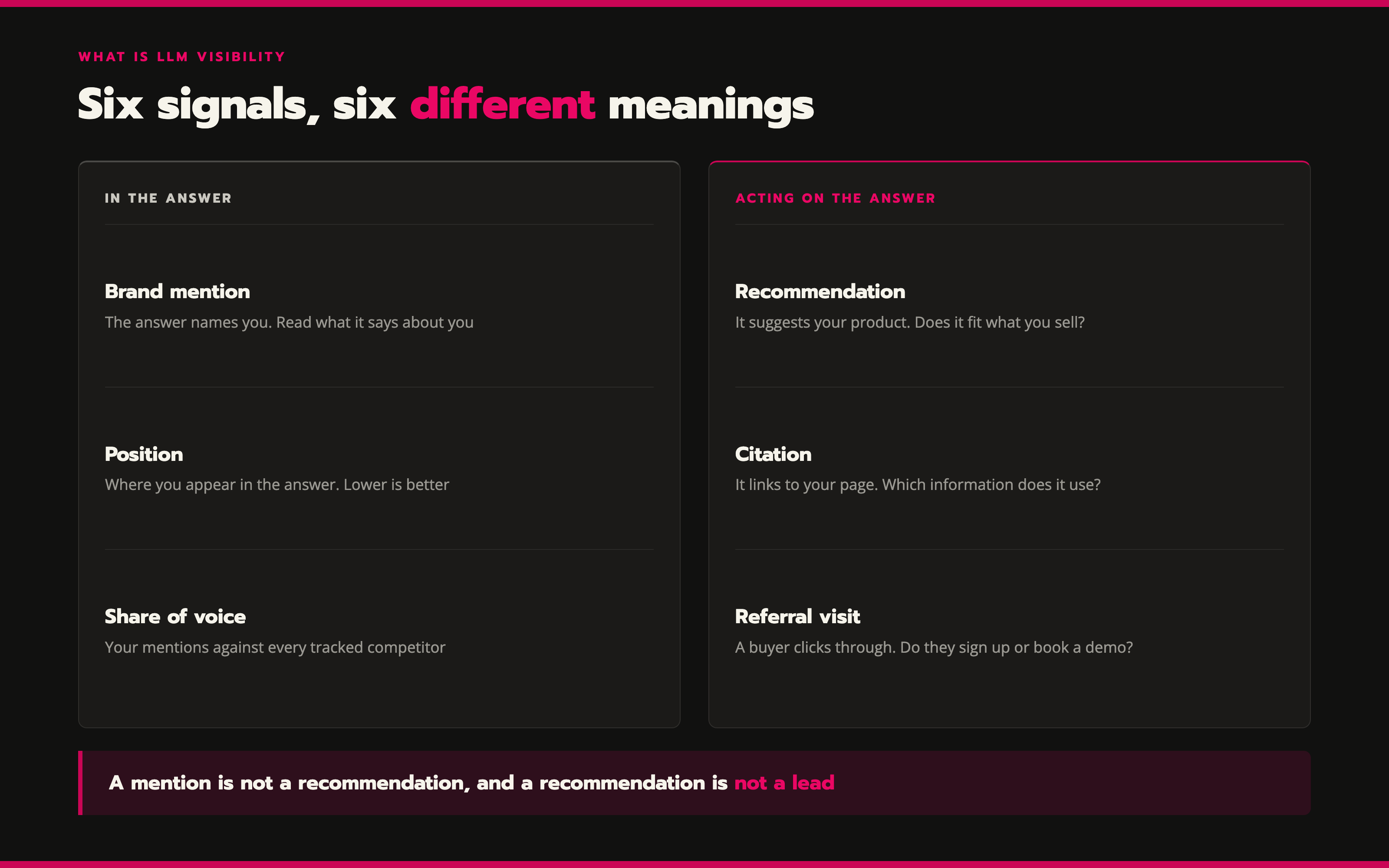
An answer can mention you while recommending a competitor. It can also cite your article without recommending your product. That’s why “we appeared more often” needs more context before it becomes something you can tout as a successful AEO strategy.
You should also separate results for ChatGPT, Perplexity, Copilot, Gemini, AI Overviews, and AI Mode. They’re different products, and an overall average can hide where you gained or lost visibility.
Does LLM visibility lead to more business?
Yes, AI assistants can help people discover your product. I’ve discovered new products through them myself. The key question is whether appearing more often in AI answers brings in more customers.
Your visibility tracker can’t answer that on its own. It tests a set of questions, but buyers may ask about the same problem in different ways. In Amanda Natividad’s small experiment, eight people given the same task wrote different prompts.
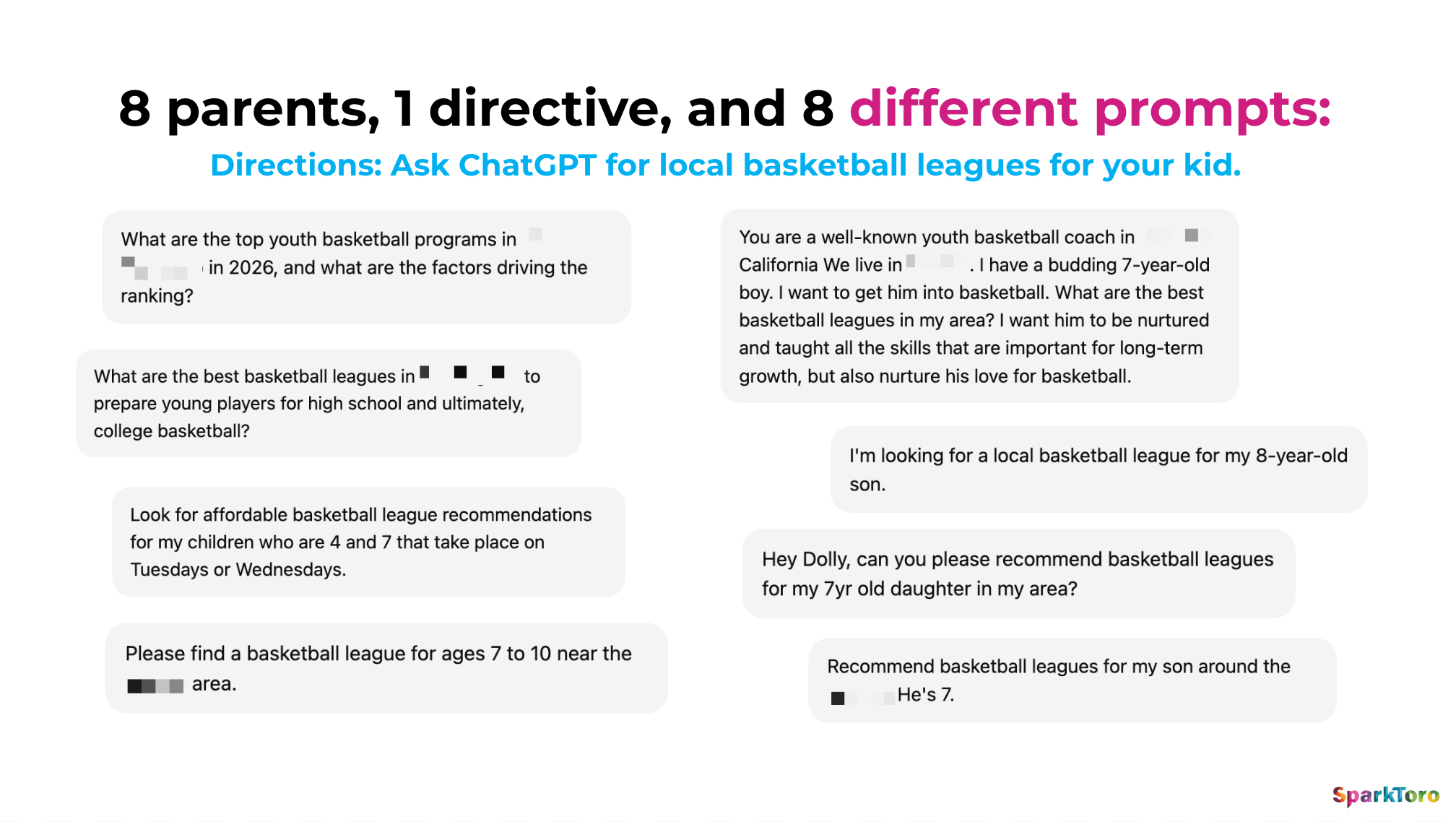
That helps explain why the questions your tool tracks won’t cover every way someone might search for your product.
But to assess business impact, you need to look beyond those answers. Are people visiting your site from AI assistants? Are those visitors becoming qualified leads or customers?
So far, studies suggest that these visits can convert, but their volume is often small compared with traditional organic search. In Marie Haynes’s analysis of 100 websites, ChatGPT sent just 0.62% as many visits as Google organic search over 12 months, showing that its referral traffic is infinitesimal compared to Google.
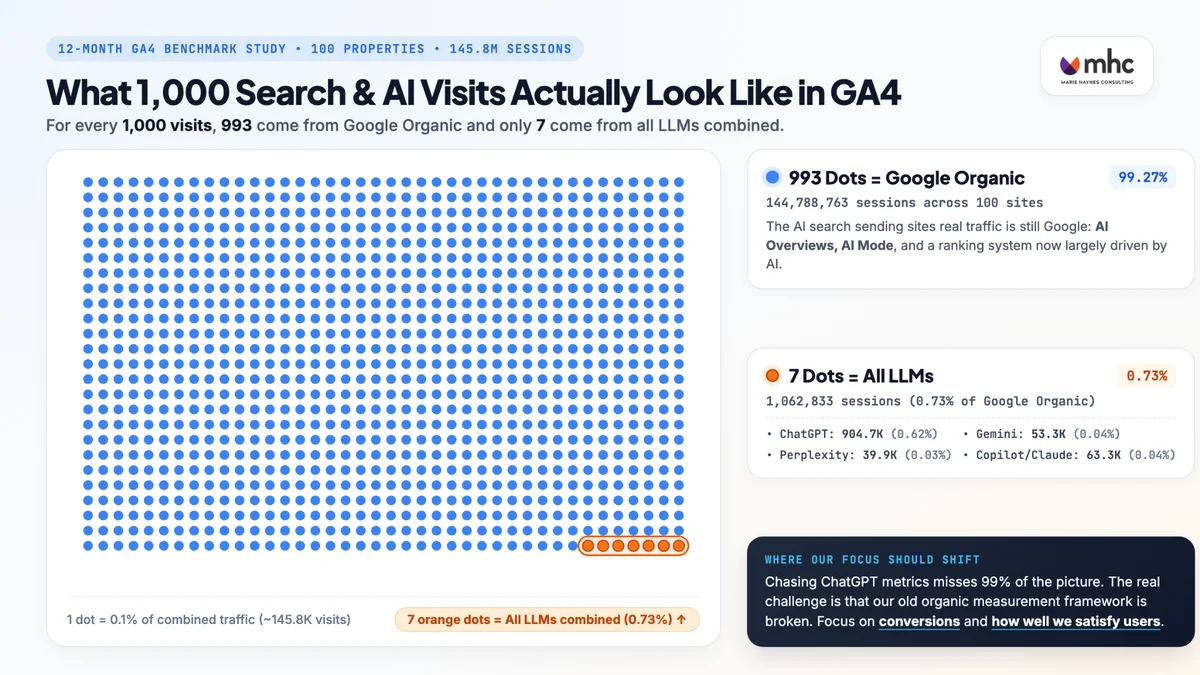
We also know that referral traffic doesn’t capture every route to a purchase, though. Someone might discover your product in ChatGPT, search for your company later, and arrive through Google.
Similarweb found a link between ChatGPT recommendations and later brand visits, while Kevin Indig’s research couldn’t reliably isolate an AI-driven increase in Direct traffic. This suggests there’s reason to investigate that influence, but we shouldn’t count unexplained traffic as AI-generated demand.
Some businesses also report revenue gains. Finseo’s Shirtinator case reports tenfold growth in attributed AI-search revenue. Without the starting revenue or fuller attribution details, however, it’s difficult to judge the size of that gain or how much the optimization work contributed to such gains.
The takeaway here is to check how many visitors from AI assistants become qualified leads or paying customers. You can also ask customers how they found you, since some may discover you through an AI tool but visit later through Google. Use those results to decide how much to invest, rather than relying only on how often your brand appears in the AI answers you track.
How to build an LLM visibility baseline
Before you try to improve how AI assistants describe your product, record what they say about it now. This is your baseline. Repeat the same questions under similar conditions after making changes so you can see whether the answers improve.
1. Collect the questions buyers actually ask
To get started, gather insights from sales calls, support tickets, customer interviews, and lost deals to understand how people describe your products. Look for questions about product categories, use cases, alternatives, pricing, integrations, and implementation.
For example, “which compliance tool works for a 200-person company without a compliance hire?” gives you a more specific situation to investigate than “compliance software.” You need to curate as many queries as possible because you’d be surprised how people use references to eventually ask the questions they need answers to.
Keep in mind that an AI assistant may rewrite your prompts and turn one question into several web searches, sometimes adding brands you didn’t mention. Where your tool exposes those searches, compare them with the original prompt to see which details it kept, changed, or added.
You should also group prompts by what the buyer originally asked, not by the search queries the assistant generated. If someone includes your company name, use that question to check how accurately the assistant describes your product. If the assistant adds your brand during its own searches, keep the original prompt in the group that doesn’t mention you.
Lastly, collect a broad range of questions, then choose a manageable set covering your main products and buying decisions. Include different ways people ask about the same need, and add more as you find gaps. The aim is to understand the answers, not build the longest prompt list.
2. Repeat the questions under consistent conditions
Record the assistant, date, country, language, exact question, and whether you’re signed in. Note the model and personalization settings too, since these can affect the answers.
For manual checks, keep those settings consistent. In ChatGPT, you can choose an unpersonalized temporary chat to exclude memory, custom instructions, and plugins. This reduces the influence of your personal context; it doesn’t reproduce what every buyer will see but can potentially give you a sense of what they’ll see when they ask a similar query.
Ask the questions again over time because answers vary. You could begin with weekly checks and compare several rounds of answers rather than treating one response as a trend.
Lastly, keep the original questions unchanged and track new ones separately. Otherwise, an increase in mentions might simply mean you added questions that were more likely to include your brand.
3. Save the answers behind your visibility scores
Record the full answer, brands mentioned, recommendations, cited URLs, and incorrect product claims. A spreadsheet is enough for an initial review.
For example, if your brand appears in 10 of 40 recorded answers. That gives you a 25% mention rate for that set. It doesn’t mean 25% of buyers saw your company, so read those ten answers to see whether they recommend your product, merely include it in a list, or get something wrong.
To calculate your recommendation rate, divide the number of answers recommending your product by the total number of answers you checked. For citation rate, count answers linking to your website instead. You should also keep a separate list of incorrect product details and the questions that produced them.
The LLM visibility tools calculate their scores differently. For example, Peec includes every response when calculating visibility, while Profound leaves out responses that mention no brand. Ahrefs’ AI share of voice gives more weight to prompts associated with higher estimated search demand. That's why you need to compare results over time within the same tool; the same percentage in another tool may mean something different.
How to connect LLM visibility with leads and revenue
An LLM visibility tool shows whether your product appears in the answers it checks. To see whether AI is bringing in business, use analytics to track identifiable visits from AI assistants and your CRM to follow the resulting leads through to sales.
For example, GA4’s AI Assistant channel groups visits it recognizes as coming from supported AI assistants. Below, you can see our own agency AI assistant visits after we started doing SEO and AEO for our agency website.
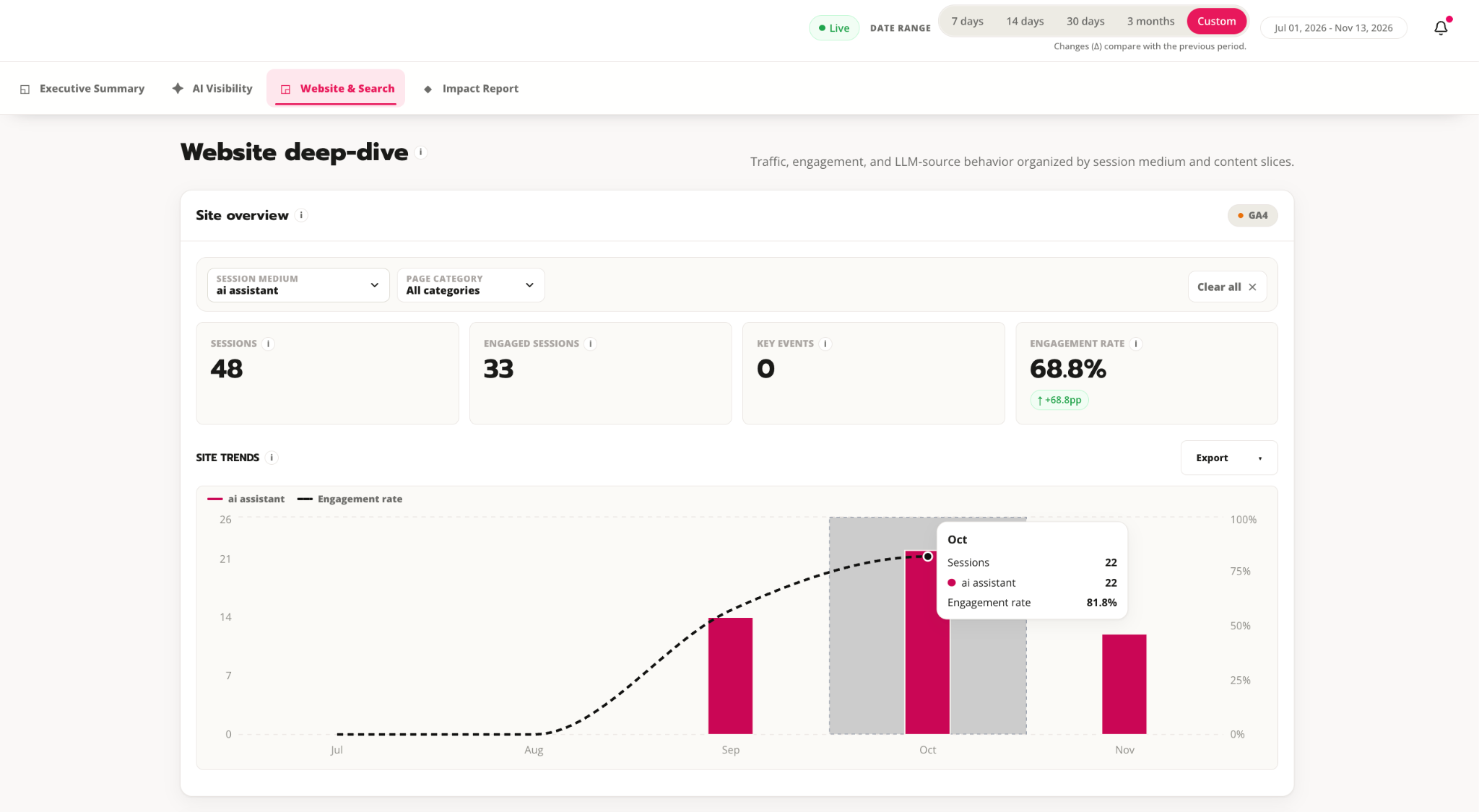
Check how many of those visitors sign up, request a demo, become qualified leads, or buy. Visits from Google’s AI Overviews and AI Mode remain within Organic Search rather than this channel.
Other reports help you understand where your pages appear, but don’t show sales. For example, Search Console’s generative AI report shows impressions in AI Overviews and AI Mode. Bing’s AI reporting shows where your content is cited in its supported AI experiences, but only GA4 can give more context if you don’t have a form that helps customers tell you where they found you.
But for better context into whether LLM visibility or optimization tactics work for you, ask customers how they found you. Someone might write “ChatGPT recommended you” on a demo form even though analytics records their visit as coming from Google or direct.
While these records won’t capture every interaction, together they give you a clearer picture of which leads involved AI. Don’t assume unexplained Direct traffic came from an assistant.
How to improve what AI assistants say about your product
Once you’ve reviewed the answers, decide what needs fixing and who will handle it. You should also decide how you’ll check whether the update helped.
1. Correct outdated prices and product details
If an AI tool recommends a plan you no longer offer or quotes an old price, check the pages it cites. Look for the same outdated information on your pricing page, documentation, partner listings, and review profiles. Update the pages you can control and ask the owners of other sites to correct theirs.
After updating the pages, ask the same questions again and compare the answers with the earlier ones. The corrections may not appear immediately, so repeat the checks over time to see whether the assistant still gives the wrong information.
2. Answer buying questions your pages leave unclear
If an AI assistant recommends competitors for a task your product also handles, read its answer and the pages it cites. Do those pages explain something better or present the information in a clearer, decipherable way? These can be requirements, integrations, or setup steps — the goal is to understand why the AI assistant didn’t cite you so you can reverse engineer what that page did.
Use what you find to audit and improve your own pages. A buyer looking for software their team can use without a compliance hire needs to understand the work involved, not just read that your product “simplifies compliance.” Explain what their team needs to do, which tasks the software automates, and what support you provide.
These details help buyers decide whether your product meets their needs. After updating your pages, repeat the relevant questions to check whether the assistant describes your product more accurately or includes it in its recommendations.
3. Check that systems can access the information
Your product details may be visible in a browser but missing from the content an AI search tool receives. Ask your web team to check whether crawlers can access the pages without errors and read important information such as features, pricing, and integrations.
Your absence from an answer alone doesn’t prove there’s an access problem, which is why you should also check for settings that accidentally block AI search crawlers. You can allow search access without allowing model training: OpenAI lets you allow OAI-SearchBot while blocking GPTBot. Your developers should check these permissions separately.
4. Get your product included in relevant comparisons and directories
If AI answers repeatedly cite comparison articles or directories that list competitors but leave you out, check whether your product fits their criteria. If it does, reach out to the editor, provide accurate product information, and ask to be considered in the list. Good old backlink strategy works for AI search as well.
Also keep your partner listings up to date and encourage customers to leave honest reviews.
If a listing or article changes, repeat the relevant questions to see whether AI answers cite the updated page and mention your product. This gives AI assistants another source of information about you, but doesn’t guarantee a recommendation.
Which LLM visibility tools are worth the money?
A paid tool makes sense when it saves your team time asking questions, recording answers, and checking what changed. Before buying, decide which AI assistants you need to monitor and how many questions you can realistically review. You can use a spreadsheet while you work that out.
Here are a few tools that can help you track your LLM visibility:
Check what the price actually covers
Check how many questions you can track, which AI platforms are included, and how often the tool checks them. A larger allowance doesn’t always mean you can monitor more questions.
For example, Ahrefs’ 2,500 checks aren’t 2,500 questions monitored throughout the month. Testing the same question again, on another platform, or for another location uses more checks. Claude uses eight checks per update. Ahrefs also charges separately for access to its existing database of AI answers, so that isn’t included in the custom tracking price.
The platforms included in each plan matter too. Peec lets you choose three supported models. SE Visible covers ChatGPT, Gemini, AI Mode, and AI Overviews. Compare prices for the platforms you actually need, including any add-ons.
With Semrush, check which platforms are available in the feature you’ll use. Its broader research reports may cover different platforms from the feature that repeatedly tests your own questions.
Check trial restrictions as well. Profound’s trial runs 50 preset questions daily for seven days across ChatGPT, Gemini, and AI Overviews. You can assess the interface and reports, but you can’t test your own buyer questions during that trial.
Test whether the tool helps your team do the work
Where the free trials allow, use the same set of questions to compare shortlisted tools. Check whether you can:
- Read the full answers and open the pages they cite
- Understand how the tool calculates its scores
- View results by AI assistant, country, and topic
- Export the answers and compare them with earlier results
- Spot something worth fixing, such as an outdated price or an unanswered product question
You should also verify if the tool will keep previous results and whether adding questions or competitors changes how it calculates your scores. You need to know whether a reported increase reflects different answers or a change to your tracking setup.
Then compare the work involved with your current process. Does the tool save time collecting answers and make them easier to review? If it only gives you another dashboard to check, it may not be worth paying for.
How we use LLM visibility framework to get our customers retrieved, cited, mentioned and recommended across LLMs
We use Peec to run controlled experiments for our clients. Peec asks a fixed set of buyer questions in ChatGPT, Perplexity, and Google AI Overviews every day and saves the answers. Below are three experiments we ran in 2026 for one B2B SaaS client that sells to enterprise buyers. Each one tested a different situation.
How we set up each experiment
We set up all three experiments the same way:
- Pick commercial prompts where the brand barely appears. We only test solution-aware questions and decision-stage questions ("what are the alternatives to X?", “what are the best tools in the XYZ category”, etc.).
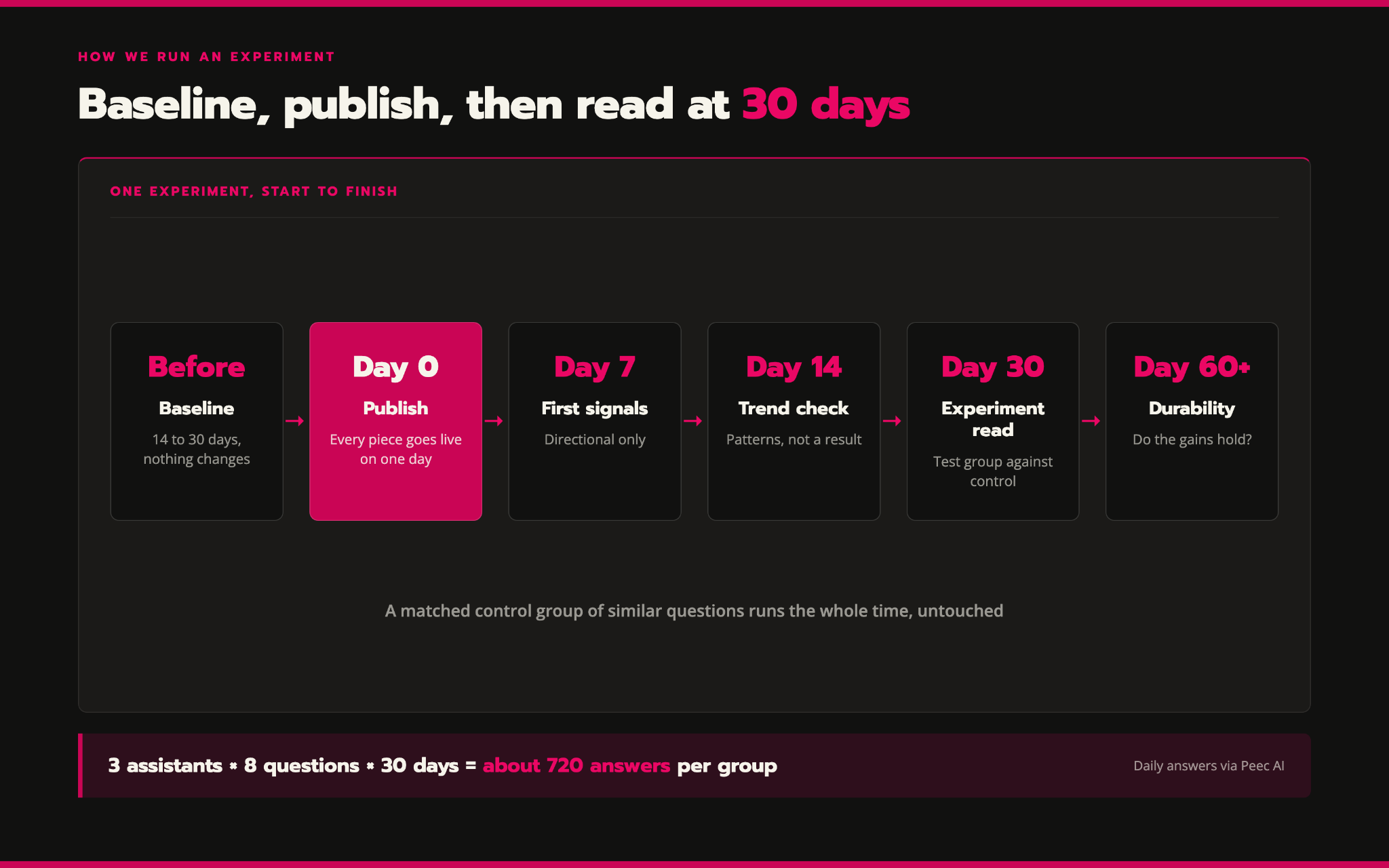
- Record a baseline first. We track the questions for at least two weeks before we publish anything, and ideally for 30 days.
- Publish everything on one day. A single start date lets us read the change against a clear before and after.
- Hold back a control group where we can. These are similar questions we deliberately leave alone: no new content, no refreshes, no internal links. If the control rises too, the lift came from something other than our work.
- Read the results at day 7, 14, and 30. We treat the early reads as directional because AI answers vary from day to day. Then we keep watching to see whether the gains hold.
Experiment 1: Eight new articles against eight held-back questions
The setup. Two of the eight target questions carried almost all of the brand's presence. Two more had no presence at all: no retrievals, no citations, no mentions. Nothing on the site answered them.
On June 2, 2026, we published eight articles. Each covered the main question, the follow-up questions an assistant typically searches for, and the long-tail angles, using specific subheadings, FAQs, and the customer's own language. We tracked eight comparable questions as a control and left them alone.
The results after 30 days (Peec, baseline May 18 to June 1 versus June 2 to July 2, 2026):
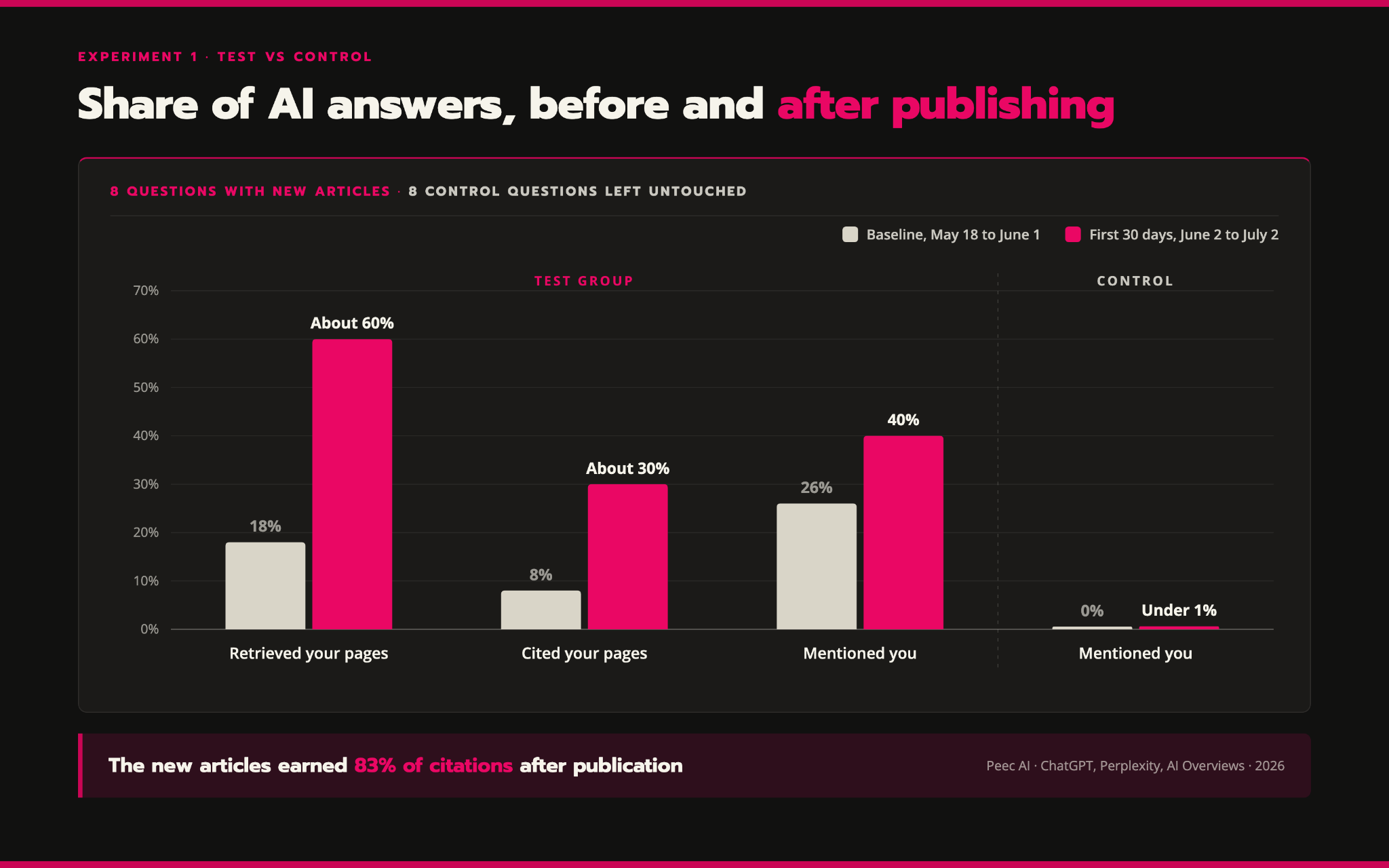
All eight questions moved, including the two that started at zero, which now showed up on all three assistants.
The new articles earned 83% of the client's citations after publication. The control group barely changed, and its one movement came from an older page that went live before the test started. That told us the new content caused the lift, not a general rise across every answer.
Experiment 2: Alternatives articles in a crowded category
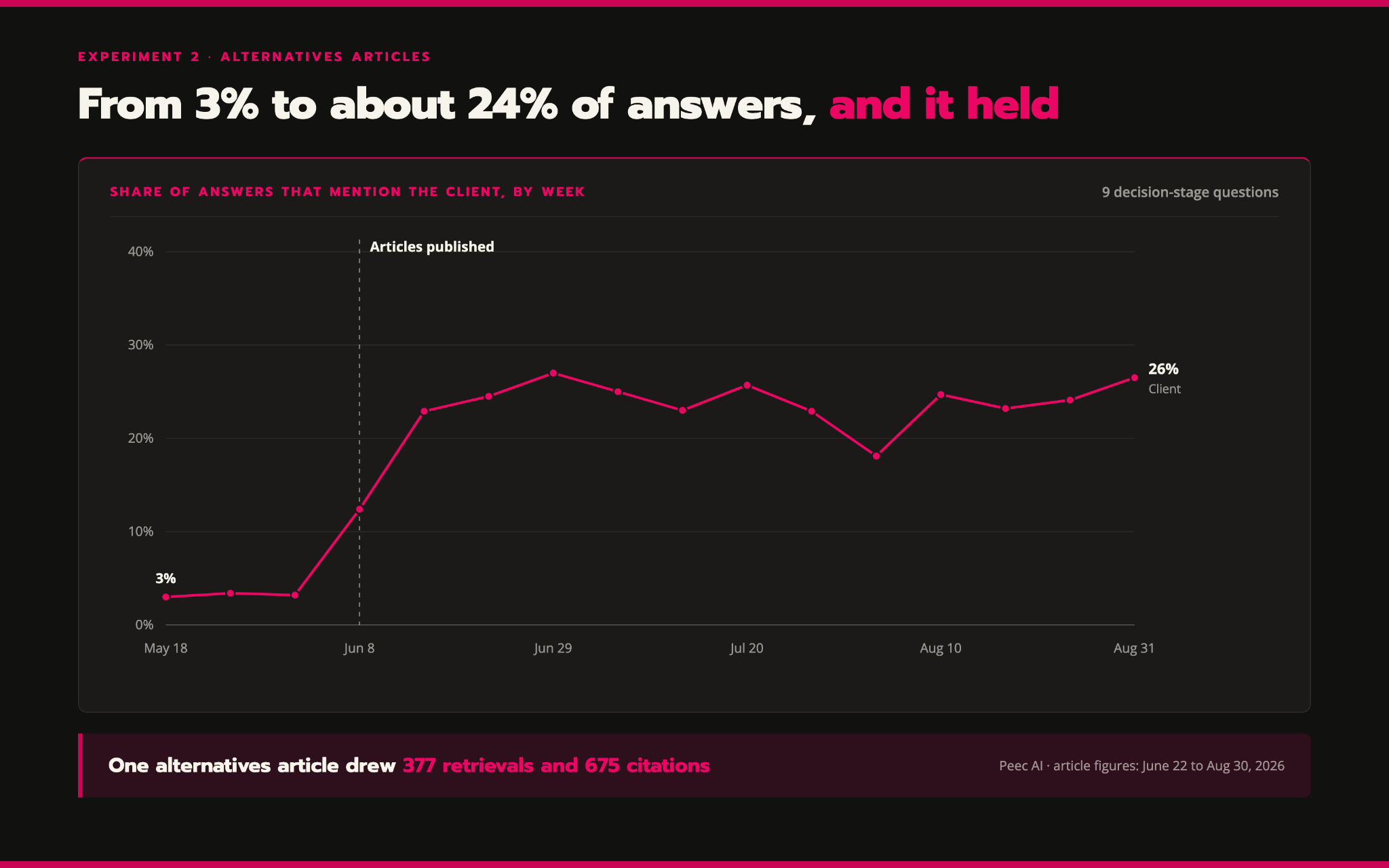
The setup. This experiment targeted nine decision-stage questions in a category led by much larger vendors. Buyers ask these questions when they compare the category leader with its alternatives. At baseline, the client appeared in 3% of answers and ranked last of the nine brands we tracked (Peec, May 18 to June 7, 2026). In the week of June 8, we published a set of alternatives and comparison articles.
The results over the next ten weeks (Peec, June 22 to August 30, 2026):
- The client's mention rate across the nine questions rose from 3% to 24%. It moved from last place to seventh and passed two larger brands.
- Assistants named the client first in 9% of answers, up from less than 1%.
- On the question about alternatives to the category leader for teams on the client's core platform, the client's mention rate rose from 17% to 85%. It came first in more than half of those answers.
- One alternatives article alone drew 377 retrievals and 675 citations over the same period.
- The gains held. Weekly visibility stayed between 18% and 27% through early September.
What didn't move. The broad "best software for portfolio leaders" questions only rose from about 2% to 9–10%, because the biggest brands own those lists. Two definitional questions about governance frameworks stayed at zero. The answers explained a concept and recommended nobody. That result is why we now leave problem-aware questions out of our experiments.
Hire Kairos Labs to help your B2B SaaS company with LLM visibility
At Kairos Labs, we help B2B SaaS companies between $10M-$400M ARR and their teams decide which buyer questions to target, what content to create or improve, and how to track the leads that follow.
Our four-week Pipeline Strategy Sprint covers SEO and AEO strategy, prompt targeting, and a plan for measuring results. If you’re unsure where AI visibility fits into your marketing, book a strategy call to discuss where to focus and what to measure.
Let's design a solid SEO/AEO strategy and execute it so you get ahead of your competitors.
Book a call